When my daughter married a gold digger who only cared about our family’s assets, I knew I had to prepare something unbreakable to protect her. I never told her what was really inside that old storage unit downtown. My son-in-law, Lucas, always looked at it with contempt.
“Dad, why don’t you just clear out that pile of junk already?” he would ask.
He has no idea that the rusty unit will be the very thing that defeats him. I’ve endured his schemes for three long years, waiting for this exact moment, the day his trap fails, and the truth finally comes to light.
One year after everything fell apart, I’m telling you the story from the perspective of that tumultuous year. I’m Vincent Ashford, I’m 64 years old, and I live in Los Angeles. It’s the kind of place where the sun shines most days, where palm trees line the streets, and where people reinvent themselves constantly. That’s something I learned the hard way.
I’ve spent a lifetime in this city, raising my daughter here after my wife, Carol, passed away twelve years ago. I thought I’d prepared myself for whatever life might throw at me. Turns out, I had no idea what was coming.
My daughter is named Sophia. She’s thirty-one now, smart as they come, with a good heart. She is the kind of person who sees the best in people, even when she shouldn’t. Three years ago, she married a man named Lucas Torrance.
I remember the wedding like it was yesterday. Everything was perfect on the surface. The venue looked beautiful, and the flowers smelled like heaven. Everyone smiled for the photographs.
I stood there watching my daughter walk down the aisle, and I felt something twist in my stomach. It wasn’t joy. It was something else entirely.
I didn’t say anything that day. I smiled. I hugged them both. I gave a toast that made people laugh. But I’d already seen something in Lucas’s eyes, a way he looked at Sophia that wasn’t quite right.
It was possessive. Like she was something he owned rather than someone he loved. At that time, I was already keeping a secret.
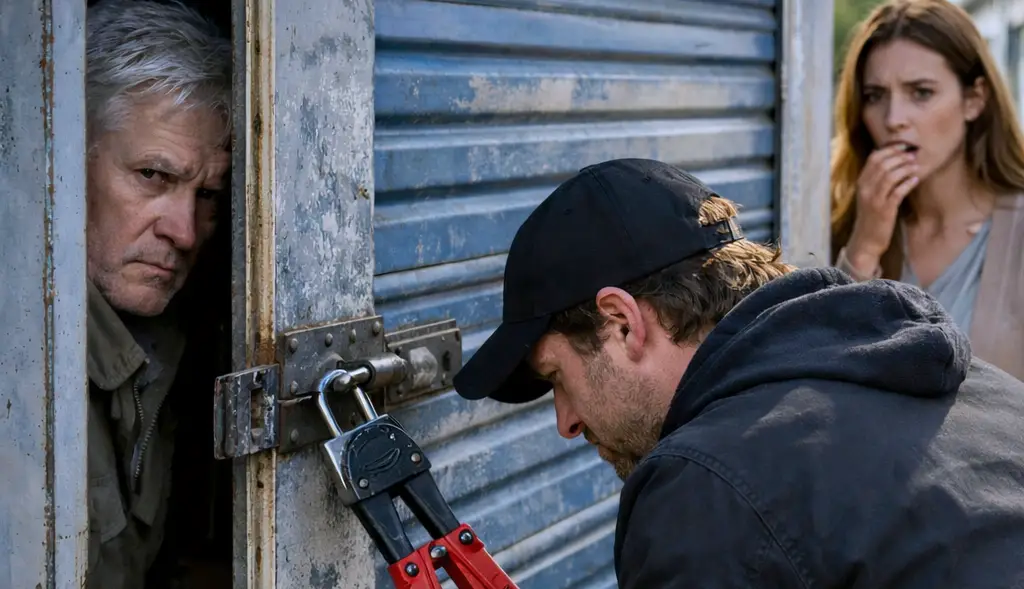
For twelve years since Carol died, I’d been renting a storage unit downtown. Not because I was disorganized or because I didn’t have room at home. I rented it because I needed a place—a fortress, really—where I could keep the things that mattered most.
It held Carol’s documents, her jewelry, the insurance policies, the will, and the trust papers that protected Sophia’s future. Everything that told the real story of our family’s financial life was in there. Most people thought of that storage unit as a place for junk.
When I mentioned it in conversation, I’d get that look, the kind that said, “Why would you hold on to all that old stuff?” I let them think that. It was easier that way.
But the truth is, I’d spent years assembling a fortress of protection for my daughter. Carol and I had done it together before she passed. We’d created a prenuptial agreement, a family trust, and a life insurance policy that would go directly into that trust.
We’d made sure Sophia would never be vulnerable, no matter what happened in her life. I never told Sophia about any of it. That was the real secret.
When she married Lucas, I made sure she didn’t have access to that storage unit. I kept the key with me, hidden away. I couldn’t explain why at the time, not really. I just felt it in my bones.
Something about Lucas wasn’t right. For the first two years of their marriage, I watched. I had dinner with Sophia when she’d let me. I called her regularly.
I noticed small things: the way Lucas would steer conversations toward money, or the way he’d question her about what I might be leaving her. I noticed the way he’d subtly discourage her from spending time with me. I started keeping notes, just little observations in a leather journal I kept in my desk drawer.
Then Jacob called. Jacob Winters has been my closest friend for thirty-three years. He’s not the type to panic or exaggerate.
So, when he called me one afternoon, three years into Sophia’s marriage, I listened. He told me that he’d overheard Lucas talking to someone about me. He heard him talking about how much my insurance was worth and about how it would all go to Sophia.
He heard Lucas say how much better things would be if I simply didn’t exist anymore. I believed him. Jacob isn’t a liar, and he wasn’t calling to stir up drama. He was calling because he was terrified.
That’s when I understood. All of those years of silence, all of those hidden documents, all of that protection I’d built around Sophia—it had been for this moment. I didn’t know it then, but my life’s work had been leading to this single conversation with my oldest friend.
He told me that my son-in-law was capable of something unspeakable. I hung up the phone and sat in my living room for a long time. I thought about Carol.
I thought about the way she’d insisted on the prenup and the trust. I thought about the way she’d left me notes, letters I’d found after she passed away, that seemed to suggest she knew something I didn’t. She’d written things like: Protect Sophia with documents, not words. Protect her from people who would use love as a weapon.
I never understood those letters until that day. Suddenly, I realized that I’d been preparing for this moment my entire life. Not consciously, maybe, but every decision I’d made, every precaution I’d taken, every secret I’d kept had all been leading here.
It led to this moment where I had to decide what to do with the truth I’d been carrying. I pulled out that leather journal. I looked at three years of notes, and I understood finally that it was time to stop watching and start acting.
It was time to open that storage unit. It was time to show Sophia what I’d been protecting her from all along. But I had no idea then how far Lucas was willing to go, or how much truth my daughter would have to face in order to survive him.
After Jacob’s warning, my mind drifted back to the beginning. Back to the night when everything started to go wrong. It was that Sunday dinner when Sophia first brought Lucas home.
I was standing by the stove when she walked through the door, and I knew it immediately. It took me exactly fifteen seconds to realize this man was different from any boyfriend she’d brought around before, and not in a good way. Sophia looked happy.
She had that glow people get when they think they’ve found something real. She introduced Lucas with pride in her voice, her hand finding his automatically. They fit together like two puzzle pieces, at least on the surface.
But something in the way Lucas looked at her made my skin crawl. He was handsome, I’ll give him that. Tall, dark-haired, and well-dressed.
He was the kind of guy who knew how to smile at the right moments and laugh at the right jokes. He complimented the dinner before he’d even tasted it. He asked about my work, about my years in Los Angeles, and about the house.
All the right questions, all the right timing. But there was something underneath it all, a calculation I could sense even if I couldn’t quite name it. When we sat down to eat, Lucas turned to me with a casual tone.
“This is a beautiful home, Vincent. How long have you owned it?”
It wasn’t a random question. I’d learned to read people after sixty-four years, and I could see the wheels turning behind his eyes. He wasn’t asking because he was interested in my real estate portfolio.
He was assessing, calculating, trying to figure out what I was worth and what he might gain from knowing it.
“Forty years,” I answered simply, cutting into my salmon. “Carol and I bought it together.”
He nodded, filing that information away like a banker tallying assets.
“Must be worth quite a bit now. L.A. real estate, right? Always going up.”
Sophia laughed nervously. “Lucas, we just got here. Let’s enjoy the meal.”
But I’d already seen it. I saw the way he looked at her when she said his name. It was like she was a possession he’d already claimed.
It wasn’t the look of a man in love. It was the look of a man who’d decided what he wanted and was methodically going about getting it. Carol used to talk about this.
Years ago, before she got sick, she’d tell me about people who wore charm like a mask. She’d say, “Vincent, love doesn’t need to prove itself. Love doesn’t calculate. Love doesn’t keep score.”
I remembered those words sitting there at my own dinner table, watching Lucas ask Sophia to pass the butter while his eyes stayed fixed on me, assessing, measuring. He asked about my work that night. He asked what I did, how long I’d been doing it, and whether I was still active or retired.
He asked about investments, about whether I traveled much, and about whether I had life insurance. The last one caught me off guard, though I didn’t show it. He framed it casually, mentioning something about his own policy at work.
But the timing felt deliberate.
“Everyone should have good coverage,” he said, smiling at Sophia. “You never know what life throws at you.”
Sophia squeezed his hand, completely oblivious to the undercurrent. She was just happy he was getting to know her father. To her, this was a man meeting her family, asking normal questions.
She had no idea that every question was a thread he was pulling, trying to map out the territory he’d decided to occupy. After dinner, Lucas helped me clear the table. For a moment, we were alone in the kitchen, and I felt the weight of his attention shift entirely onto me.
It was subtle, just a change in the air, a slight hardening of his expression when he thought Sophia couldn’t see.
“Vincent, you’ve done well for yourself,” he said, loading dishes into the sink. “Sophia’s lucky to have this security.”
There it was. Not “I’m lucky to have Sophia.” Not “We’re going to build something together.”
But “Sophia’s lucky to have security.” Like that was the point of her existence: to inherit what I’d built. I didn’t respond.
I just kept rinsing plates and handing them over to him. Later that night, after they’d left, I sat in my study with a glass of whiskey. Carol’s photograph was on the shelf above my desk, the one taken on our honeymoon back when we were young and everything seemed simple.
I stared at it for a long time. She would have seen what I saw, that instant recognition of danger. She would have known that Lucas Torrance wasn’t interested in my daughter as a person.
He was interested in what came with her: the house, the money, the life I’d built. Sophia was just the vehicle to get there. That night, I made a decision.
I wasn’t going to say anything to Sophia. Not yet. She wouldn’t believe me anyway, not after just one dinner, not when she was already falling for him.
If I spoke up too soon, I’d just push her closer to him. I’d seen it happen a thousand times: a girl whose father warns her about a boy, and suddenly that girl is determined to prove everyone wrong. So instead, I decided to watch.
I decided to listen and to wait. I pulled out a leather journal from my desk drawer, something Carol had given me years ago back when she insisted on organizing our finances and our future. I opened to a blank page and dated it Sunday, First Meeting with Lucas Torrance.
Then I wrote down everything I’d observed. The questions he’d asked. The way he’d looked at Sophia.
I noted the calculation in his eyes and the comment about security. All of it. I told myself I was just being careful, just being protective.
But deep down, I think I already knew. I think some part of me understood that this wasn’t just a boyfriend. This was a threat.
I was beginning a documentation that would, three years later, become the only thing standing between my daughter and something unspeakable. I should have said something that night. I should have pulled Sophia aside and told her what I’d seen in Lucas’s eyes.
But I didn’t know yet how far he was willing to go. I only knew I had to watch, listen, and wait for the moment when I’d need to act. The real warning came six months into their marriage.
It was subtle. So subtle that Sophia didn’t even see it. But I did.
It started with a question Lucas asked her one evening. Sophia called me in a voice that sounded different, confused, wounded. She asked if we could talk, and I knew immediately something had shifted.
“Dad, Lucas thinks I should know more about the family finances,” she said carefully. “He says it’s weird that I don’t know anything about your money. He thinks you’re keeping secrets from me.”
I felt something cold settle in my chest. This was Lucas’s move. Calculated.
But I kept my voice steady. “What did you tell him?”
“I told him I didn’t really think about it,” Sophia said. “But now I’m wondering. Why haven’t you told me about your finances, Dad? It does seem kind of strange.”
Of course, it seemed strange to her. Lucas had made Sophia question me without ever having to voice a direct accusation himself. He’d planted a seed of doubt about her own father.
But that wasn’t even the worst part. A week later, Sophia called me again. This time she was upset.
“Dad, I need to ask you something, and I need you to be honest with me.”
“Of course,” I said. “What’s going on?”
“Lucas says that Jacob has always had feelings for me. He says Jacob told him that he thinks our marriage is a mistake. He says Jacob wants to break us up because he’s still in love with me.”
I went very still. Jacob is my oldest friend, the man who’d been part of my family for three decades. Lucas was lying to my daughter about him. And she was believing it.
“Sophia, that’s not true. Jacob would never.”
“How do you know that, Dad? How do you really know what Jacob says when you’re not around?”
The question landed like a punch. She was actually starting to doubt Jacob now. Lucas had successfully taken one of the most important relationships in her life and poisoned it with a lie.
And Sophia, being good-hearted, was starting to believe it.
“Lucas has no reason to lie to me,” she said, defensiveness creeping into her voice. “He barely even knows Jacob. Why would he make that up?”
He did it because Lucas was systematically isolating my daughter. He was cutting her off from the people who might protect her, who might see what he was doing, who might warn her. And he was doing it so cleverly that Sophia couldn’t even see it happening.
Over the next few weeks, I watched as Sophia pulled away from Jacob. She didn’t return his calls as quickly. She made excuses when he invited us both to dinner.
Worst of all, I could see the doubt in her eyes when she looked at him, doubt that Lucas had carefully planted there. This was the moment I really understood what I was dealing with. Lucas wasn’t just a gold digger looking for an easy score.
He was something more dangerous. He was methodical. He was strategic.
He understood psychology in a way that most people don’t. He knew exactly how to manipulate my daughter, not through force or aggression, but through seeds of doubt and carefully crafted lies.
One night, I sat in my study and pulled out that journal, the one I’d started after that first Sunday dinner. I flipped past my initial observations about Lucas’s questions, his calculating eyes, and his comment about security. Those had seemed ominous, but they were nothing compared to what I was witnessing now.
I wrote down everything. The conversation Sophia had reported about Lucas questioning my finances. The lie about Jacob.
I noted the way Sophia was starting to pull away from my oldest friend. The isolation tactics were happening in real time. And as I wrote, something crystallized in my mind.
This wasn’t just about money, though money was certainly part of it. This was about control. Lucas wanted to control Sophia completely: her mind, her relationships, her sense of reality.
He wanted to make sure that when the moment came where she needed someone to tell her the truth, there would be no one left to turn to. Her father would seem like he was keeping secrets. Her best friend would seem like he had ulterior motives.
Lucas would be the only person she could trust. It was a masterclass in psychological manipulation, and it was happening to my daughter in real time. That night, I made a decision.
I wasn’t going to confront Lucas. I wasn’t going to try to convince Sophia that he was lying. I’d learned enough about manipulation to know that would only drive her closer to him.
Instead, I was going to document everything. Every lie, every manipulation, every calculated move he made. I was going to build a record that would eventually show Sophia the truth.
I started writing in that journal every single night. I’d note down conversations Sophia had mentioned. I’d record my own observations.
I’d track the timeline of when Lucas made particular moves, what he said, and how Sophia reacted. It was methodical work, the kind of work that required patience and focus. At the time, I didn’t know exactly why I was doing this.
I didn’t have a specific plan. I just knew in some deep part of myself that I was going to need this evidence. I knew that someday, in some way I couldn’t yet imagine, my daughter would need to see the truth laid out in black and white.
When that day came, I wanted to be ready. I had no idea then that Lucas’s isolation tactics were just the beginning. I had no idea that the next three years would involve so much more than psychological games and careful lies.
I had no idea what he was truly capable of. But that night, I made a choice. I would watch.
I would document. And when the time came—and I was starting to believe that time would come—I would be ready to protect my daughter, no matter what it cost me.
I drove to the storage unit the next morning and pulled out an old leather journal. It had been sitting there for twelve years, untouched. I’d bought it years ago, thinking maybe I’d write about the time I spent with Carol.
I never did. Now, I opened it to the first blank page. The leather was soft, worn in places.
I uncapped a pen and looked at the empty page in front of me. For a moment, I just sat there in that climate-controlled storage unit, surrounded by boxes of my life, trying to figure out how to begin. I dated the first entry May 15, 2021.
Then I wrote: Sophia seemed distant today. Lucas must have said something to her.
That was how it started. One observation. One sentence.
But I knew even then that this journal would become something important. So, I committed to it. Every week I’d come to the storage unit and write down what I’d seen, what I’d heard, what I’d noticed.
By June, the entries had become more detailed.
June 3: I watched Lucas touch Sophia’s arm when she laughed too hard at something I said. She was happy. He didn’t like that. The touch wasn’t affection. It was a signal, a subtle reminder that he was there watching, controlling even her joy.
July 12: Lucas checked Sophia’s phone while she was in the bathroom. He did it like it was nothing, like he had every right. When she came back, he smiled at her like nothing had happened. She had no idea.
August 8: Lucas said to Sophia, “Your father doesn’t understand us. He’s too old to see what we have.” And I watched my daughter nod. I watched her accept that I was the enemy, that he was the only one who truly cared about her.
The pattern started to emerge around September. It wasn’t random. It wasn’t occasional moments of jealousy or insecurity.
It was systematic, methodical, deliberate.
September 20: Lucas insisted Sophia’s yoga class was a waste of money. She didn’t argue. She just accepted it. I’m starting to see the bigger picture now. It’s not just about money or control of her time. It’s about erasing her sense of self. Every “no” he gives her, every decision he makes for her, every opinion he corrects—it’s all part of the same pattern.
October 5: I overheard Lucas on the phone. He was talking about Sophia’s future, about inheritance, about “how much better their life would be when her old man was gone.” Those were his exact words. I felt something cold move through my chest.
October turned into November, and the pattern became impossible to ignore. I filled page after page with observations, dates, and specific moments. Lucas controlled what Sophia wore.
He controlled who she saw. He controlled how much money she had access to. He controlled her schedule, her phone, her relationships.
But it was more than that. He controlled the narrative. He controlled what she thought about me, about Jacob, about herself.
He told her I was keeping secrets. He told her Jacob wanted to destroy their marriage. He told her she was lucky to have him, that no one else would love her like he did.
November 15: Three patterns clearly established. First, isolation. Lucas has successfully cut Sophia off from everyone who might protect her. Second, financial control. He knows every dollar she has. Third, psychological manipulation. He’s rewired how she thinks about the people who love her.
November 28: But there’s a fourth pattern emerging, and this one scares me the most. Lucas is asking more questions about my life, my work, my insurance, my assets. This isn’t just about loving my daughter anymore. This is about something else entirely.
By December, I’d filled almost two hundred pages. Two hundred pages of observations, dates, times, and specific quotes. Two hundred pages documenting the careful, calculated way Lucas was dismantling my daughter’s independence and replacing it with dependence on him.
I sat in the storage unit on December 15, 2021, and read through an entire year of entries. The pattern was unmistakable. It was clear. It was undeniable.
Lucas wasn’t a boyfriend who’d gotten a little too controlling. He wasn’t a husband with jealousy issues. He was something far more calculated.
He was a predator. And he was following a specific playbook that he’d likely used before and would likely use again. The isolation had happened first.
Then the financial control. Then the psychological manipulation. And now the targeting.
The questions about my money. The comments about how much better things would be when I was gone. I didn’t know where this was heading.
I didn’t know what Lucas was truly capable of. But as I sat there in that cold storage unit surrounded by evidence, I understood something with complete certainty. I was watching a pattern unfold in real time.
I had no idea how it would end. But I knew one thing absolutely. I knew that I had to be ready for whatever came next.