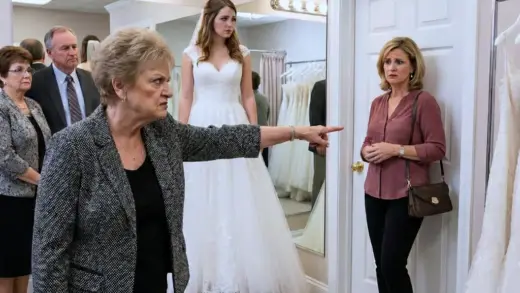
My father’s face hardened into a sneer. “You will regret this, Cassandra. When the grief passes and you are alone in this big house with all those memories, you will need your family.”
“I have family,” I said, walking to the front door and holding it wide open. “Not one of them is in this room.”
“Please leave my home and do not come back. Any further communication can go through my lawyer.”
They left in stunned silence. My mother paused at the door, tears in her eyes that might have been genuine remorse or simply the frustration of a plan thwarted. Either way, it was too late. As I closed the heavy door behind them and threw the deadbolt, a strange sensation washed over me. It wasn’t the crushing loneliness I had expected. It felt remarkably like freedom.
The first night after confronting my parents and Stephanie, I slept more peacefully than I had since the day of the diagnosis. There was something clarifying about having the truth out in the open, about no longer needing to make excuses for people who had never deserved my loyalty.
The next morning, I woke to sunlight streaming through the bedroom window and made a decision. I would take Bobby’s final gift to me—the freedom from financial worry—and use it to rebuild my life with intention.
I started with small steps. I returned to work part-time in the ICU. My colleagues welcomed me back with understanding and space to heal. Many had attended the funeral and knew about my family’s absence, but no one pressed for explanations. Instead, they covered my shifts when waves of grief hit unexpectedly, brought me coffee during long nights, and shared their own stories of loss and recovery.
Captain Miller and the firefighters from Bobby’s station remained a constant presence in my life, in ways I hadn’t anticipated. They showed up regularly to mow the lawn, fix a leaking faucet, or simply share a meal and stories about Bobby. They became the family that had been there all along, hiding in plain sight.
“Bobby made us promise to look out for you,” Miller told me one evening as he repaired our deck railing. “But honestly? We would have done it anyway. You are one of ours now.”
Three months after the funeral, I met with Sam Wilson, the financial advisor Bobby had selected. Together, we established a foundation in Bobby’s name that would provide scholarships for the children of firefighters. It felt right to honor his legacy of service by supporting the next generation.
“Your husband was incredibly thorough,” Sam commented as we finalized the paperwork. “He really thought of everything to make this transition smoother for you.”
“That was Bobby,” I said, smiling through tears. “Always taking care of others.”
As summer faded into fall, I resumed the painful process of going through Bobby’s belongings. Each item held a memory. His coffee mug with the chipped handle remained on its hook in the kitchen. His reading glasses lay on his nightstand beside a half-finished mystery novel. I didn’t rush. Some days I could only manage to sort through a single drawer before emotions overwhelmed me. Other days brought unexpected laughter at discovering Bobby’s collection of silly socks or the love notes he had hidden throughout our bedroom.
One afternoon, while organizing his desk, I found a business card for Jason—Bobby’s estranged brother—with a sticky note in Bobby’s handwriting: Should try again someday.
After hesitating for days, I finally called the number. Jason answered on the second ring.
“I found your card in Bobby’s things,” I explained, my voice trembling slightly. “I thought… maybe we could get coffee sometime?”
We met the following week at a quiet cafe. The resemblance to Bobby was even more striking in the daylight—the same crinkles around his eyes when he smiled, the same thoughtful pause before speaking.
“I regret not reaching out sooner,” Jason said after we had exchanged awkward pleasantries. “Our falling out was over something so stupid. Family business disagreements after our parents died. Pride gets in the way of so much.”
“Bobby never talked much about it,” I admitted.
“That sounds like him. Never one to speak ill of others.” Jason stirred his coffee absently. “When I saw his obituary, it hit me how much time we had wasted. Years we can’t get back.”
“He kept your card,” I offered. “I think he wanted to reconnect too.”
That first meeting led to others. Jason shared stories of Bobby as a child—his fearlessness, his protective nature, his determination to become a firefighter despite their parents’ objections. I found comfort in these glimpses of the man I loved before I knew him. Jason had a family of his own—a wife named Rachel and twin boys who had Bobby’s smile. They invited me for Sunday dinners and holiday gatherings, incorporating me into their lives with a natural ease that made me realize what genuine family felt like.
On the one-year anniversary of Bobby’s death, I held a small memorial at our favorite spot by the lake. Jason’s family came, along with Bobby’s firefighter brothers and several of my nursing colleagues. We shared memories and planted a young oak tree with a simple plaque: Robert Mitchell. Beloved husband, brother, friend. His love continues to grow.
That evening, alone in our house which now felt truly mine, I opened a letter that had arrived in the morning mail. It was from Stephanie.
Cassandra, it began.
I have written this letter a dozen times over the past year. Nothing I can say will excuse what I did. Greed and envy got the better of me, and I betrayed the most important friendship of my life. I am not asking for forgiveness or reconciliation. I just want you to know that losing your friendship has taught me what truly matters, and I will spend the rest of my life trying to be worthy of the trust I squandered. I hope you have found peace, and that Bobby’s memory continues to bring you comfort.
I didn’t respond to the letter, but I didn’t throw it away either. It represented something important—an acknowledgment of the pain caused and the consequences of betrayal. My parents had made no such attempt at amends, maintaining through mutual acquaintances that I had “pushed them away” during my grief.
As the seasons changed, I found myself volunteering at a grief support group for young widows and widowers. Sharing my experience helped others navigate their own losses, and their stories reminded me that pain, while unique to each person, is also universal.
When spring came again, I made another significant decision. Using some of Bobby’s life insurance money, I purchased a small cottage near the lake where we had dreamed of retiring someday. The main house—our home together—I kept, unable to part with the walls that had witnessed our love story from beginning to end. But the cottage became my weekend sanctuary. A place to hear the loons at dawn and watch fireflies at dusk. A place to feel Bobby’s presence in the beauty of nature he had so loved.
“You were right,” I whispered to him one evening as I sat on the dock, feet dangling in the cool water. “I did find joy again. Not the same joy we had, but something new that honors what we shared.”
New friendships entered my life—genuine connections formed through shared interests and mutual respect rather than history or obligation. I became close with Maria, the hospice nurse who had guided us through Bobby’s final days, discovering in her a kindred spirit who understood both loss and resilience. I resumed nursing full-time but switched to hospice care, drawing on my experience to comfort families navigating their own journeys through grief. The work was emotionally demanding but deeply fulfilling, allowing me to transform my pain into compassion for others.
Two years after Bobby’s death, I sat on our front porch—the one where he had promised we would grow old together—watching a summer thunderstorm roll in. The air felt electric with possibility.
The betrayal by those I had trusted most had taught me painful but necessary lessons. I learned that family isn’t defined by blood, but by presence. I learned that love is demonstrated through actions, not words. And I learned that loss, while devastating, can also be clarifying.
Bobby had seen the truth about my parents and Stephanie long before I was ready to acknowledge it. His final act of protection—ensuring my financial security and independence—had given me the freedom to rebuild my life on my own terms, surrounded by people who valued me for myself rather than what they could gain.
The greatest lesson I learned from losing everything was that I hadn’t actually lost what mattered most. Bobby’s love remained with me, not just in memories, but in the strength he had helped me discover in myself. The ability to stand alone rather than accept conditional relationships. The courage to begin again.
If you have ever had to rebuild your life after betrayal or loss, I hope my story offers some comfort. True family isn’t always who we are born to; sometimes it is the people who show up when everyone else walks away. The colleagues who become friends. The estranged brother who becomes a lifeline. The neighbors who bring casseroles not to gain something, but simply because they care.
Bobby once told me that the measure of a life well-lived isn’t in possessions or achievements, but in the love we give freely, expecting nothing in return. By that measure, his short life was richer than most that span decades longer. I still miss him every day, but now when I think of Bobby, my first thought isn’t of loss, but of gratitude. Gratitude for the love we shared, and the lessons that continue to guide me.