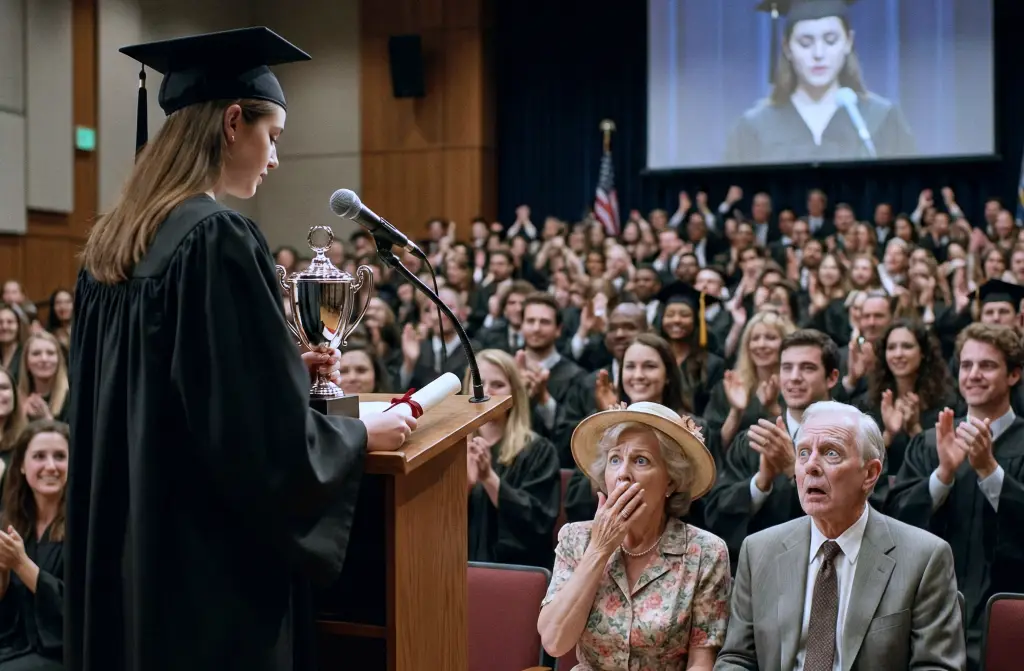
My name is Emma Wilson. At twenty-two years old, standing on the manicured lawn of Westfield University, I realized that my college graduation wasn’t just a milestone. It was the sweetest, coldest form of vindication.
I stood shoulder-to-shoulder with my sister, Lily, our matching caps and gowns fluttering in the May breeze. By all accounts, this moment should have been pure, unadulterated joy. But the path that had led me here was paved with years of accumulated scar tissue.
I could still hear the ghost of their words echoing in the back of my mind, as sharp as the day they were spoken. “She deserved it, but you didn’t.”
I grew up in what looked like a postcard-perfect slice of suburban Michigan. Our two-story house sat behind a white picket fence that gleamed under the summer sun, a facade that promised wholesome family values. Inside, the walls were lined with framed photographs featuring forced smiles that masked a much more complicated reality.
My parents, Robert and Diana Wilson, were the pillars of our community. Dad was a steady, number-crunching accountant, and Mom taught high school English. We weren’t wealthy, but we were comfortable. Financial ruin wasn’t something that was supposed to be written in my stars.
Then there was Lily. Two years my junior, she somehow always seemed miles ahead of me in our parents’ estimation. With her cascading blonde curls, effortless charm, and a knack for academic achievement that seemed to require zero friction, she was the embodiment of everything they valued.
From the time we were toddlers, the dynamic was set in stone. Lily was the golden child, the protagonist of the family narrative. I was the supporting character, the afterthought.
I can still vividly picture Christmas mornings, the smell of pine and cinnamon thick in the air. I would watch, forcing a smile, as Lily tore into wrapping paper to reveal the year’s most expensive gadgets and toys. When my turn came, I’d unwrap practical bundles of tube socks or generic, plastic-wrapped craft kits from the discount bin.
“Your sister needs more encouragement to nurture her talents,” Mom would explain smoothly when I dared to question the disparity. Even at eight years old, the logic tasted wrong, like spoiled milk. But I learned to swallow the disappointment.
School events were where the spotlight truly burned. When Lily had a science fair, both Robert and Diana would take personal days off work, hovering over her with glue guns and poster board to create elaborate, winning displays.
When I had an art exhibition, I was lucky if Mom rushed in for fifteen minutes during her lunch break. She would check her watch every thirty seconds, eyes darting to the door.
“Art is just a hobby, Emma,” Dad would say, his voice heavy with dismissal. “It won’t get you anywhere in the real world.”
The only person who truly saw me was my grandmother, Eleanor. Our summer visits to her lake house became my sanctuary, a place where I could breathe. She would sit with me for hours on her weathered porch, watching as I sketched the ripples of the water and the swaying pine trees.
“You have a special way of seeing the world, Emma,” she would tell me, her voice raspy but warm. “Don’t let anyone dim your light.”
It was in her small, dust-mote-filled library that I discovered biographies of entrepreneurs and business leaders. I read about titans who had climbed over insurmountable obstacles. I began to dream of something beyond just surviving my childhood.
I dreamed of building a fortress of achievement so high my parents would be forced to crane their necks to see me. By high school, I had forged a resilient armor out of necessity. I threw myself into every business-related club the school offered.
I devoured math and economics, discovering a natural aptitude for numbers and strategy that surprised even my most supportive teachers. When I won the regional business plan competition as a sophomore, my economics teacher, Mr. Rivera, called my parents personally. He gushed about the exceptional quality of my work.
“That’s nice,” Mom said after hanging up the phone, her eyes already drifting away. She turned to my sister. “Did you remember to help Lily with her history project? She has that big presentation tomorrow.”
During my junior year, I took a job at a local coffee shop. I sensed, with a sinking feeling in my gut, that I would need my own resources sooner rather than later. I worked twenty hours a week, smelling of roasted beans and stale milk.
Yet, I managed to maintain a pristine 4.0 GPA. Meanwhile, Lily joined the debate team and instantly became the star. My parents attended every tournament, celebrating each minor victory with special dinners at steak houses I couldn’t afford to join.
By senior year, despite the age gap, Lily had accelerated through her coursework, landing us in the same graduating class. We both applied to Westfield University, a prestigious institution renowned for its business and political science programs. Against the odds, two thick envelopes arrived on the same day.
I remember the trembling in my hands as I tore mine open.
“I got in,” I announced at dinner, my voice cracking with suppressed joy. “Full acceptance to the business program.”
My father glanced up from his phone, his expression flat. “That’s nice, Emma.”
Minutes later, the front door flew open. Lily burst in, waving her own envelope like a flag of victory.
“I got into Westfield’s political science program!” she shrieked.
The transformation in the room was immediate and visceral. Dad practically leapt from his chair. Mom rushed to embrace Lily, and suddenly our lukewarm dinner was abandoned for an impromptu gala. Champagne was popped for the adults, sparkling cider for us.
“We always knew you could do it!” Mom gushed, hugging Lily tight. She seemed amnesiac to the fact that I had announced the exact same achievement moments prior.
Two weeks later, the verdict was delivered. We were gathered for a family dinner, a rare occasion where phones were set aside and everyone was present.
“We need to discuss college plans,” Dad announced. He folded his hands on the tablecloth, his demeanor serious. However, his eyes were fixed solely on Lily.
“We’ve been saving for your education since you were born,” he continued. “The Westfield tuition is steep, but we can cover it entirely. We want you to focus on your studies without the burden of worrying about money.”
Lily beamed, radiating pride. I waited for the second half of the sentence, the part about me. I assumed the savings were a collective pot.
The silence stretched, thin and uncomfortable, until I couldn’t breathe.
“What about my tuition?” I asked, my voice barely a whisper.
The temperature in the dining room seemed to plummet. My parents exchanged a look—a quick, guilty flicker.
“Emma,” my father said slowly, employing his professional, accountant voice. “We only have enough capital for one of you. Lily has always shown more academic promise. We believe investing in her education will yield better returns.”