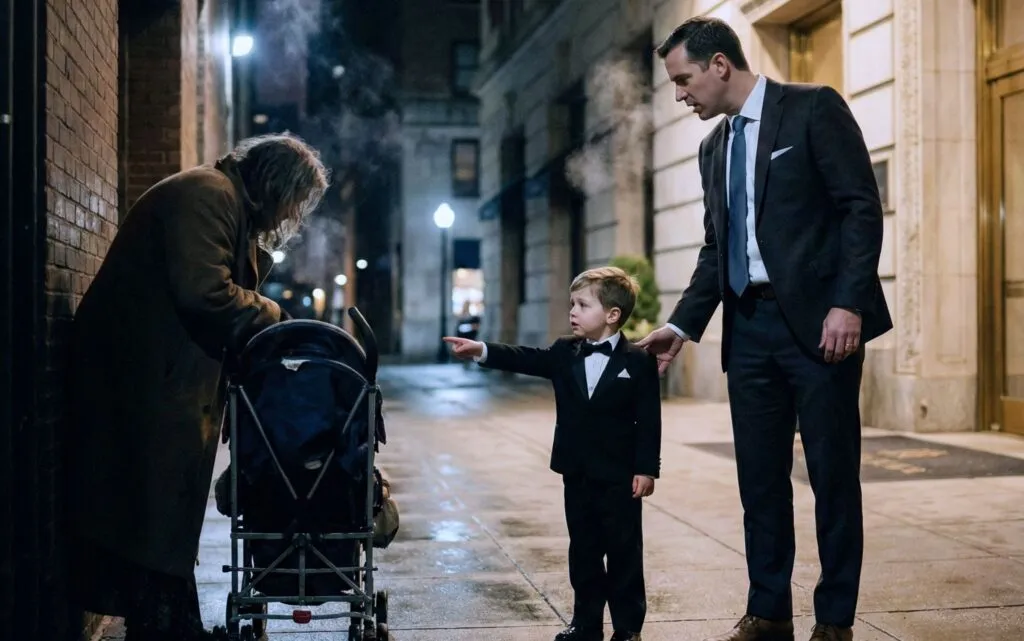
The heavy brass doors of the Blackstone Hotel swung shut, muffling the jazz music and laughter from the grand ballroom inside. Outside, the city night was crisp, the air biting with a chill that didn’t seem to touch the golden glow of the building’s entrance.
Leo Blake, small for his age and dressed in a miniature tuxedo, gripped his father’s hand with white-knuckled intensity. Behind them, the world was champagne flutes and crystal chandeliers; ahead, it was just the dark, paved reality of the street.
Valets in red vests were sprinting back and forth, retrieving sleek black cars for men in sharp suits and women shivering in glittering, backless gowns. The scent of expensive perfume hung heavy in the air, mixing with the exhaust of idling luxury engines.
But Brian Blake didn’t stop to savor the evening’s success. He was a man perpetually in motion, his mind already racing toward the next fiscal quarter. One hand was buried deep in his wool coat pocket, the other steered Leo down the marble steps with practiced efficiency. Brian tapped his Bluetooth earpiece, his voice low and commanding.
“Yes, I understand the constraints. We can close by Monday,” Brian said, cutting through the ambient city noise. “Have the documents on my desk first thing. No excuses.”
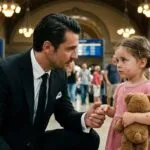
Leo looked up at his father, his large eyes tracing the sharp line of Brian’s jaw, but he stayed silent. In his free hand, Leo clutched a worn, plush lion. It was a ragged little thing, missing a whisker and grayed with love, completely out of place in this polished, high-society world.
It belonged to a different life, a house filled with soft voices and bedtime stories that Leo struggled to remember but refused to forget.
They turned the corner onto a side street where the glamorous lights of the hotel didn’t reach. It was darker here, quieter. The wind picked up, whistling through the alleyways, and puddles on the sidewalk reflected the flickering neon sign of a closed coffee shop.
Leo’s pace slowed. He felt a tug in his chest, an instinct he couldn’t name. Then, he heard it. It was a voice, fragile and thin, barely audible over the hum of the city, carried on the wind like a ghost.
“You are my sunshine, my only sunshine…”
Leo stopped dead in his tracks. Just ahead, nestled into the alcove of a shuttered storefront, a woman sat hunched over a battered, second-hand stroller.
Her blonde hair was pulled back in a loose, messy knot, with stray strands dancing across her pale cheek. Her coat was several sizes too big, the sleeves fraying at the cuffs, and her hands moved with delicate, deliberate care over something inside the carriage.
Leo blinked, trying to see through the gloom. It wasn’t a baby inside. Resting on the stained fabric was a small, ancient teddy bear wrapped snugly in a faded blanket. The woman was shielding the toy from the biting wind, murmuring to it with a tenderness that made Leo’s heart ache.
Brian noticed the lag in their pace immediately. He glanced sideways, his eyes sweeping over the woman and the stroller. In a fraction of a second, his mind categorized her: homeless, likely unstable, perhaps under the influence.
It was a tragic sight, certainly, but it was a social issue for the city to manage, not him. He had written a substantial check to charity that very evening; he had done his part.
“Don’t stare, Leo,” Brian said, his voice sharp but weary. “Keep walking.”
Leo resisted. He planted his feet, letting his father’s tug pull his arm but not his body.
Brian sighed, eager to get to the warmth of the car. “I’m tired, Leo. It’s been a long day. Let’s go.”
Leo glanced over his shoulder one last time. The woman leaned forward, tucking the blanket tighter around the bear.
“Shh, sleep, baby,” she whispered. Her hand brushed the teddy bear’s head with a gentle, rhythmic stroke.
The words hit Leo’s chest with the force of a physical blow. It wasn’t just the song. It was the cadence. It was the way the “shh” floated into the cold air like a kiss goodnight. It was a sound woven into the deepest fibers of his memory.
“Dad,” Leo said. His voice was small, trembling, but absolute in its certainty. “That’s Mom.”
Brian froze. The world seemed to tilt on its axis. For a heartbeat, the traffic noise faded, leaving only the ringing silence of the street.
He turned slowly, his eyes locking onto the figure huddled in the shadows. She was still seated, her gaze lowered, her lips moving silently to the end of a verse. The overhead streetlight flickered, casting a harsh, orange glow that threw her features into relief.
Brian saw it then. The familiar slope of her jawline. The exact shade of blonde in her hair. And there, a faint, jagged line running across her right cheek—a scar.
The breath left Brian’s lungs. A part of his rational mind staggered.
“No,” he said aloud, speaking to the night more than to his son. “That’s not possible.”
He crouched down, bringing himself to Leo’s eye level, trying to keep the tremor out of his voice. “Leo, look at me. Your mom is gone. We’ve talked about this. You know that.”
Leo didn’t blink. He looked past his father, his gaze fixed on the woman.
“She’s not gone,” the boy whispered. “She’s just… not home yet.”
Brian opened his mouth to argue, to offer logic, but the words died in his throat. His gaze drifted back to the woman and her ragged teddy bear. At that moment, she looked up.
Her eyes were tired, glassy, and distant. They brushed past Brian like he was made of smoke, seeing him but not recognizing him, like a ghost who had forgotten her own name.
Brian straightened up abruptly, clearing his throat to dislodge the lump forming there.
“Come on,” he said, his voice tight. “Let’s go.”
But this time, he didn’t pull Leo. He just stood there for a terrible, stretching second. In that pause, in the unsettled breath between one step and the next, the solid, logical fortress Brian had built around his life began to crack. Just a little.
The morning arrived with a cruel wind that cut through layers of worn fabric. Donna sat curled at the edge of a shuttered bakery, her arms wrapped protectively around the faded stuffed bear resting inside the stroller.
The wheels squeaked a rhythmic protest as she rocked it back and forth. It was a soothing, maternal motion that her body remembered even if her mind had lost the details.
“Leo’s cold today,” she murmured, tightening a scavenged scarf around the bear’s fraying neck. “We’ll find a warmer spot soon, baby. Mommy promises.”
Her voice was soft, barely a whisper. She had learned the hard way never to speak loudly. Voices drew attention, and attention brought eyes. She hated the eyes. They never really saw her; they looked through her, or worse, they judged her.
She knew what the passersby thought. Crazy. Dirty. Useless.
But she wasn’t crazy. She just… didn’t remember everything. The past was a puzzle with missing pieces. She didn’t remember where she came from, or why her stomach often twisted with an ache that wasn’t just hunger. She only knew that the world had become a place of deep shadows, and the only light left was Leo.
The Leo she pretended to feed small spoonfuls of oatmeal to. The Leo she cradled gently during the long, empty afternoons. The Leo who never cried, never fussed, and always listened. The Leo that everyone else saw as just a bear.
Sometimes, kind strangers dropped coins at her feet or offered half-eaten sandwiches wrapped in foil. She accepted with a polite nod, always grateful.