
“Don’t tell me you actually invited him to the wedding,” a guest whispered harshly, the sound cutting through the hushed anticipation of the church. The bride, ignoring the protocol of the moment, hiked up her pristine gown and ran toward the entrance. She moved to embrace a homeless man who had just timidly stepped inside.
Many of the attendees turned their heads away, their faces twisted in visible discomfort and second-hand embarrassment. But the awkward tension lasted only a few minutes before the heavy double doors swung open again. Twelve Marines appeared, resplendent in their formal dress uniforms. They lined up in a formation so perfect it seemed to freeze time, before saluting the bride in thunderous unison.
Emily Sanchez was a woman who believed that kindness was a discipline, not just a feeling. Her days began in the dark quiet of 4:30 a.m., arriving at Sunrise Bakery in San Diego long before the city’s morning rush began to stir. By the age of thirty, she had already dedicated six years to her role as head pastry chef, building a reputation that stretched across the neighborhood.
Locals knew her not just for her smile, but for her baking. They came for the delicate, flaky layers of her croissants and her signature cinnamon rolls that seemed to melt the moment they touched your tongue. However, within the walls of the bakery, among the flour-dusted counters and stainless steel ovens, Emily was known for a different, quieter legacy.
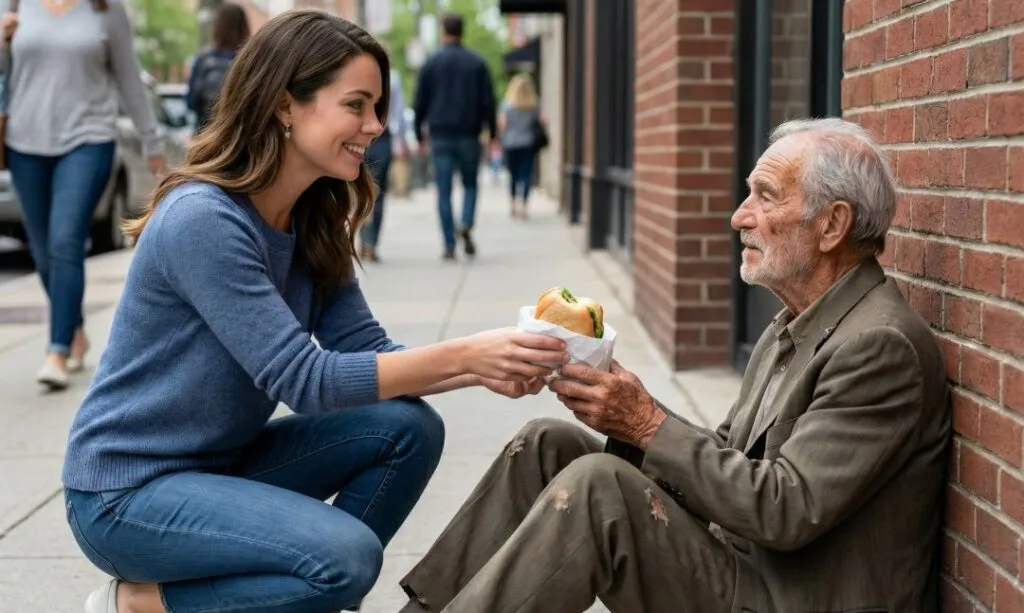
This daily ritual began the instant she pulled the first steaming batch of pastries from the oven. Every single day, with absolute consistency, Emily would select a fresh, warm pastry and carefully wrap it. She would pour a robust cup of coffee into a to-go container and slip quietly out the back exit.
There, she would place the breakfast on a specific bench near the bus stop. It was always accompanied by a handwritten note that simply read: “Wishing you a peaceful day.” The recipient of this silent offering never changed. He was an elderly man with silver hair and a coat that had seen better decades, let alone better days.
He never begged, never harassed the customers, and never asked for more. He simply sat on that same bench every morning, a statue of quiet endurance. In six years, Emily had never asked for his name, and he had never offered it.
Inside the bakery, her compassion was often met with cynicism. Her co-workers would mock her when they thought she was out of earshot. “She is just wasting good product on a lost cause,” one would sneer while traying up muffins.
“Mark my words, one day he’s going to take advantage of her naivety,” another would predict with absolute certainty. The tension escalated three months ago when the bakery came under new management. During Emily’s performance review, her supervisor leaned back in his chair, his tone dripping with corporate concern.
“Regarding your personal charity work,” he began carefully, “it is admirable, in theory. But we have had customers mention they feel uncomfortable seeing him there. Perhaps you could direct your efforts toward supporting a proper homeless shelter instead?”
Emily had nodded politely, absorbing the critique without accepting the premise. She changed nothing about the act itself; she simply adjusted her timing. She began arriving fifteen minutes earlier to leave the food before the critics arrived.
She assumed her adjustment had gone unnoticed until last week, when a new employee caught her returning from her morning mission. “She’s been feeding that bum for five years now,” the employee whispered to a regular customer, ensuring the volume was just loud enough for Emily to catch. “Every single day.”
The customer had shaken her head, her expression a toxic cocktail of pity and judgment. “Poor thing,” the woman sighed. “Thinking she is actually making a difference.” Emily had pretended to be deaf to the insults, continuing to roll out dough with the same rhythmic care she always applied to her craft.
Yet, the words stung. They hurt not because she sought validation, but because these people were blind to what she saw. She didn’t see a problem to be solved or a nuisance to be removed; she saw a human being. “You are too soft-hearted for this world,” her mother had warned her when Emily announced her engagement to Marco.
Marco was a firefighter, a man who understood her morning ritual implicitly because his own life was dedicated to helping strangers on their worst days. “Always picking up strays, always giving away what you’ve earned,” her mother had lamented. But Emily possessed a knowledge that the cynics lacked: giving wasn’t about the transaction or the recognition.
It was about acknowledging the invisible people that the rest of society stepped over. It was about the unfairness of invisibility. Emily had never actually held a conversation with the elderly man. Their interaction was a dance of brief nods and fleeting eye contact, until one rainy morning in December.
Seeing him shivering violently on his exposed bench, Emily didn’t hesitate. She removed her own worn wool scarf and placed it beside the usual breakfast container. The following day, the dynamic shifted. For the first time, she found something waiting for her: a note scrawled in shaky pencil on the back of her own napkin.
“Thank you for seeing me as a person.” Emily kept that fragile piece of paper in her wallet, treating it like a talisman. She would take it out occasionally when the world felt particularly cold or indifferent, reminding herself of why she bothered.
As her wedding day approached, it was only natural that Emily ordered her cake from Sunrise Bakery and invited all her colleagues to the ceremony. Marco had teased her gently about inviting the entire neighborhood, but he supported her inclusive nature. It was, after all, one of the many reasons he loved her.
Two days before the ceremony, a mysterious envelope arrived at the reception venue. It was hand-delivered and unmarked, addressed simply to “The Bride, Emily Sanchez.” Inside was a card containing neatly penned well-wishes and a single, cryptic line that puzzled the wedding planner.
“Tomorrow I will come, not for cake, but to honor a debt.” There was no signature and no return address. Emily wondered briefly if it might be from a distant relative or perhaps one of Marco’s firefighter colleagues who had a flair for the dramatic. However, something about the handwriting stirred a faint, ghostly recognition in her memory that she couldn’t quite place.
On the morning of her wedding, Emily was a bundle of nerves and joy as she prepared in the church’s bridal room. Through the window, she watched the guests arriving—family members, friends, and co-workers all dressed in their finest attire. Then, standing somewhat awkwardly near the church entrance, she spotted him.