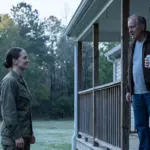
The next morning, February 6th, Rachel Torres from Montana Fish, Wildlife and Parks arrived promptly at nine. She was professional, efficient, and kind, but her uniform carried an air of absolute authority.
“Mrs. Mitchell, the protocol is clear,” Rachel said, clipboard in hand. “Rescued wild animals go to certified rehabilitation centers. The wolf and cubs will be transferred to the Northern Rockies Wildlife Sanctuary immediately. They’ll receive proper care and, eventually, release back into their natural habitat.”
“No,” Sarah said.
Rachel blinked, her pen hovering over the paper. “Excuse me?”
“Not yet,” Sarah said, standing between Rachel and the cages. “The mother is still too weak. The smaller cub has pneumonia. Moving them now, putting them in a transport van for hours… it could kill them.”
Rachel looked ready to argue, citing regulations, but Dr. Reardon stepped in.
“She’s right, Rachel,” he said, crossing his arms. “Medically speaking, transport right now would be high risk. The stress alone could cause cardiac arrest in the mother. I recommend seventy-two hours of stabilization before any movement.”
Rachel sighed, looking from the doctor to the stubborn woman with dark circles under her eyes. She saw this often—people bonding with animals they shouldn’t. It always made her job harder.
“Three days,” Rachel conceded. “Then they go to rehabilitation. And Mrs. Mitchell? You understand you cannot visit them there, correct? We need to minimize human contact to ensure they can be released.”
Sarah swallowed hard. “Three days.”
During those three days, something fundamental shifted in Sarah Mitchell’s soul. She didn’t return to Helena. She rented a cheap room at the motel beside the clinic and spent sixteen hours a day in the recovery room.
Dr. Reardon allowed it because she was extraordinarily helpful with the feedings, but the truth was, he recognized she needed this more than the wolves needed her.
Sarah learned to prepare the special formula for the cubs: a precise mix of goat milk, supplements, and proteins. Every four hours, she fed them with tiny bottles. The cubs sucked with surprising strength, their little paws kneading the air, their bellies expanding like warm balloons.
She named them in the quiet privacy of her mind, knowing she shouldn’t, but unable to stop herself.
Ash was the larger one, dark gray, bold, and brave.
Echo was the smaller one, light gray, the one with pneumonia—more cautious, more fragile.
The mother wolf, whom Sarah called Luna only in her thoughts, recovered slowly but steadily.
On day two, Luna stood for the first time, her legs trembling but holding.
On day three, she ate raw meat, tearing into deer flesh with teeth made for survival, watching Sarah with an intensity that felt like a conversation.
There was a moment on the second day that nearly destroyed Sarah. She was feeding Echo. The cub finished his bottle, and with his belly full and warm, he let out a milk-drunk sigh. He yawned, exposing tiny pink gums, and fell asleep right there in Sarah’s palm, trusting her completely.
Sarah looked at that tiny ball of gray fur sleeping in her hand and the memory hit her like a physical blow—Ethan at three months old, sleeping on her chest, heavy and warm and perfect.
The weight, the warmth, the absolute trust. She cried silently for twenty minutes, tears dripping onto her jeans. Luna watched from her medical bed, her head resting on her paws, reacting only by observing. She didn’t growl. She understood.
At the end of the third day, Rachel Torres returned with the transport team.
“Time to go, Mrs. Mitchell.”
Sarah had lied to herself that she was prepared. She wasn’t. When the Fish and Wildlife team placed Luna and the cubs in the heavy-duty transport crates, Luna resisted for the first time.
She looked frantically for Sarah, pushed her nose against the metal bars, and whined—a low, mournful sound that vibrated in Sarah’s chest. The cubs, sensing their mother’s distress, began to cry.
Sarah approached the crate. She put her hand flat against the bars. Luna pressed her nose against Sarah’s fingers, inhaling her scent deep into her memory.
“You are going to be okay,” Sarah whispered, her voice thick. “You are going to raise them. They are going to be strong. And one day… one day you will go back to the forest where you belong.”
Rachel touched Sarah’s shoulder gently. “You did something incredible, Sarah. But now they need distance from humans for their own good.”
Sarah nodded, not trusting her voice. She walked out to the parking lot and stood there in the cold, watching the van drive away until the red taillights disappeared completely around the bend.
Dr. Reardon stood in the clinic doorway, wiping his hands on a rag. “You want a beer? You look like you need a beer.”
“I need ten,” Sarah replied.
Sarah returned to Helena, to the empty house where every room still held traces of a seven-year-old ghost. His bedroom remained unchanged; a museum of grief. Moving his shoes by the door felt like erasing him completely, so she stepped over them every day.
Sarah had kept her memories like open wounds she refused to let heal.
She tried to return to the rhythm of her “normal” life. She went back to managing the hardware store where she had worked for nine years, selling paint and nails to people who didn’t know her world had ended.
She went grocery shopping. She went to the gym three times a week and lifted weights until her muscles burned, trying to drown out the noise in her head.
In therapy sessions every Thursday, Dr. Helen asked, “How are you doing?”
Sarah lied. “Fine.”
But nothing was fine. Something had broken open in her chest, and she didn’t know how to close it again. She felt the absence of the wolves like a physical ache, a phantom limb.
It wasn’t the old, familiar pain of losing Ethan—that grief was a constant companion, worn smooth by time like a river stone. This was different. Sharp. Fresh. The absence of Luna, of Ash, of Echo.
In therapy, Dr. Helen pressed gently. “The anniversary was last week. It was different from previous years. How are you feeling about that?”
Sarah answered slowly, picking at a loose thread on the couch. “I don’t know. I saved them, but now it feels like I lost them too. Is that crazy?”
“It is not crazy,” Dr. Helen said. “You connected your own loss to theirs. Saving them was saving a part of yourself. Losing them is complicated.”