The vibration of my phone buzzed against the polished mahogany of the boardroom table on December 18th. We were in the thick of analyzing our Q4 projections, so I ignored it, letting the call roll over to voicemail. When the meeting finally adjourned at 4:30 p.m., I checked the screen.
Three missed calls from my younger sister, Rachel, followed by a cryptic text: “Call me.”
Assuming it was about Christmas plans, I walked back to my corner office on the 14th floor of the Boston Medical Center’s research tower. I dialed her back. Rachel picked up almost immediately, a sharp edge of irritation already present in her tone.
“I’ve been trying to reach you for hours,” she snapped.
“I was in a board meeting, Rachel. What’s going on? Is it about Christmas Eve?”
“Yes, it’s about Mom and Dad’s annual party.” She hesitated for a split second, the air on the line growing heavy. “We need you to skip it this year.”
I set my coffee cup down slowly on the desk.
“Excuse me?”
“Look, don’t make this a big thing,” she rushed on. “It’s just… my boyfriend is coming.”
“Dr. Marcus Chin?” I asked. “The cardiothoracic surgeon from Mass General?”
“Yes. He’s kind of a big deal, Natalie. He’s being considered for department head. And… well, I’ve told him about our family. I told him how successful we all are. Dad’s accounting firm, Mom’s interior design business. Me working in pharmaceutical sales.”
“And?”
“And I didn’t tell him about you.” She let the words hang there. “Natalie, come on. You know how it is. You’re thirty-four, still single, living in that tiny apartment in Jamaica Plain, working some hospital job we don’t really understand.”
She continued, not waiting for a response. “Marcus comes from a family of elite doctors and academics. If he meets you and realizes you’re, well, struggling, it’s going to raise questions about our family pedigree.”
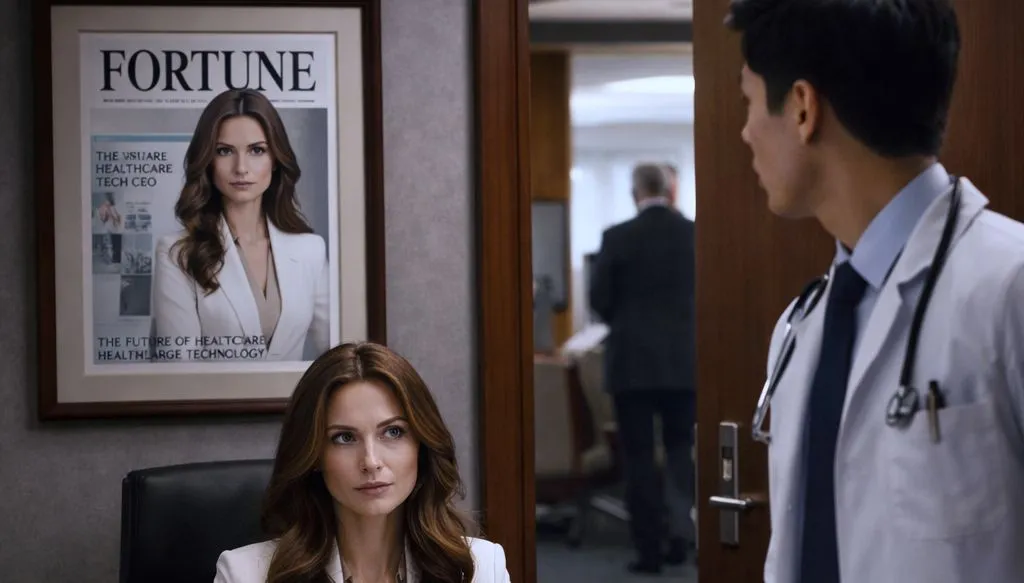
I stared at the wall opposite my desk. Hanging there was a framed cover of Fortune magazine featuring the headline: “The Future of Healthcare Technology.” Below it was a photo of me, Dr. Natalie Morrison, 32, recipient of the Innovator of the Year award. Next to it hung my diplomas: MD from Johns Hopkins, MBA from Wharton, PhD in Biomedical Engineering from MIT.
“What exactly did you tell Marcus about me?” I asked, my voice dangerously quiet.
“I said you work at a hospital in an administrative role. Which is technically true, right? You do work at BMC.”
“Rachel…”
“Please, Nat. This is important to me,” she interrupted, her voice dropping to a whine. “Marcus is the one. I can feel it. His family is hosting us for New Year’s, and I need everything to be perfect before then. Having you at Christmas, with Mom asking those pitying questions about your job and Dad making awkward comments about you still renting… it would ruin the image I’ve built.”
There was a rustling sound on the line, and then my mother’s voice filtered through.
“Natalie, honey? Rachel put me on speaker. Your father is here, too.”
“Great,” I muttered.
“Sweetheart, we’re not trying to hurt you,” Mom said, her tone pleading. “We just want Rachel to have her moment. You understand, don’t you? She’s finally found someone wonderful, and we don’t want anything to complicate things.”
“By ‘anything,’ you mean me.”
“That’s not what we’re saying,” Dad interjected, his voice gruff. “We’re just thinking about first impressions. Marcus is very accomplished, and Rachel wants to present our family in the best possible light. Maybe it’s better if you sit this one out just this year. We’ll do something special together after the holidays, just the four of us.”
I closed my eyes, absorbing the blow.
“So, you are all agreeing that I am too embarrassing to attend my own family’s Christmas party?”
“Don’t be dramatic,” Rachel snapped. “We’re trying to be practical. You’ve always been the sensitive one, making everything about you.”
“Okay,” I said.
The silence that followed was deafening.
“You… you’re okay with this?” Mom sounded genuinely surprised.
“You’ve made your position clear. I won’t attend Christmas Eve. Is there anything else?”
“Thank you for understanding, sweetheart. We’ll make it up to you, I promise.”
I hung up without another word. A moment later, a knock sounded at my door. My executive assistant, David, poked his head in.
“Dr. Morrison? Dr. Chin from Mass General just confirmed his consultation appointment for the 27th. He’s evaluating our cardiac monitoring AI for his department.”
I looked up sharply.
“Dr. Marcus Chin, cardiothoracic surgery?”
David checked his tablet.
“That’s him. Apparently, he heard about our platform at the American Heart Association conference and wants to see a demo. The Chief specifically requested you handle this one personally. He says Chin could bring the entire Mass General cardiac program into our client base.”
My hands remained steady as I opened my digital calendar, though my mind was racing.
“What time?”
“2:00 p.m. on December 27th. I’ve blocked your afternoon.”
“Perfect. Thank you, David.”
After he left, I pulled up Dr. Marcus Chin’s professional profile. Harvard Medical School, top of his class. Cardiothoracic surgery residency at Johns Hopkins. Published extensively on minimally invasive cardiac procedures. Currently being considered for Chief of Cardiothoracic Surgery at Mass General at the age of thirty-seven.
His credentials were undeniably impressive. But he had absolutely no idea that he was dating the sister of the woman whose technology he was coming to evaluate. The same woman his girlfriend had deemed too embarrassing to meet.
Growing up, I was always the outlier. Rachel was two years younger, bubbly, and intensely social. She was the daughter who brought home cheerleading trophies and prom queen crowns. She had majored in communications, went into pharmaceutical sales, made a comfortable living, and resided in a trendy apartment in Cambridge that our parents helped her afford.
I, on the other hand, had been the awkward kid who spent weekends in the library. I got a full scholarship to MIT at sixteen and graduated with a triple major at nineteen. While Rachel was pledging sororities, I was publishing research papers. While she was dating football players, I was surviving medical school.
My parents never quite knew what to do with me. “You’re so serious all the time,” Mom would say. “Can’t you just relax and enjoy life like your sister?” Dad had his own version: “Not everyone needs three degrees, Natalie. Sometimes you need to know when enough is enough.”
I had completed my MD at Johns Hopkins at twenty-four. Then came the PhD in biomedical engineering at MIT, followed by an MBA at Wharton, all while working as a trauma surgeon at Boston Medical Center. At twenty-eight, I had burned out completely.
I had been in the ER for thirty-six hours straight when I lost a patient—a fifteen-year-old girl with an undetected cardiac arrhythmia. Her EKG had looked normal. By the time we realized something was wrong, it was too late. I remembered sitting in the break room at 4:00 a.m., staring at her chart and thinking, “There has to be a better way.”
That was the moment CareLink AI was born. The concept was simple: an artificial intelligence platform that continuously monitored patient vitals, recognized subtle patterns humans missed, and predicted complications before they became catastrophic. The execution, however, was brutally complex. It involved algorithms, machine learning, clinical trials, FDA approval, and hospital integration.
I had used my savings—$400,000 from surgical work and smart investments—to build the first prototype. Eighteen months later, we had our first client, a small community hospital in Vermont. Within three years, we had sixty hospitals across twelve states.
Within five years, we had prevented over 2,400 documented patient deaths. Last year’s revenue was $180 million. The current company valuation sat at $3.2 billion. And I owned 68% of it.
Forbes had called me “the surgeon who is saving more lives outside the OR than she ever could inside it.” Fortune had profiled our AI platform as “the future of preventive healthcare.” The New England Journal of Medicine had published our outcomes data showing a 34% reduction in unexpected patient mortality at hospitals using our system.
My family had no idea. When they asked about my work, I simply said, “I work in healthcare technology at BMC,” and changed the subject. When they saw my modest two-bedroom apartment in Jamaica Plain, I didn’t mention the $6.2 million penthouse I owned in Back Bay as an investment property.
When they assumed I was struggling financially, I didn’t correct them. I wasn’t hiding out of shame; I was conducting an experiment. Would they value me without the external validation of massive success? Would they treat me with respect when they thought I was ordinary? The answer, apparently, was a resounding no.
The week after Rachel’s call, I threw myself into preparing for the Marcus Chin consultation.
“He’s bringing his department head and two attending physicians,” David informed me during our prep meeting. “They want to see live demos, case studies, and integration timelines. Mass General would be our biggest client to date. Forty-three surgeons, two hundred residents, nearly a thousand beds.”
“What is Chin’s specific interest?” I asked.
“Cardiac monitoring for post-operative patients. He’s concerned about sudden complications in the first seventy-two hours after surgery. He wants to know if our AI can predict events like tamponade, arrhythmia, or pulmonary embolism before they become critical.”