“Why do you choose a job dedicated to saving people if everyone eventually leaves anyway?”
The question sliced through the polished, ambient silence of the café, cutting straight through the false identity Lena Moore had worn since sliding into the booth. Lena froze, her teacup hovering in midair. She looked up, startled by the sudden depth of the inquiry. The man sitting across from her was tall, impeccably dressed in a charcoal suit, and visibly uncomfortable. Yet, as he met her gaze, his eyes held a kind of wounded honesty that disarmed her.
He wasn’t trying to hurt her; he was speaking from a place of raw, unpolished exhaustion. The superficial small talk evaporated instantly, taking his polite mask with it. “That is a rather heavy question for someone you just met,” Lena said, attempting to keep her voice casual as she lowered her cup…
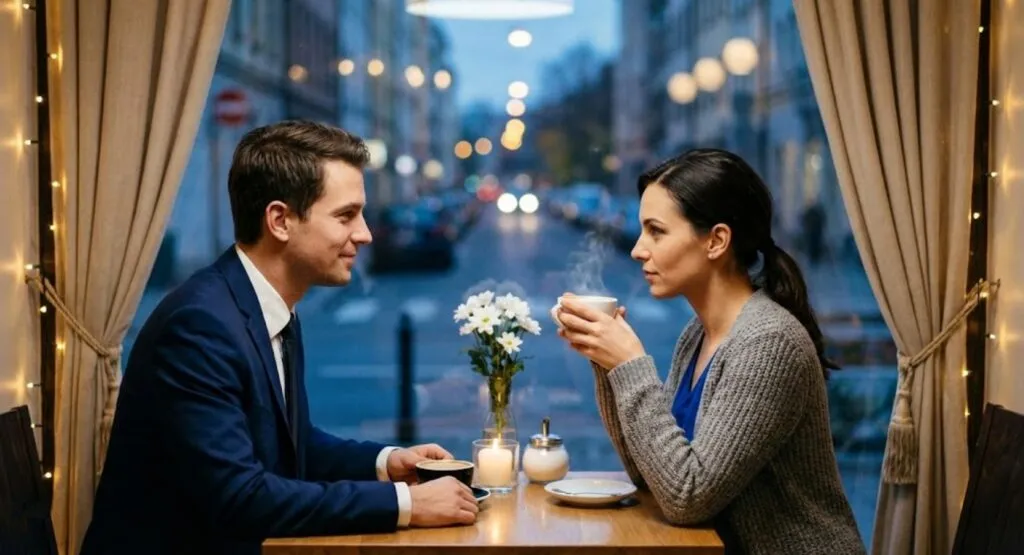
“I suppose it is,” he replied, staring down as he slowly stirred his black coffee. “But I do not like wasting time.” His name was Caleb Everett. Lena already knew this, of course. Joyce had shoved his photo in her face earlier that day, bragging about his CEO status and the tragic detail that his wife had died young. “Just go,” Joyce had urged, pressing the issue. “Pretend to be me, feel it out, and keep the option open in case he’s worth my time.”
Lena had refused at first, but eventually relented, not out of curiosity, but out of sheer fatigue. It was easier to sit for an hour than to argue with Joyce for ten minutes. Now, sitting across from him under a borrowed name, she felt a shift in the atmosphere. “I’m sorry,” Caleb said, breaking the silence. “That probably sounded more bitter than I intended.”
“No,” Lena replied softly, surprised by her own candor. “It is a fair question.” She set the cup down on the saucer with a soft clink, her fingers tightening around the handle as a memory flickered violently behind her eyes. A trauma room. A lifeless body. Her own hands pressing, compressing, trying, and failing.
“I was in medical school,” she began, the truth spilling out before she could check herself. “I wanted to be a doctor. But my younger brother died during a trauma case while I was an intern. I was right there. I tried to save him.” She paused, swallowing the lump in her throat. “I couldn’t.”
Caleb said nothing. He didn’t look away, nor did he offer a platitude. He just listened. That surprised her more than anything. “After that,” she continued, “I couldn’t go back. Not to med school. Not to who I was before. I became a nurse instead. It is quieter work. There is less illusion of control.”
Caleb leaned back slightly, a faint shadow crossing his face. “My wife died three years ago. Brain aneurysm. One minute she was making coffee in the kitchen, and the next, she was gone.” Lena inhaled softly, recognizing the specific frequency of his grief. “Everyone thinks I need to start over,” he said with a dry, humorless chuckle. “So here I am, on a blind date I didn’t want, with someone I never planned to meet.”
Lena allowed a breath of genuine laughter to escape. “I am glad we are both here against our will, then.” A small, genuine smile tugged at the corner of his mouth.
“I am sorry about your brother,” he said quietly. “That is a terrible thing to carry.” Lena blinked, caught off guard. She had expected awkwardness, maybe polite disinterest, but not this stillness. Not this care.
“I didn’t mean to hijack your night with sad stories,” she said, looking down at the table.
“Neither did I,” he replied. “But at least it is honest.” Lena nodded, then caught herself.
“Joy—” Her voice caught before she could say the full name ‘Joyce.’ “I wasn’t expecting this.”
His brow lifted slightly. “Neither was I. My mother set this up. She thinks I need saving.”
“Yeah,” Lena murmured. “I think I need truth more than saving.” He looked at her then, truly looked at her, and the air between them changed. It wasn’t romantic, nor was it intense in a passionate sense; it was simply real.
The waiter returned with the check, placing it discreetly on the table. Neither moved to grab it immediately. Caleb spoke first. “I was going to walk around Central Park a bit. Clear my head.”
She hesitated. “Is that an invitation?”
He smiled, a genuine expression that reached his eyes. “Only if you need some air too.” Lena surprised herself by saying yes. As they walked out of the café and into the crisp autumn air side by side, something quiet settled between them. It wasn’t tension, and it wasn’t immediate attraction. It was the beginning of something neither of them recognized yet—something not loud or grand, but deep enough to be worth staying for.
Sometimes, it is in the most unexpected meetings—the ones we never intended to matter—where something small but soul-shifting begins. The air outside the café was crisp, carrying that early autumn scent of turning leaves and distant rain. Caleb held the door open as Lena stepped out, unsure why she had agreed to prolong the evening. She had instructed Haley, the hostess, to seat them, planning to leave after thirty minutes. She had even told Joyce she would walk out if the man was arrogant or dull.
But he was neither. Now, here she was, walking beside him in companionable silence toward a small park just a few blocks from his office building. “I usually come here with my son,” Caleb said, glancing toward the empty swings in the distance. “He likes watching the pigeons more than playing on the equipment.”
Lena smiled politely, though a knot tightened in her chest. Talking about family still made her anxious, but she listened. They walked a little farther down the paved path. The evening light filtered through the trees in soft amber hues. Children were scattered around the playground with nannies and caregivers, their laughter echoing off the nearby buildings.
It was ordinary and peaceful until Lena noticed him. A little boy, no older than three, stood beside a bench. His lower lip was trembling, and his eyes were glossy with unshed tears. His white T-shirt was stained bright orange from spilled juice, and he was holding the empty plastic cup in both hands like it had personally betrayed him. He looked utterly lost.
Lena instinctively glanced around. A woman, likely the nanny, was busy wrangling two other toddlers near the sandbox, completely oblivious to the crisis by the bench. Without thinking, Lena walked over and knelt in front of the boy. “Hey there, champ,” she said softly, her voice adopting the soothing tone she used with scared patients in the ER. “Looks like Mr. Orange Juice didn’t play nice today, huh?”
The boy sniffled, nodding solemnly. Lena reached into her purse and pulled out a soft, worn handkerchief. It was pale blue with a faded cartoon giraffe stitched in one corner—something her brother had once picked out for her during a hospital gift shop visit years ago. She had carried it ever since. “Looks like Mr. Giraffe is on duty today,” she whispered, gently dabbing at the sticky juice on his shirt. “Let’s fix this mess, shall we?”
The boy watched her work, mesmerized by her gentle movements. Then, without warning, he leaned forward and wrapped his tiny arms around her neck. Lena blinked, startled, her hands freezing in midair. Slowly, she wrapped her arms around his small body, holding him in a quiet, instinctive embrace. It felt effortless, natural, and achingly familiar.
The little boy pulled back slightly, just enough to look over her shoulder, and suddenly beamed. “Daddy!”
Lena turned, confusion flashing across her face, just as Caleb stepped into view. His eyes were wide, his breath caught in his throat. “Lucas,” he said, the name leaving his lips like a prayer. The boy wriggled out of Lena’s arms and ran to him, juice-stained shirt and all. Caleb knelt and scooped him up, pressing his forehead to the boy’s as if grounding himself.
Then, he looked back at Lena. “She didn’t see me spill,” Lucas explained between hiccuping breaths. “She helped me.”
Caleb stared at Lena, his voice quiet with something heavier than surprise. “He hasn’t hugged anyone since his mom passed.”
Lena rose slowly, her heart pounding against her ribs. “I’m sorry, I didn’t know he was your son.”
“Do not apologize,” Caleb said, shaking his head slowly. “Thank you for making him smile.”
Lucas reached for the handkerchief still clutched in Lena’s hand. She crouched down to give it to him. “Can I keep Mr. Giraffe?” he asked, wide-eyed.
Lena laughed softly, gently, almost tearfully. “Of course you can.”
Caleb looked at the two of them—his son clinging to a woman he had just met, and the woman kneeling like she had known the child her whole life. There was a softness in her eyes that felt like something long forgotten. After a few more minutes of quiet conversation, with Lucas now happily distracted by a squirrel and holding his new giraffe cloth like a treasure, the nanny hurried over, flustered and apologetic. As she gathered Lucas to take him home, Lena stood beside Caleb again.
“I should go,” she said, brushing a strand of hair behind her ear. “It’s getting late.” He did not ask her to stay, but he looked at her like he wanted to. She turned to leave, her heart strangely full and heavy at the same time.
Later that evening, as Lucas settled into his car seat, the nanny glanced at him through the rearview mirror. “You were very brave today,” she said.
Lucas nodded, then almost dreamily whispered, “Daddy smiled today. He never does when we go out.”
The photo was unmistakable. It showed Joyce in a bikini, standing beside a glimmering infinity pool on a rooftop in Bali. The caption read: “Girls escape. Blind dates? Sorry, not sorry.”
Caleb stared at the post on his phone, his thumb hovering above the screen. He checked the timestamp again. Yesterday, 4:12 PM. Roughly thirty minutes after his date had started. His breath stilled. It did not make sense at first. He had met Joyce—or someone who said she was Joyce. She had introduced herself with that name. She had responded to it.
And yet, the woman in Bali was clearly the real Joyce. The woman he had spoken to yesterday—the one with the sad eyes and the quiet strength, the one who had told him about her brother and why she became a nurse—she had lied. It wasn’t just a small omission. It was her name, her identity. The anger rose slow and sharp. It wasn’t loud or explosive, but cutting, like a wire pulled too tight.
He did something he rarely did: he left the office mid-morning without telling anyone.
Lena was stocking supplies in the medication cabinet at the hospital when she turned and saw him standing in the doorway. She blinked, startled. “Caleb?”
His expression was unreadable. “Is there somewhere we can talk?” he asked.
Lena’s heart sank. She followed him into an empty hallway, her palms already beginning to sweat. He faced her, his jaw clenched and his eyes cold—so different from the man who had stood beside her in the park yesterday, watching his son laugh for the first time in months.
“Your name isn’t Joyce.” It was not a question.
Lena’s lips parted, but no words came. Her throat tightened.
“You let me sit there and pour my heart out while pretending to be someone else?” he continued, his voice low and controlled. “Was I a joke? A game between you two?”
“No,” she said quickly, her voice barely above a whisper. “It wasn’t like that.”
“Then explain it to me.”
Lena looked down, ashamed. “Joyce… she asked me to go in her place, just to hold the seat. She thought you’d be arrogant or controlling. She wanted to scope you out first without risking her image.”
Caleb let out a humorless laugh. “So you were the scout?”
“No, I didn’t want to go,” Lena said, shaking her head. “I told her no at first, but I was off shift and she kept pushing. I only agreed to sit for a few minutes. I wasn’t going to say anything personal.”
“But you did,” he snapped. “You told me about your brother. About med school. About why you became a nurse. Was that a lie too?”
“No,” she said, her eyes glossy. “All of that was true.”
“But your name wasn’t,” he said, taking a step back. “So how am I supposed to believe anything else?”
Lena flinched. “I didn’t go there to lie,” she said quietly. “I stayed because I didn’t want to lie anymore.”
For a second, he just looked at her. That silence hurt more than shouting ever could. “I opened up to you,” he said finally. “I trusted you with pieces of me I haven’t shared with anyone since my wife died. I thought maybe…” He shook his head. “I was wrong.”
He turned to leave. “Caleb,” she started, stepping toward him.
But he held up a hand without looking back. “Please don’t.”
The hallway echoed as his footsteps faded away. Lena stood there, frozen, tears gathering at the edges of her lashes. Her fingers dug into her palms, the ache of her own shame pulsing with every heartbeat. She had not gone there to deceive him, but that did not matter anymore. In the end, all he saw was the lie. And it hurt more than she expected because somewhere between coffee, Mr. Giraffe, and Lucas’s little arms around her neck, she had begun to hope. And now, it was all unraveling.
The slam of the door still echoed in Lena’s mind long after Caleb disappeared. She tried to breathe. Tried to focus. Tried to remind herself that she had no right to expect anything more. She had lied, even if it wasn’t meant to hurt. But it did hurt. The rest of the shift crawled by in a blur. Patient to patient. Chart to chart. Smile to smile. She had learned how to function through pain years ago.
But today, she felt hollow. Like she had lost something she had only just begun to believe she could have.
Then came the code call. “Incoming trauma. Pediatric head injury. Male, three years old. Playground fall. ETA five minutes.”
Her heart skipped, then slammed hard against her ribs. She told herself it wasn’t him. It couldn’t be. But when the gurney rolled in, she knew. The blood on his forehead. The juice-stained shirt. The damp curls. The small body shaking, too scared to cry.
“Lucas?”
For a moment, Lena couldn’t breathe. Her knees weakened, and her hands turned to ice. It was too familiar. Years ago, it had been her brother. A different gurney, a different hospital, but the same panic. The same helplessness. That time, she had not saved him.
But now, Lena moved. Her training took over. Her voice steadied. “Vitals,” she called out.
A nurse answered instantly. “Stable, but fast heart rate.”
Lucas whimpered as someone tried to clean the blood from his head. Lena stepped in, her voice dropping to a soft murmur. “Hey, baby. You remember me?”
Lucas’s eyes fluttered open. He didn’t speak. He just stared. She gently dabbed the wound with a cloth. “It’s okay, baby. We’ll tell Mr. Giraffe you’re safe. I’m right here.”
He blinked again. Then his tiny hand reached out and grasped hers.
Lucas was sent in to prep for stitches. Lena’s shift had technically ended, but she did not leave. She paced the hallway outside the procedure room, arms crossed, head down. In her mind, she was no longer at work. She was back there. On that cold tile floor. Whispering her brother’s name. Watching life leave his body before help ever came.
She whispered to no one. Or maybe to him. “Please, just let him be okay. Let me get it right this time. I wasn’t enough before. Don’t let me fail again.” Her voice cracked. Her fingers trembled. This was no longer just grief; it was penance.
She didn’t hear the footsteps until they stopped nearby. She looked up. Caleb stood there. He was drenched in rain, eyes wide with panic. “Where is he?” he asked breathlessly.
She pointed. “In there. Just a cut. They’re stitching him now.”
He exhaled, the sound half relief, half dread. Then his gaze found hers. “You’re here.”
Lena nodded, barely holding back tears. “I was on shift,” she said. “I didn’t know it was him. But when I saw him… I couldn’t walk away.”
Caleb said nothing for a moment. But in that silence, he saw her fully. Not the woman who had lied. Not the stranger who sat across from him with a false name. But the woman standing here now. Broken. Still standing. Still choosing to stay.
“You stayed,” he murmured. “Even when you didn’t have to.”
Her voice broke. “I couldn’t leave him scared. I couldn’t lose another child.”
A nurse appeared a few minutes later. “Mr. Everett? He’s awake.”
Caleb rushed in. Lena followed, unsure if she should, but unable to stay away. Lucas lay under a blanket, his cheeks pink, a white bandage covering his head. “Daddy?” he whispered, smiling weakly.
Caleb took his hand. Then Lucas looked over and reached out his other arm. Lena approached slowly. “You came,” he said.
She knelt. “Of course I did.”
And with quiet certainty, Lucas wrapped his arms around her neck. “You’re my safe lady.”
Lena held him close. And this time, when the tears came, she let them fall. Because in that moment, the past did not win. Guilt did not win. Love did. And for the first time in years, Lena began to believe she could be healed too.
Caleb stared at the printed chart in front of him. His hands were unmoving, but the pages trembled slightly. Even in the stillness of the office, the air felt heavy. He had pulled strings to get this. A favor here, a discreet inquiry there. Old medical records were not easily accessed, especially when they involved a minor from over five years ago.
But Caleb Everett was a man who got what he wanted when he needed it. And right now, what he needed was the truth.
Patient Name: Ethan Moore. Age: 10. Time of Death: 4:13 a.m. Cause: Blunt force trauma from a car accident.
Treatment Notes: Multiple fractures. Internal bleeding. Noted delay in surgical prep due to conflicting assessment from attending physician.
But what caught Caleb’s eye—what sent a chill down his spine—was the name scribbled in rushed handwriting in the margin of the trauma response log: Intern L. Moore. Initiated compressions. Applied trauma protocols. Remained until resuscitation terminated.
His eyes scanned the rest of the document slowly, taking in the devastating details. The boy had coded three times. There had been confusion about intubation timing. The attending physician on call had insisted on a CT scan before clearance to surgery, wasting over twenty minutes. Lena had been the only one who had acted immediately. Even as an intern, she had done everything she could.
Caleb leaned back in his chair, the file resting in his lap now. His thoughts were heavy, swirling. So that was the night she had lost him. And she had been there. Not watching from the sidelines, but on the floor, hands shaking, trying to bring her own brother back to life. She had told him the story in fragments, but she had never said it was her shift. She never said that she had watched him slip away while others hesitated. She had carried that guilt alone ever since.
A soft knock on his office door made him look up. Lucas was there, holding a crayon drawing in one hand and a juice box in the other. “Daddy. I drew a lion.”
“He is brave,” Caleb said, opening his arms. Lucas climbed into his lap.
“I like lions,” the boy said. “They… don’t get scared.”
Caleb smoothed his son’s hair gently. “Even lions get scared sometimes,” he said. “But they keep trying anyway.”
Lucas nodded solemnly, clearly believing that to be true. Caleb looked at the drawing again. Crude lines, uneven shapes, but something fierce in the way the little lion stood tall. Just like Lena. All this time, Caleb had thought she had run from her past. But now he saw it. She had not run. She had stayed. She had fought. And when no one saved her from the crushing weight of that night, she chose to carry it alone.
His voice was barely a whisper as he said the words aloud, more to himself than to Lucas. “You tried to save him. While no one tried to save you from the guilt.”
He closed the file gently and set it aside. The truth was no longer tangled. It was painfully clear. Lena Moore had not lied to protect herself. She had lied because she thought she no longer deserved anything real. And maybe… maybe it was time someone saved her for once.
The building stood tall against the gray sky, its modern glass exterior gleaming even in the muted light. A small plaque near the entrance read: Hope Medical Research Center. Lena hesitated outside the door, her fingers brushing against the cold metal handle. She had no idea why Caleb had asked her to come. Just a simple message on her phone: There’s something I want to show you. Will you come?
Now, here she was. Inside, the lobby buzzed with quiet excitement. Staff in crisp lab coats mixed with donors in tailored suits. Name tags were clipped to expensive jackets. A small reception table displayed brochures, a guest list, and flutes of champagne.
Then she saw him. Caleb stood near the far wall, deep in conversation with two board members. When his eyes met hers, he paused mid-sentence. He excused himself politely and walked straight to her.
“You came,” he said softly.
Lena nodded. “I wasn’t sure I should.”
“I was.” He gestured for her to follow him down a quiet corridor, away from the bustle of the gala. They walked in silence until he stopped before a door. It was plain and unassuming, but new. A temporary nameplate hung beside it. It was blank.
“This room,” he said, “was supposed to be named after my late wife.”
Lena’s heart tightened. She looked down. “You don’t have to explain. I understand.”
He shook his head. “No, you don’t. Not yet.”
He opened the door. Inside was a spacious, sunlit laboratory. It was empty for now, waiting for life. Desks, whiteboards, and research equipment lined the walls. On one side, there was a dedicated children’s corner with small chairs, a bookshelf, and soft toys—a gentle reminder that healing is not just clinical; it is human.
“I designed this space in her memory,” Caleb said. “It was supposed to represent the future she never got to finish.”
Lena turned toward him slowly, unsure what to say.
“I stopped trusting doctors after she died,” he continued. “I stopped believing in hospitals. In systems. In people who claimed they could help but never truly cared.” He looked at her then, not with pain, but with clarity. “Until one reminded me what healing looks like.”
Lena’s breath caught.
He stepped closer. “You didn’t just care for Lucas. You stayed with him. You stayed with me. Even when you had no reason to. And you did it while carrying your own wounds.”
She shook her head, her voice trembling. “I don’t want to be someone’s second chance. I don’t want to live in someone else’s shadow.”
Caleb’s voice was gentle but firm. “You are not a replacement.” He took her hand, slowly, deliberately. “You are the reason I am ready to begin again.”
Lena closed her eyes for a moment. When she opened them, something had shifted. Not all the pain was gone, but for the first time in years, she did not feel like she had to carry it alone.
Then came the twist. From the hallway behind them, heels clicked sharply against the tile. The scent of designer perfume drifted in. And then, the voice.
“Well,” Joyce said smoothly, stepping into the doorway. Her smile was practiced, her dress just a little too polished for the occasion. “I always thought I’d be the one you’d choose, Caleb.”
Lena stiffened but said nothing. Caleb turned to Joyce, his expression calm but firm.
“You thought wrong.”
For a beat, Joyce’s smile faltered. She glanced at Lena, then back at him. “I see,” she said, her tone clipped.
“I hope you enjoy the gala,” Caleb added politely, but with finality.
Joyce lingered a moment longer, but the door was already metaphorically closing. Lena hadn’t moved. Hadn’t spoken. Caleb turned back to her. “I didn’t invite her,” he said.
“I know,” she replied quietly.
Their eyes met in a room that had never been named. Something new was born there—not in honor of the past, but in hope for what could still be. And this time, Lena did not walk away.
The rain had started just after sunset, a quiet, steady drizzle that clung to the air like a whispered memory. Lena stood beneath the awning of the assisted living center where she had just finished her shift. Her scrubs were damp at the shoulders, her hair curling slightly in the humidity. She did not reach for her umbrella. The rain felt honest. Unfiltered.
She closed her eyes for a moment, letting the droplets tap lightly against her skin. A car horn sounded once—low and familiar. When she looked up, Caleb’s car was parked by the curb. He stepped out before she could move, holding no umbrella, only a small box wrapped in dark blue twine. His shirt was already wet through, but he did not seem to care.
He walked up to her slowly. “You forgot your umbrella,” he said gently.
“I think I meant to,” she replied.
There was a pause. Not awkward, but expectant. Then Caleb extended the box toward her. She took it with cautious fingers. The weight surprised her. When she opened it, inside was a folder embossed with the logo of Hope Medical Research Center. She glanced up sharply.
“It’s a contract,” Caleb said. “Official. Not symbolic. We want you to come on as Program Director for the Hope Lab. Specifically for nurse training and trauma response research.”
Lena stared at him. “I don’t need a favor,” she whispered.
“This is not a favor,” he said. “It is where you were always meant to be.”
Her throat tightened. The rain blurred her vision, but not enough to hide the emotion in her eyes. “I am scared,” she admitted. “Of being seen. Really seen. And still not being enough.”
Caleb stepped closer, his voice steady against the falling rain. “Then let me see you fully. And stay anyway.”
His hand reached for hers. Not forcefully. Just open. Just waiting. Lena did not speak. She looked down at his hand, then up into his eyes. Then she stepped into the rain, and into him.
They stood for a long moment like that—two people, both once shattered, now quietly choosing to stand whole, together.
Later that week, Lena found herself sitting on a bench near the edge of the Hope Lab’s community garden, flipping through the contract once again, though she already knew every word. She heard footsteps behind her. Turning, she saw Joyce.
She wasn’t in heels. She wasn’t wearing designer anything. Just jeans, sneakers, and a light jacket. Her face held none of the usual gloss, only uncertainty.
“I heard you accepted,” Joyce said.
“I haven’t signed yet,” Lena replied, her voice neutral.
Joyce sat beside her, sighing deeply. “I owe you an apology,” she said. “For pushing you into that date. For trying to step back in when it was already too late.”
Lena looked ahead, not answering immediately.
Joyce’s voice softened. “I thought I’d be the one he wanted.” Lena finally turned toward her. Joyce continued, her eyes slightly glossy. “But Caleb didn’t need someone impressive or charming. He needed healing. And you… you gave him that.”
Silence stretched between them. Then Joyce added, almost afraid, “Can we still be friends?”
Lena’s face softened. “We always were,” she said.
Joyce blinked, then smiled. It was small and sheepish—the kind that said thank you without saying it out loud.
That night, Lena sat at her kitchen table, the signed contract resting beside her tea. She looked at the copy of the offer again. At the line that read: Program Director: Lena Moore. Not someone’s assistant. Not the girl who once failed. Just Lena. Whole. Worthy. And this time, she believed it. The rain tapped softly on her window, but inside her chest, something finally felt still.
Laughter floated through the hallway like sunlight. Lena paused outside the preschool classroom, peeking in. Inside, small hands held up drawings of stick figures, bright suns, and crooked trees reaching for the sky. In the corner, Lucas sat at a tiny table, his tongue sticking out in focus as he added bold red lines to his picture.
His teacher passed by, smiling. “He’s been waiting to show you this,” she whispered.
Lena stepped in. Lucas beamed. “Mom! Look!” He held up his drawing. Three stick figures stood under a rainbow. One tall. One medium. And one small with outstretched arms.
“Daddy. Me. And Mommy.”
Lena knelt beside him. “Is that me?”
Lucas nodded proudly. “That’s our family.”
Tears burned behind her eyes, but she smiled through them. “It’s perfect.”
It had been one year since Caleb handed her that box in the rain. Since then, Hope Lab had become more than just a research center. Under Lena’s quiet leadership, it grew into a refuge. It became a place for nurses who had left the field, for doctors on the edge of burnout, for trainees who believed they were not enough. She had helped redefine what healing looked like. It wasn’t just medicine; it was grace and humanity.
Each time she walked its halls, she remembered the girl in the ER hallway, whispering to her brother’s ghost. And each day now, she walked forward anyway.
The wedding was small, held by the lake behind the Hope Lab. There were just close friends, family, and the rustling of leaves. No aisle, no altar—just an open circle of chairs beneath the trees. Caleb waited by the water in a simple gray suit, his eyes calm but searching.
When Lena stepped forward in her ivory dress—uncomplicated, soft, and not at all like what she used to picture as a little girl—Caleb’s smile was like light after a long gray winter. Lucas, dressed in a tiny vest and bow tie, walked toward them with a velvet ring box clutched tightly in both hands. He paused between them, looked up, and said, “I asked Mommy in heaven. She said it’s okay to love again.”
The world went still. Caleb dropped to one knee. His hands trembled as he opened the box. “I can’t promise perfection,” he said. “But I promise to keep choosing you. Every day. Even when it’s hard.”
Lena reached for his hands, her voice shaking. “Then you’ll never be alone in that choice.”
They exchanged rings. No other words were needed. Lucas clapped first, grinning wide, and everyone joined in.
Later, the three of them stood outside the Hope Lab. Caleb’s arm was around Lena, her hand resting on Lucas’s shoulder. The little boy was hugging Mr. Giraffe close to his chest. A photographer clicked one last photo just as sunlight poured through the clouds behind them, lighting the stone wall above the entrance. Carved into it were the words Lena had insisted on:
Everyone deserves a second chance. Not just to heal others, but to be healed.
Lena looked up at the building, then down at the little boy who had made her believe she was still worthy of love. Lucas reached for her hand. “Mommy, can we go home now?”
She smiled and squeezed his fingers gently. “Yes, baby. Let’s go home.”
And they did. Three imperfect souls, stitched together not by chance, but by choice. A family with no rule book, but a family all the same. Some stories live on pages. Others live in hearts brave enough to break, and brave enough to heal.
Lena, Caleb, and little Lucas didn’t meet by chance. They chose love over fear, truth over pride, and healing over silence. Because family isn’t always blood. Sometimes, it’s the people who stay.