Ms. Johnson called. “Don’t come to school. The principal wants to meet. There are reporters outside.”
Reporters? Because of her? Zara felt like she was drowning.
But then, at 7:15 AM, something changed. A woman named Sophia Mitchell posted a video. She was in her thirties, Black, sitting in a recording studio with gold records behind her.
“My name is Sophia Mitchell. I’m a session singer. And I’m the voice Chase Hendricks has been selling as his own for fifteen years.”
Zara’s mother grabbed her hand.
“That little girl told the truth last night. I sang the Whistle Register notes on ‘Higher Ground’ and four other songs. I was paid two thousand dollars per song and asked to sign an NDA.” Sophia held up a document. “This is my contract. This is proof. And I’m done staying silent while a child gets attacked for exposing what I was too afraid to expose.”
The video had been posted eight minutes ago. Already fifty thousand views. Within an hour, two million. Within three hours, seven more session singers came forward, each with contracts, each with recordings, each confirming what Zara had said.
By noon, the narrative had flipped. Chase Hendricks Exposed was trending with proof, not speculation. Zara sat on her worn couch, watching the internet tear apart the man who’d tried to destroy her. She wasn’t alone anymore.
Chase Hendricks wasn’t going down quietly. By that afternoon, his legal team had filed a ten-million-dollar defamation lawsuit—not just against Zara, but against Sophia Mitchell, against Marcus Webb, the producer who’d spoken up at the gala, and against Jefferson Elementary School for “allowing a minor to make false public accusations.”
Ten million dollars.
Zara’s mother stared at the legal document that had been hand-delivered to their apartment at 3:00 PM. Her hands shook so badly she could barely hold the paper. “We don’t have money for a lawyer,” she whispered. “We don’t have money for anything.”
The lawsuit was strategic, designed not to win, but to terrify. Chase’s team knew that even if they lost, the legal fees alone would bankrupt everyone involved. It was a weapon, and they were wielding it with precision.
But the counterattack went deeper than lawsuits. By 4:00 PM, gossip sites were running coordinated stories. Sources “close to the Williams family” claimed that Zara’s mother had pushed her daughter to confront Chase, that the whole thing had been planned to extort money. One article included quotes from former neighbors saying the family was known for “playing victim” and “looking for handouts.” None of it was true. All of it was published.
By 5:00 PM, Zara’s school was under siege. Not just reporters now, but angry Chase Hendricks fans—teenagers and adults standing outside Jefferson Elementary with signs. Liars. Frauds. Leave Chase Alone.
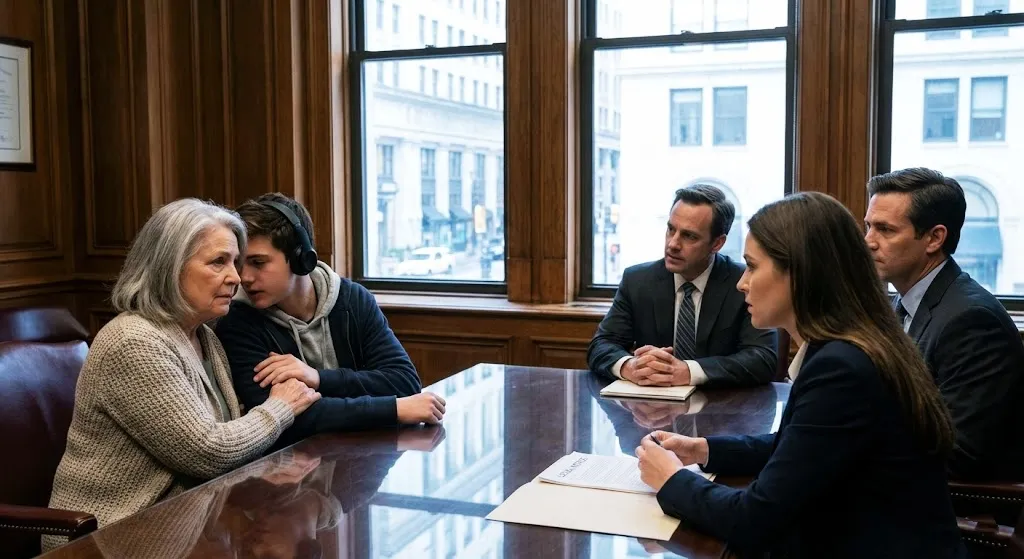
The principal called an emergency meeting. Zara and her mother sat across from him in his office, and he looked like he’d aged ten years overnight.
“I’m sorry,” he said. “But the school board is considering suspending Zara pending investigation.”
“Investigation of what?” Zara’s mother demanded. “She told the truth. You saw the video, everyone saw it.”
“The board is concerned about the attention, the threats. We’ve had to increase security. Parents are calling, worried about their children’s safety.” He rubbed his face. “And Chase Hendricks’ lawyers are threatening to sue the district for negligence. They’re saying we failed to supervise Zara, that we allowed her to defame their client on school time.”
“She wasn’t on school time,” Ms. Johnson interjected from the corner where she’d been standing. “She was at an evening event.”
“It was a school-sanctioned event,” the principal said. “The choir was there representing Jefferson Elementary, which means legally we’re liable.”
Zara felt her chest tighten. “So I’m being suspended because I told the truth?”
“You’re being suspended because the school can’t afford to fight a lawsuit from Chase Hendricks’ legal team.” The principal’s voice was heavy with regret, but the words still landed like stones. “I’m sorry, Zara, I truly am. But the board meets tomorrow, and I don’t think I can protect you.”
They left the school through a back entrance to avoid the cameras. At home, the apartment phone wouldn’t stop ringing. Reporters, threats, someone claiming to be from Child Protective Services saying they’d received reports that Zara’s mother was exploiting her child. It was fake—CPS didn’t work like that—but it was effective. Every call was a small knife.
Zara’s brothers were scared. They didn’t understand why angry people were outside their building, why their sister was on TV, why everything felt like it was falling apart.
That night, Zara’s mother sat on the edge of her bed. Her eyes were red from crying. “Baby, I need to ask you something.” Her voice was barely above a whisper. “If you could take it back, would you?”
Zara thought about the question. About the fifty-thousand-dollar scholarship she’d refused. About the reporters outside their building. About her school suspending her. About the threats and the lies and the ten-million-dollar lawsuit that could destroy their lives.
“No,” she said finally. “I wouldn’t take it back.”
Her mother closed her eyes, and a tear slid down her cheek. “Then we fight. I don’t know how, but we fight.”
But fighting seemed impossible when the enemy had unlimited money and unlimited reach. At midnight, Zara lay awake in the bed she shared with her brothers, listening to them breathe in their sleep. She thought about Chase Hendricks in his mansion somewhere in the Hollywood Hills, probably sleeping peacefully, protected by lawyers and money and the knowledge that the system was built to protect people like him. She thought about how easy it would be to give up, to sign the paper his lawyer had offered, to say she was sorry for telling the truth.
And then she thought about Sophia Mitchell, who’d been silent for fifteen years before finding the courage to speak. About Marcus Webb, who’d stayed quiet for three decades before standing up. About the seven other session singers who’d come forward risking their own careers. They’d all been afraid, but they’d spoken anyway because someone had to. Even if that someone was just an eleven-year-old girl who refused to lie.
Zara closed her eyes and tried to sleep, knowing tomorrow would be worse. Not knowing that tomorrow would bring something she never expected: help.
The knock came at 7:00 in the morning. Zara’s mother answered cautiously, expecting reporters. Instead, she found a woman in her forties, professionally dressed, carrying a briefcase…