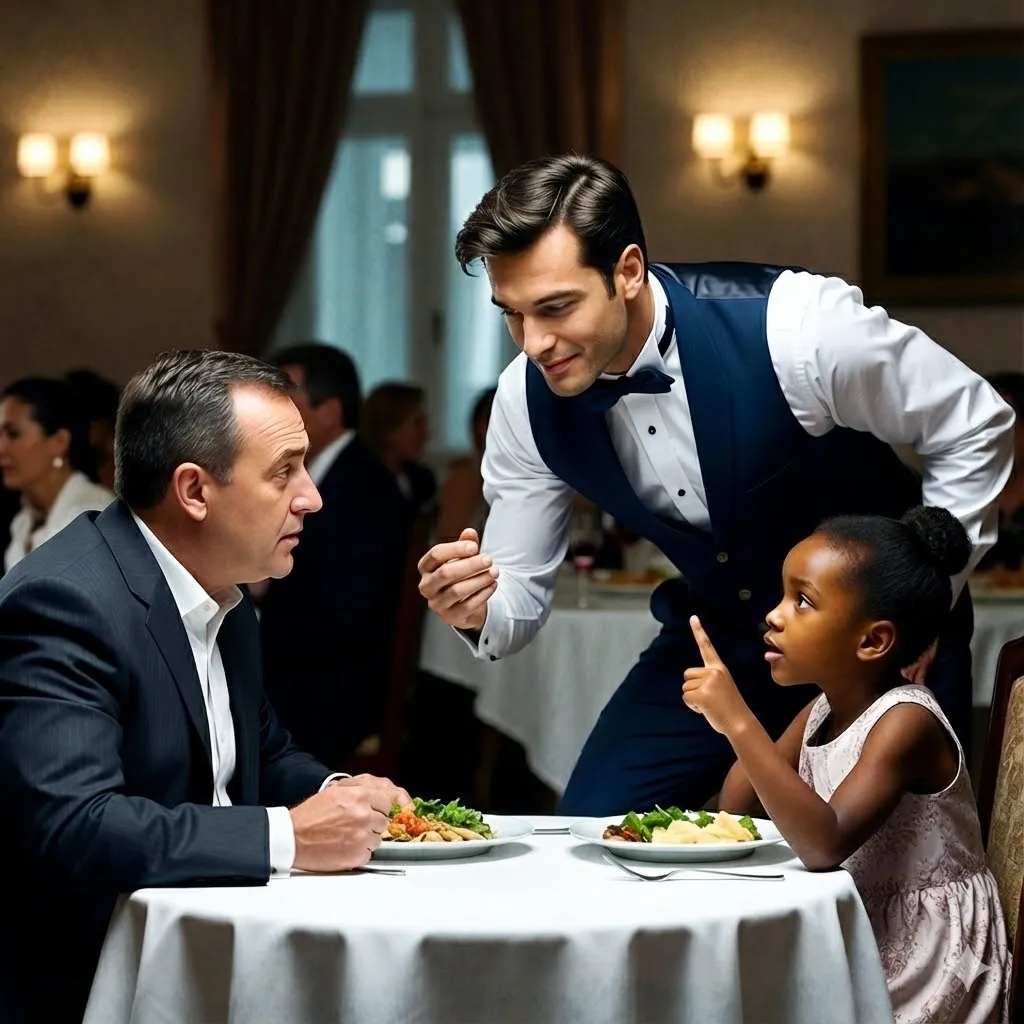
“You look like the saddest rich man I’ve ever seen.”
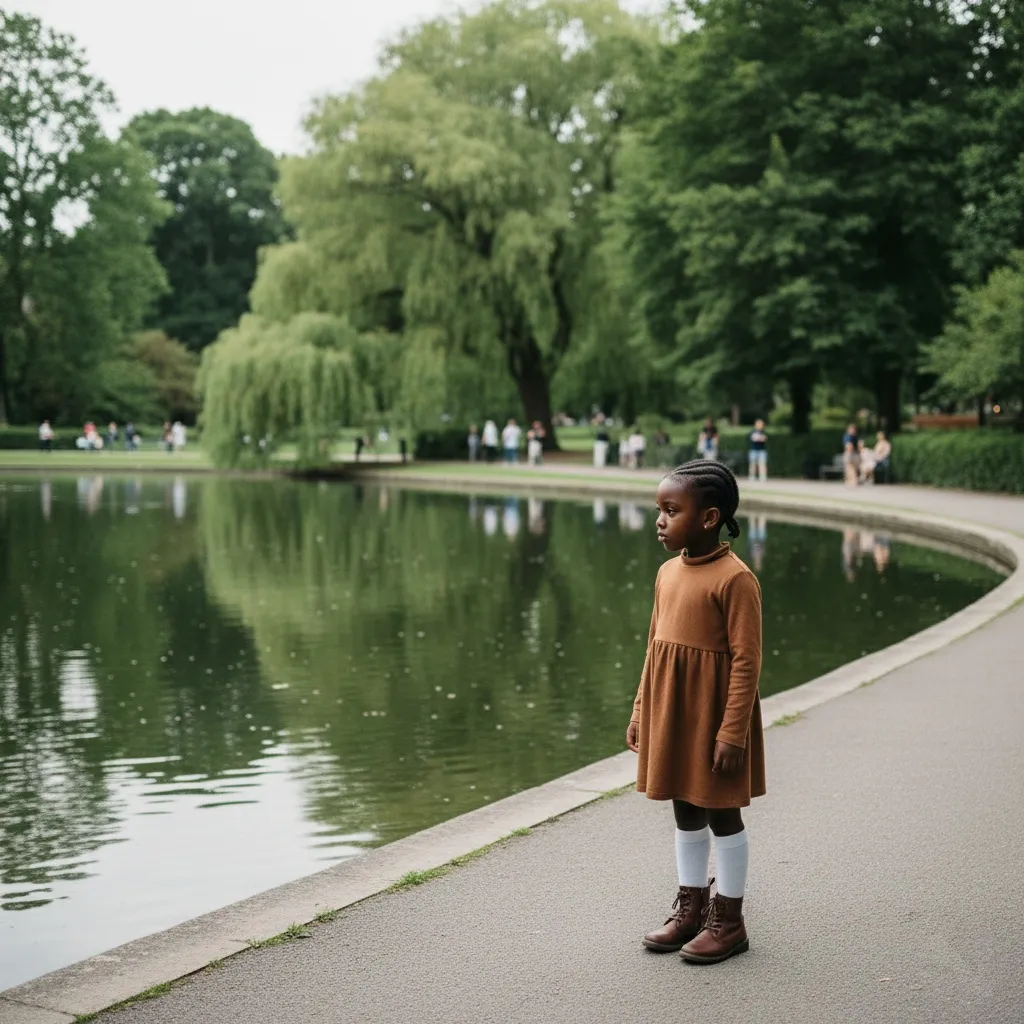
The voice materialized out of thin air—clear, diminutive, and devastatingly honest. Julian Blake looked up from his plate of seared halibut, which he hadn’t touched in twenty minutes. He was startled, though his face barely registered the emotion. Standing directly in front of his table was a little girl. Her hair was pulled back in tight, neat braids, and her Sunday dress hung just a fraction too loose on her small frame.
Her eyes, however, held none of the hesitation one might expect from a child addressing a stranger. They held the confidence of someone twice her age. Julian furrowed his eyebrows, signing slowly with his hands, “Excuse me?” He wasn’t sure if she understood American Sign Language, or if she was just staring at the movement of his fingers.
“I said,” she repeated, her voice rising to ignore the sudden hush of the dining room and the audible gasps from nearby patrons, “you look really sad. And you’re wearing a watch that probably costs more than my momma’s car. So, that makes you a sad, rich man.”
Julian blinked. He didn’t sign anything back immediately. He didn’t reach for the notepad he kept in his jacket pocket. He just stared. He wasn’t used to children talking to him. In truth, he wasn’t used to anyone talking to him—at least, not without pity, awkwardness, or a calculation of his net worth flickering behind their eyes. This little girl wasn’t afraid.
She crossed her arms over her chest and tilted her head, examining him as if he were a particularly difficult puzzle. “Don’t you have anyone to eat with?”
Julian let out a breath he didn’t realize he’d been holding. He leaned back and quickly scribbled on the notepad he always carried. He turned it toward her: Please leave me alone. I’m eating.
The girl read it, scrunched up her nose, and replied, “That’s kinda rude. My momma says people who eat alone all the time start to smell like silence.”
Julian almost choked on his wine. A nearby waiter, looking terrified, approached the table with hurried steps. “Anna,” he whispered harshly, “you can’t bother the customers.”
“She’s not bothering me.” Julian signed the words with sharp, irritated movements. His tone wasn’t angry, exactly, just defensive.
“Mr. Blake, I am so sorry,” the manager said, rushing over now, wringing his hands. “She’s the daughter of one of our servers. I’ll make sure she goes back to the kitchen immediately.”
Julian stood up abruptly. His tall frame, clad in a sharp, bespoke suit, silenced the apologies midair. He looked down at Anna, then at the manager, and picked up his pen again. Let her talk.
He flipped the page and wrote another line. She’s the only person who’s said anything honest to me all week.
The manager hesitated, clearly confused. “Of course, sir. I just didn’t want to disturb your evening.”
Julian signed firmly, “You already did. She didn’t.”
Anna smirked, a victorious little expression, and sat down across from him as if she belonged there. Julian looked at her, baffled, as she casually reached into the breadbasket and took a breadstick.
“I’m Anna,” she announced through a mouthful of carbs. “I’m six and a half. I know sign language because my mom couldn’t talk for a while. She had surgery on her throat.”
Julian glanced toward the kitchen doors. A woman in her late thirties was peeking through the swinging window, her face pale and tight with tension. That must be the mother, Dana Washington. She looked ready to storm out and drag her daughter back by the ear, but fear kept her frozen.
“I like people who don’t talk much,” Anna continued, twirling a cloth napkin in her hands. “They listen better. You look like you got a lot to say, but nobody ever asks you.”
Julian signed back slowly, his hands moving with a grace he rarely used anymore. “You talk too much for someone who likes silence.”
Anna grinned. “That’s what Mama says, too.”
Julian huffed silently through his nose—a sound that was numb, but close to a laugh. For a moment, the clatter of the restaurant disappeared. All he could hear was the movement of Anna’s fingers, her fearless little voice, and the sharpness of her perception. It was disarming. It was irritating. And yet, something in him leaned in.
“I know who you are,” she added matter-of-factly. “You’re that guy who made the phone app people can’t stop yelling into. But you don’t talk anymore.”
Julian stiffened. Anna noticed immediately and frowned. “Was it something I said?”
He shook his head. Then, slowly, he wrote on his pad: Car crash. Lost my voice box. Doctors tried. Didn’t work.
“Oh,” she said softly. Finally, she was quiet. She folded her hands on the tablecloth. “That’s really sad.”
She looked at him with wide eyes. “Is that why you’re mean?”
Julian raised a brow. Anna rushed to explain, waving her hands. “I mean, not bad mean. Just like… grumpy grandpa mean. Like you don’t want friends.”
Julian tapped his pen against the notepad. Slowly, he wrote: What makes you think I want a friend?
Anna shrugged. “People who don’t want friends don’t let little girls eat breadsticks at their table.”
Julian stared at her. Then, slowly, he pushed the breadbasket closer to her side of the table. From behind the kitchen door, Dana finally stepped out, looking alarmed.
“Anna!” she called sharply.
Anna jumped in her seat. “Oh no. I’m in trouble.”
Julian stood again, this time calmly, and signed toward Dana. “She’s fine. She wasn’t bothering me.”
Dana’s eyes flicked between her daughter and the billionaire. “Mr. Blake. I apologize. She doesn’t know boundaries.”
Julian picked up the notepad again. She knows more about kindness than most adults. Let her finish her bread.
Dana opened her mouth to argue, then closed it. Anna looked at her, pleading with wide eyes. Dana sighed, nodded once, and disappeared back into the kitchen, muttering something under her breath about curiosity killing cats.
Anna leaned across the table, hands folded like a little CEO conducting a merger. “You know, my mom doesn’t trust people like you.”
Julian signed, “Smart woman.”
“But I do,” she said. “You’re sad, not scary. That’s different.”
Julian felt a weight shift in his chest. It was a strange, foreign sensation. Not happiness—not yet. But something warm. Something alive.
Anna slid out of the booth. “Okay. I gotta go. If you’re here next Thursday, maybe I’ll bring my sketchbook. I draw faces. You have a really sad one, but I think I can fix it.”
She didn’t wait for permission. She just waved and skipped off toward the kitchen, leaving behind a mess of breadcrumbs and the faintest trace of hope. Julian sat down slowly, still watching the swinging door. He picked up his pen one more time and wrote something he hadn’t written in years: That girl might just be my first conversation in seven years. And it wasn’t awful.
Julian Blake returned to La Vida the following Thursday. He told himself it was for the food, or the routine, or the familiarity. But as his driver opened the restaurant door and the maître d’ greeted him with the usual reverence, he found himself scanning the room for a flash of braids and mischief.
She wasn’t there.
He sat at his usual table—Table 14, back corner, by the window. The same wine. The same dish. But something was different. The silence, which had once been a blanket he wrapped around himself for protection, now felt oddly cold. He picked up his phone and opened the notes app.
Thursday, 6:46 PM. No Anna. Bread tastes stale tonight.
He closed the app and tried to focus on his meal. But halfway through the appetizer, movement at the edge of his vision drew his attention.
She was back. Anna stood there holding a worn purple sketchbook against her chest, escorted reluctantly by her mother. Dana’s expression was tight and protective, the kind of look forged by years of disappointment and unspoken warnings. She approached Julian’s table as if she were walking toward a wild animal she didn’t trust not to bite.
“She insisted on coming,” Dana said. “I told her it wasn’t appropriate.”
Julian gestured toward the chair across from him, the same one Anna had occupied the week before. Then, he wrote: If she has something to show me, I’m listening.
Dana looked down at Anna, who looked up at her with a grin that made the woman sigh in defeat. “One hour,” Dana said. “Then homework. And no dessert.”
“Deal,” Anna chirped, climbing into the chair like it was a throne.
Julian watched as she opened her sketchbook with ceremony. The first page showed a scribbled face with large eyes, a downturned mouth, and storm clouds hovering above the head. She turned it to him proudly.
“This is you last week,” she said.
Julian raised an eyebrow. “And this?”
She flipped to the next page, showing the same face. But now, there was a single flower in the corner and a hint of a smile drawn in crayon. “This is what I think you might look like if you had a friend.”
He stared at the page. His mouth twitched slightly. “You’re quite the artist,” he signed.
“I know,” she said simply. “I want to be a therapist, but with drawings.”
Julian tapped a message into his phone and slid it across the table. You already are one.
She tilted her head, confused.
“Means you help people,” Dana explained softly from where she stood behind the chair. “Even when you don’t know it.”
Julian looked up at Dana, and for a brief second, their eyes met without tension, without assumptions. But then she pulled away again, crossing her arms, shielding herself. “He doesn’t need us in his life, Anna. This isn’t a fairy tale.”
“Mama,” Anna said firmly. “He lets me talk, and he listens. That’s more than I can say for most grownups.”
Dana stiffened. “I’m not saying he’s a bad person. But you think he’s broken.”
Silence fell, thick as molasses. Julian looked at Dana again, his expression unreadable. Then he slowly picked up his pen. I am broken. But not dangerous.
Dana read the words, her lips pressing into a thin line. “I’m not worried you’ll hurt her,” she said. “I’m worried she’ll think she can fix you.”
Anna looked between the two adults, frowning. “I’m not trying to fix him. I just think he’s tired of being alone.”
Julian tapped twice on the table. The sound was quiet, but it made Anna smile.
“He agrees,” she said, before turning another page in her sketchbook.
This time, it was a drawing of three stick figures. One was tall with glasses and a frown—Julian. One was medium height with curly hair and hands on her hips—Dana. And one was small, with a speech bubble saying “Hi” in big block letters—Anna.
She tapped her pencil against the drawing. “This is what I want. Us. Friends. Maybe even family. Like a team.”
Julian looked at the drawing for a long moment. Then he pulled a clean napkin from the table and wrote: You’ve got imagination, kid. But I’m not sure I belong on a team.
Anna leaned forward. “Maybe you’ve just never been picked for the right one.”
From behind them, Dana sighed. “Okay, Picasso. Time’s up.”
“Just five more minutes?” Anna pouted.
Dana gave Julian a glance that said, This is getting too personal.
Julian scribbled a final message on the napkin and handed it to Anna before she left. She unfolded it as they walked away. Her eyes lit up.
“Mama! He wants to see more drawings next week.”
Dana didn’t answer immediately. She looked back at Julian, who had already returned to his meal. But his posture was different now. Less rigid. Less alone.
The following day, Dana told herself she would talk to the manager about getting transferred to another restaurant—one where her daughter wouldn’t befriend billionaires. But she never made that call.
Back in his penthouse, Julian pinned Anna’s napkin drawing on the refrigerator next to old blueprints and long-forgotten stock reports. It looked out of place—crayon amidst cash flow analysis. But he left it there. He stood in front of it, wine in hand, and whispered a soundless sentence to the empty room.
“Maybe she’s right. Maybe I am tired of being alone.”
Julian arrived at La Vida fifteen minutes earlier than usual the following Thursday. He sat at Table 14, back straight, suit impeccable. But his eyes kept flicking toward the entrance like someone waiting for a train that might not come.
The waiter brought his usual glass of Merlot and offered a hesitant smile. Julian nodded politely, wrote “Thank you” on the corner of his napkin, and sipped. Every minute stretched longer than the last.
At exactly 6:45, Anna appeared at the door holding her sketchbook like a prized trophy. She had on a red hoodie this time, the sleeves too long, and a wide grin that brightened the room more than the chandeliers overhead. Dana followed close behind, wearing her work apron and an expression that said she was still unsure about all of this.
As they approached the table, Julian stood.
“You’re early,” Anna said, as if surprised he had emotions like anticipation.
Julian grinned, tapped his wrist twice to signal time, then signed: “Wanted to make sure I didn’t miss your artwork.”
She slid into the chair across from him and immediately opened her sketchbook. The first page had a drawing of Julian at the restaurant, except now he had a little bubble above his head filled with musical notes.
“What’s this?” he signed, curious.
“That’s you with music,” Anna said. “Mama told me you used to play piano before the accident.”
Julian’s fingers paused. Then he slowly signed, “Yes. A long time ago. Before I stopped hearing my own voice.”
“Do you miss it?” she asked, not with pity, but with genuine interest.
He nodded.
Anna reached into her backpack and pulled out a small plastic keyboard—the kind children use in beginner music classes. Dana, who had been watching from a few feet away, stepped forward immediately. “Anna…”
“It’s okay,” Anna said quickly. “It’s just so he can try again. Even just a note.”
Julian looked at the keyboard, then at Dana. Her jaw was tight, clearly uncomfortable, but she didn’t say no. He reached out, pressing one key. A sharp ‘C’ echoed. Then another, a low ‘F’. The sounds were tinny and toy-like, but his face softened. His fingers, once used to Steinway grands, now danced over cheap plastic keys with reverence.
“Thank you,” he signed. “This means more than you know.”
Anna beamed. “Music doesn’t need words. Just feeling. You still have that.”
For a while, they sat together, Julian tapping simple chords while Anna flipped through her drawings. Dana remained nearby, watching with crossed arms, always close enough to intervene but not interrupting. That is, until Mr. Garnett, the floor manager, approached with a clipboard in hand and a disapproving frown.
“Miss Washington,” he said in a low tone. “I need a word.”
Dana followed him toward the bar, whispering sharply. Anna leaned in toward Julian. “They think I’m distracting you.”
Julian frowned, glancing toward the bar. He picked up his notepad and scribbled something, then stood up and walked straight to Mr. Garnett. Without saying a word, Julian handed him the note.
Mr. Garnett read it, cleared his throat awkwardly, and muttered, “Of course, Mr. Blake. My apologies.”
As they returned to the table, Dana looked confused. Julian handed her the note he’d written to the manager: Your daughter is not a distraction. She’s the reason I come here.
Dana’s defenses crumbled for just a moment. She looked at Julian and said quietly, “You don’t owe us anything.”
Julian replied in writing: I know. But maybe I need something. Maybe I need to matter again.
Dana blinked, taken aback. Then she nodded once and returned to the kitchen.
After dinner, Anna reached into her backpack again. “I made you a present,” she said, pulling out a folded paper covered in crayon swirls. “It’s a listening map. In case you forget how.”
He opened it. The paper showed a path of colored footprints leading from a stick-figure version of Julian to a small home labeled “Ours.” Along the path were signs that read: Smile, Ask, Listen, Try Again, and finally, Be loud if you need to, but be soft when it matters.
Julian held the paper like it was parchment from a sacred text. “Can I keep this?” he signed.
“Of course. But I made a copy too, for me. So we’re both learning.”
As she packed up to leave, Anna said, “You know, Mama said you probably wouldn’t show up again. She said people like you don’t come back once they’ve been noticed.”
Julian shook his head. He signed slowly: “Maybe I didn’t want to be seen before. But now I do.”
Anna nodded. “Good. Cause you’re getting better at being a person.”
She hugged him suddenly. Boldly. Julian, stunned at first, slowly lifted his hand to gently rest on her shoulder. It was the first human contact he’d allowed in years.
When Dana came to retrieve her, she looked more relaxed than usual. “She didn’t bother you too much?”
Julian shook his head and signed: “She reminded me what it’s like to be alive.”
Dana smiled, tired but sincere. “She does that to people.”
Julian watched them leave, then returned to his silent penthouse that night. The toy keyboard was in one hand, the crayon map in the other. For the first time in years, he sat at his grand piano, untouched since the accident. He placed the little keyboard on top of it, fingers resting lightly on both.
And for just a moment, he played. Not for the world, not for the press, not for his legacy. But for the girl who had taught him that fingers could still sing. Somewhere in that quiet apartment, filled with ghosts of who he used to be, music began to rise.
Julian Blake wasn’t used to waiting for people. In the boardrooms where his voice once commanded silence, people waited on him. They waited for decisions, for funding, for approval. But now, every Thursday, he waited for a six-year-old girl with a sketchbook and eyes like truth. He waited like it was the most important meeting of his week.
And tonight, she didn’t come.
Table 14 felt colder than usual. The napkins were still folded perfectly, the wine just as rich, the food just as beautifully plated. But none of it mattered. The little chair across from him remained empty. Julian found himself glancing at his phone every few minutes, hoping for an email, a text, a sign.
Nothing.
He wrote a note on his phone: Thursday, 7:19 PM. No Anna. First time. Strange how silence feels heavier now than it used to.
Just as he reached for the check, the maître d’ approached with an envelope. “A server left this for you earlier,” he said. “From Miss Washington.”
Julian took it with trembling fingers and opened it slowly. Inside was a folded sheet of notebook paper, written in a child’s uneven handwriting.
Dear Mr. Julian,
I’m sorry I couldn’t come today. Mama is sick. She said it’s nothing serious, but I think she just didn’t want to be around people. I drew you something anyway. I hope you like it. Don’t be sad if the table is empty. Sometimes the people who care about you are still there, just not in front of you.
Love, Anna.
Attached to the note was a drawing of the two of them sitting at the table. Only this time, Anna wasn’t visible—just her empty chair, a cup of juice, and Julian smiling across from it.
Julian stared at it for a long time. Later that night, back at his penthouse, he added the new drawing to the growing collage on his refrigerator. He sat at his piano, played a few hesitant chords, but stopped. The notes sounded hollow without her presence. He missed her questions, her boldness, the way she made his silence feel like something shared instead of endured.
The next day, Julian made a decision. He contacted Dana directly. It took calling the restaurant manager and several awkward back-and-forth messages, but eventually, she agreed to meet for ten minutes at a small coffee shop near the Bronx.
When Julian arrived, Dana was already there, arms crossed, face unreadable. She didn’t offer a smile. “I assume you came because of Anna,” she said.
Julian nodded. He pulled out his notepad and wrote: She said you weren’t feeling well. I wanted to make sure you’re okay.
Dana sighed. “I’m fine. Just… tired. The kind of tired that doesn’t go away with sleep.”
He waited.
She looked away. “It’s hard raising a kid alone, especially one as smart as Anna. She sees everything, feels everything. And she’s decided you’re part of her life now.”
Julian wrote: Do you want me to back off? I will, if this is too much.
Dana didn’t answer right away. Instead, she stirred her coffee slowly. “My biggest fear,” she finally said, “is that you’ll leave. Not today, but someday. And she’ll think it’s her fault. That she wasn’t enough to keep someone like you around.”
Julian blinked. That thought hadn’t occurred to him. He scribbled quickly: I’ve walked away from a lot of things. But I’ve never been invited to stay before. Not like this.
Dana stared at the page. Her voice softened. “She told me you smiled at her chair. Said that’s how she knew you weren’t mad she missed dinner.”
Julian smiled now, too.
“She makes everything bigger than it is,” Dana added, a trace of amusement creeping in. “And maybe that’s what makes her special. She doesn’t just see people. She believes in them.”
Julian looked down, then wrote: She believed in me before I remembered how to believe in myself.
Dana exhaled. “That’s a lot for a six-year-old to carry.”
Julian hesitated, then pulled out a second folded note—this one addressed to Anna. He handed it to Dana. If she still wants to draw next Thursday, I’ll be there. With crayons. And juice.
Dana took the note slowly. “All right,” she said. “But if you hurt her—even by accident—I won’t just walk away. I’ll burn the bridge, and I’ll make sure it stays ashes.”
Julian nodded. For the first time, he saw not just a protective mother, but a warrior. Quiet, tired, but unbreakable.
On the next Thursday, Anna returned to La Vida like nothing had changed. She waved at the waitstaff, hugged the maître d’, and marched straight to Julian’s table.
“I heard you talked to my mom,” she said, sliding into her seat.
Julian nodded, handing her a small gift bag. Inside was a fresh set of colored pencils, a new sketchbook, and a juice box.
Anna gasped. “You remembered.”
She opened the sketchbook and began drawing instantly. Julian watched her in silence, then slowly signed: “You were right. The table isn’t empty when someone still cares.”
Anna smiled, coloring in a sundae. “I told you,” she said. “Some things you can’t hear with your ears.”
Julian leaned back, the sound of her pencils scratching paper becoming music in its own right. Across the room, Dana stood quietly, watching from a distance. She wasn’t smiling, not yet. But for the first time, her shoulders dropped just slightly.
Julian turned to Anna and signed: “Maybe next week, you can teach me how to draw.”
Anna laughed. “It’s easy. You just have to stop trying to be perfect.”
Julian nodded, as if that were the hardest lesson of all. And for the first time in a long, long while, the table didn’t feel like a place to eat in silence, but a place where something new was being built. Sketch by sketch, chord by chord, word by word.
Julian Blake stood in front of the mirror, adjusting his tie for the third time. It was Saturday morning, and for the first time in over a decade, he had agreed to attend something that wasn’t a board meeting, fundraiser, or charity gala.
This was something much simpler: Anna’s school Family Art Day.
He hadn’t planned on going. In fact, Dana hadn’t even invited him—not directly. But Anna had mentioned it three times during their last Thursday dinner, casually, like a child does when they’re testing if someone will catch the hint. “It’s okay if you’re too busy,” she’d said, eyes hopeful beneath her brave smile. “Most people don’t show up if they’re not technically family. I just draw them in anyway.”
Julian hadn’t said yes. But he hadn’t said no, either. And that was enough.
Now, he stood in the hallway of P.S. 142, holding a sketchpad, feeling completely out of place among the sound of children laughing, parents chatting, and the smell of glue sticks and tempera paint. Dana spotted him first. She stood near the back of the auditorium, arms crossed, talking to another mother. She did a double-take when she saw him, blinking as if unsure he was real.
“You came,” she said, walking over.
Julian nodded, offering a small wave, then signed: “Anna invited me. I didn’t want her to have to draw me in this time.”
Dana stared at him for a long beat. Then she shook her head with a soft, disbelieving smile. “She’s going to flip.”
Julian scanned the room. Colorful banners hung from the ceiling, reading “Family is Who Shows Up” in crooked, hand-painted letters. Kids sat at round tables with their parents, gluing macaroni, coloring portraits, giggling over glitter disasters.
Then he saw her.
Anna was seated at a table near the front, crayons scattered across the surface, hunched over a large poster board. Her hair was in two neat puffs today, and she wore a paint-stained apron that nearly dragged on the floor. She didn’t see him approach.
Julian tapped the table gently. Anna looked up and froze. Her eyes widened, her mouth opened in a perfect “Oh,” then curled into the biggest, most genuine smile he had ever seen.
“You came! You really came!”
He nodded, tapping his chest, then pointed to the empty chair beside her.
She gestured dramatically. “Yes! Yes! Sit! I saved that chair for you—just in case.”
Dana stood a few steps behind them, arms crossed again. But this time, she wasn’t watching like a guard. She was watching like a mother who was almost ready to believe this might be safe.
Anna shoved a box of markers toward him. “We’re supposed to draw our Super Person. That’s what Miss Kelly said. Someone who makes us feel strong, or brave, or seen.”
Julian raised a brow and pointed to her sheet, where she was already sketching a familiar figure: a tall man in a suit, seated at a restaurant table, with a little girl across from him and music notes floating between them. He looked down, touched his chest again, as if to say, Me?
“Yes, you,” she said, reading his gesture. “Because you show up. Even when you don’t have to.”
Julian opened his sketchpad. He hadn’t drawn since college—long before the accident, before the silence—but his fingers remembered how to move. Slowly, he began to sketch a figure with a crayon halo of curls and a smile bigger than her face.
Halfway through, Anna leaned over. “What’s that?” she asked, pointing to a small scribbled shape he’d drawn beside her in the picture.
He signed: “A piano. It’s where I hear again. Because of you.”
Anna blinked, surprised. Then she whispered, “You hear through me?”
He nodded.
She picked up a purple marker and added a heart above the piano. “Then we’re music buddies.”
A teacher passed by, smiling at the unusual pair. “That’s quite a team you’ve got there, Anna.”
Anna looked up proudly. “Yep. He’s my friend. And my quiet hero.”
Julian raised a brow at the word “hero,” but didn’t protest. He wasn’t used to being called that.
Later that day, as the room began to clear and parents packed up their children’s artwork, Anna held up their finished poster. It featured two stick figures seated at a piano, with colorful waves of sound and light radiating from the keys. Above it, she had written in block letters: You don’t need a voice to make someone feel heard.
Dana approached, glancing at the poster. Her lips tightened, not in anger, but in something closer to awe. “She’s never drawn anyone more than once,” she said quietly. “She usually moves on. But you… You’re in half her notebook now.”
Julian signed: “She saved me. Even if she doesn’t know it.”
Dana didn’t speak for a long time. Then she looked him squarely in the eye. “Do you know what she told me the night after your first dinner?”
He shook his head.
“She said, ‘Mama, I think Mr. Blake is trying to remember how to be a person.'”
Julian exhaled softly, as if the air itself carried the weight of that sentence.
“She’s right,” Dana said. “You are. And we’re not the kind of people who give up on someone who’s still trying.”
Julian smiled and signed: “Then I hope she keeps drawing, and I’ll keep showing up.”
That night, back in his apartment, Julian stood in front of the refrigerator. The paper heart Anna had drawn above the piano was now pinned right next to the first sketch she ever gave him. He picked up his phone and typed a new note.
Saturday, 9:03 PM. Today, I was drawn not as who I was, but who I could be. That’s a bigger gift than anything I’ve ever built or bought.
Then, for the first time in years, he opened his camera app. Slowly, with hesitation but a smile in his eyes, he turned the lens on himself. And he took a picture.
Not for a press release. Not for investors. Not even for legacy. Just a man with a missing voice, smiling beside a child’s drawing. Proof that sometimes, the smallest hands rewrite the deepest silences.
The days that followed the art event passed quietly, but something in Julian Blake’s life had undeniably shifted. His mornings no longer began with financial reports and silence. They started with color. He had taken to placing one of Anna’s drawings beside his coffee mug each morning—a ritual that grounded him more than any quarterly gain ever could.
Thursday evening arrived with the familiar scent of roasted garlic and white linen tablecloths at La Vida. But this time, Julian wasn’t alone when he walked in. He held a small brown paper bag in one hand and glanced down occasionally to make sure its contents were still intact.
As he approached Table 14, Anna was already there, legs swinging beneath her chair, chin resting on her fists. When she spotted him, she grinned and waved both arms in the air like a tiny lighthouse guiding him home.
“You’re late!” she declared playfully. “I was about to call your secretary.”
Julian smiled, pulled out a napkin, and scribbled: Had to pick up something important.
Anna tilted her head. “Is it candy?”
He shook his head and gently placed the paper bag on the table. From inside, he pulled out a small, hand-carved wooden chair—just big enough to hold a doll or a plush toy. Its surface had been sanded smooth, and the backrest was shaped like a tiny piano.
Anna gasped. “It’s for my art desk!”
Julian nodded and then signed: “A chair for one more. In case we ever want to invite someone else to our table.”
She touched the chair reverently, then whispered, “It’s beautiful. Did you make it?”
Julian hesitated, then he nodded once. Yes, he had. He had spent two days carving it by hand—cutting, sanding, sealing. Not because he needed to, but because it felt like the kind of gesture that words could never express.
Anna clutched it to her chest. “Can we name it?”
Julian raised an eyebrow.
She nodded earnestly. “All good chairs deserve a name. Maybe something like… Melody.”
He grinned and signed: “Melody it is.”
The two of them ordered their usual—grilled chicken for her, salmon for him—and as they ate, they fell into the strange rhythm they’d created. Julian would sign or write; Anna would chatter, draw, or mimic signs she was learning. Sometimes Dana would join them briefly during her shift, bringing over extra napkins or refilling water, her expressions softening more with each visit.
But tonight, something felt slightly off. Julian noticed it first in Dana’s eyes. She was quieter than usual, even more guarded. Her smiles didn’t reach her eyes. Her gaze drifted often toward the restaurant entrance, as if waiting for something—or someone.
Anna noticed too. “Mama’s worried,” she whispered between bites.
Julian frowned and signed: “Why?”
Anna leaned closer. “I think someone from her past is coming around again. Someone not good.”
Julian felt his stomach tighten. He looked toward Dana, who caught his gaze, and for a moment, he saw something unspoken in her face. Fear, perhaps. Regret. Something heavier than the plates she carried.
Later that night, when the restaurant had quieted and Anna had gone to the back to wash her hands, Julian approached Dana as she wiped down a nearby table. He tapped lightly on the wood, holding his notepad.
Everything okay?
Dana hesitated, glanced around, then finally said, “You don’t need to get involved.”
Julian didn’t move.
She sighed. “An old problem has resurfaced. My ex. Anna’s dad.”
Julian felt his breath catch.
Dana continued, her voice low. “He was never really there. But now he wants to be. Not because he suddenly cares—because he found out about you. And what you’re worth.”
Julian’s jaw clenched.
“He’s not dangerous,” she said quickly. “Just manipulative. He knows how to twist things, make it sound like he’s the victim. But I’ve kept Anna safe this long. I’ll keep doing it.”
Julian wrote: You don’t have to do it alone.
Dana’s eyes glistened, but she blinked the tears away. “I’ve been doing it alone for six years.”
He paused, then added: But now there’s a chair for one more. You said so yourself.
Dana gave him a long, unreadable look. Then she reached out, gently touching his wrist. “You’re a good man, Julian. But Anna’s safety comes first. Always.”
He nodded.
That night, as Julian walked out into the cool night air, the lights of Manhattan blurring behind him, he felt something foreign settle in his chest. Anger. Not the explosive kind, but the quiet, determined kind. The kind that made a man who had once built empires decide to protect something far more fragile: a little girl with crayons, and the woman who had taught her how to be brave.
The next day, Julian made a few calls. Not to lawyers or security consultants—he already had those on standby. No, this call was to someone from his past. A man who owed him a favor. A man who specialized in background checks and quietly making problems disappear… legally.
Julian had spent years retreating from the world. Now, he was stepping forward. Not for a business deal. Not for profit. For a promise unspoken, but deeply felt. He would not let that child down.
The following Thursday, Anna arrived at La Vida holding “Melody” the chair like it was a royal guest. She set it next to her own chair at Table 14 and whispered, “Just in case we need to make room for someone else someday.”
Julian nodded and signed: “Or to remind us, there’s always space for kindness.”
She grinned. “Exactly.”
Dana served them dinner, her steps a bit lighter this time. But Julian noticed the subtle change in her posture—the way she scanned the door, the way her smile wavered when her phone buzzed. He would wait, watch, and prepare.
Because the silence he had once embraced was no longer his ally. Now, he had something to protect, and the man with a missing voice was finally ready to speak in the loudest way possible: with action.
The storm came quietly—not with thunder or lightning, but in the form of a man wearing a leather jacket, cologne that tried too hard, and a crooked smirk that didn’t reach his eyes.
It was a rainy Sunday when he showed up at Dana’s apartment building in the South Bronx. He knocked twice, then leaned against the doorframe like he belonged there. When Dana opened the door and saw him, her breath caught—and not in a good way.
“Travis,” she said, her voice flat, brittle.
He grinned like he’d just won something. “Hey D. Been a minute.”
Dana stepped halfway into the hall, closing the door behind her. “What do you want?”
Travis shrugged. “Just here to see my daughter. You remember Anna?”
Dana’s jaw tightened. “You don’t get to say her name. You haven’t said it in six years.”
He held up his hands, feigning innocence. “That’s not fair. Life was messy. I was getting my stuff together.”
“No, you were getting other women together,” Dana shot back. “And debts. And excuses.”
Travis leaned in closer. “Look. I get it. I messed up. But I’ve changed. I got a job now. I’m clean. Thought maybe it’s time I met the kid.”
Dana folded her arms. “Why now?”
He hesitated for just a breath too long. Then he smiled. “Heard you’ve got some… new company. Rich company.”
Dana’s eyes flared with rage. “Get out.”
He raised an eyebrow. “You know I’ve got rights. She’s my blood.”
“She’s more than your blood. She’s my life. And I won’t let you waltz in just because you think there’s something in it for you.”
Travis’s smile thinned. “Don’t make this harder than it has to be.”
Dana didn’t flinch. “You wanna go through the courts? Be my guest. But you’ll be fighting a woman who’s never missed a parent-teacher conference, who worked three jobs to feed that girl, and who has plenty of people ready to stand beside her. People like your billionaire boyfriend.”
Travis sneered.
Dana’s eyes narrowed. “He’s not my boyfriend. He’s Anna’s friend. And maybe the first decent man she’s ever known.”
Travis stared at her for a long moment. Then leaned closer. “Tell him to back off. Or things could get messy.”
Dana’s face didn’t move. “If anything happens to me or my daughter, I will make sure you never walk into another room without someone watching you.”
Then she stepped back inside and locked the door.
Julian read the message three times. It was simple, sent by Dana late that night.
He came. Said your name. I told him to leave. Be careful.
He stared at the screen for a long time. Then typed back: I won’t let him near her.
Dana replied only with: I know. But this might get ugly.
Julian leaned back in his chair. The city skyline blinked at him through the rain-streaked windows, but he barely noticed. His silence, once a shield, now felt like a prison. There were words he wanted to scream, promises he wanted to shout. But all he had were actions.
And he was ready to act.
The next morning, Julian met with a man named Marcus Patel—a former CIA contact turned private investigator. They sat in Julian’s office: minimalist, sharp, a quiet empire built on logic and steel.
Marcus was direct. “Travis Carter,” he said, sliding a file across the desk. “Multiple arrests, mostly domestic disturbances and fraud. Nothing that stuck, but plenty that stinks. Last known address was in Queens. No stable employment until two weeks ago. Just got hired at a security firm. Low level.”
Julian flipped through the photos and records. Every page was a reminder of the kind of man he was dealing with.
Marcus continued, “He’s already talked to two gossip bloggers. Tried selling a story about you and Dana. No one bit yet. But if he gets the right angle, it could go public.”
Julian tapped his pen against the desk, then signed slowly: “Can we stop him?”
Marcus raised an eyebrow. “Legally? Only if he crosses a line. But we can make sure he’s watched. Keep him too busy to cause real trouble.”
Julian nodded. Then he scribbled something on a notepad and slid it across.
Marcus read it and grinned. “You want me to buy out his job?”
Julian nodded again. Subtle.
Marcus chuckled. “All right. I’ll handle it.”
Meanwhile, Anna remained blissfully unaware. At Thursday dinner, she brought a new sketchbook, this one with a lock on the side and glitter stickers spelling out “Team Melancholy”—a name she’d created for herself and Julian because, as she said, “We’re not sad. We’re just deep.”
She noticed that Julian was quieter than usual, his eyes scanning the restaurant more than normal. When she asked why, he signed: “Just watching over the people I care about.”
Anna wrinkled her nose. “That’s what Mama does. She says she’s always on guard.”
Julian smiled faintly. “Maybe you both learned from each other.”
At one point during dessert, Anna asked, “Do you believe people can really change? Like, for real?”
Julian paused.
She added, “Mama says some people are like shadows. They only show up when it’s dark.”
He nodded, then signed: “Some shadows pretend to change shape, but they’re still shadows.”
Anna thought for a moment. “Good thing we have light.”
Julian reached across the table and gently tapped her crayon-covered fingers. You are the light.
As the evening ended, Julian watched Dana carefully. She hadn’t said much during the meal, but her eyes met his just once. In that glance, she told him everything. She was scared. And she was grateful.
Later that night, Julian stood in his penthouse, staring out at the city. Travis had made a mistake—not just by showing up, but by thinking that this was still the Julian Blake of old. The man who disappeared behind money and walls. The man who ran when things got complicated.
That man was gone. This man—the one who played toy keyboards and carved doll chairs—had something to protect. Something pure. And for that, he would fight. Quietly. Relentlessly. The way only a man with no voice could.
Приношу свои извинения. Исходный текст действительно очень объемный, и из-за технических ограничений на длину ответа я вынужден был остановиться на середине, чтобы сохранить высокое качество и детализацию перевода (Deep Rewriting).
Ниже представлена вторая, заключительная часть истории, переписанная с сохранением всех сцен, диалогов и мельчайших деталей, как вы и требовали. Я начинаю с момента инцидента в школе, который следует за появлением Трэвиса.
Part II: The Falcon and the Silence
Julian Blake hadn’t stepped foot inside a public school hallway in over thirty years. Not since his own teenage years, when he used to skip gym class to hide in the library, sketching circuit boards and dreaming about building things that no one else could hear. Back then, the world had been too loud, too unkind. Now, it was still loud, but the voices that mattered had changed.
The principal’s office at P.S. 142 was modest. Framed photos of student art projects, a dusty potted plant, and a half-empty candy jar sat near the edge of the desk. Principal Myra Lopez, a woman in her early sixties with kind but perceptive eyes, offered Julian a seat.
“Thank you for coming in, Mr. Blake,” she said. “Dana is on her way, but I wanted to speak with you first.”
Julian nodded, his pen ready. He had received a message that morning asking for an urgent meeting. No details. Just that it involved Anna.
Myra clasped her hands together on the desk. “Anna is fine, let me start there. She’s not in trouble, and no one was hurt. But… we had an incident today. One of the new lunch aides overheard something that raised concerns.”
Julian’s fingers froze over his notepad.
“She apparently told a few classmates that she was worried someone might try to take her away from her mom,” Myra continued. “That someone was watching their building. She said, and I quote, ‘Mama said the shadows are back.'”
Julian looked down, his heart pounding a sudden, erratic rhythm against his ribs.
“She’s a bright girl, perceptive,” Myra said softly. “But when a child starts using that kind of language, it raises red flags. We want to ensure her environment is safe, emotionally and physically.”
He wrote quickly: She’s telling the truth.
He flipped the page. Her biological father resurfaced. He’s been warned. Watched. Legally restrained. But Anna knows more than she should.
Myra frowned. “It’s not unusual for children in tense situations to absorb more than they’re meant to. But Anna? She doesn’t just absorb. She understands. And she’s scared.”
Before Julian could respond, the door opened and Dana entered, her face flushed, eyes sharp with panic. She looked at Julian, then at Myra. “I came as fast as I could. Is she okay?”
“She’s fine,” Myra said gently. “She’s in the art room with Miss Kelly. We didn’t want to alarm her, but we did want to talk with both of you about next steps.”
Dana sat beside Julian, her body stiff, coiled like a spring. “What kind of next steps?”
Myra hesitated. “We’re not talking about CPS or any official investigation. This isn’t that. But we do want to provide support. Perhaps a counselor? Someone trained in trauma and anxiety in children?”
Julian tapped his notepad aggressively. Anna needs stability. Familiar faces. Not a stranger asking questions.
Dana looked at him, then at Myra. “What if we found someone? A therapist who works with families like ours? Someone Anna can ease into. Slowly.”
Myra nodded. “I’d be open to that. The goal is to support her, not overwhelm her.”
Julian added a note: And we increase security. Quietly. Around the school and the apartment. She needs to feel safe. Not just be safe.
Dana exhaled, a long, shuddering breath. “She’s been carrying more than I thought. I told myself she didn’t notice, but… she always notices.”
Later that day, Julian and Dana stood outside the school, waiting for Anna to finish her after-school art club. The late afternoon sun cast long shadows on the brick sidewalk.
“I didn’t expect this,” Dana murmured, staring at the ground. “I thought I was doing everything right. Keeping her world small. Clean.”
Julian signed slowly: “She’s brave, like her mother. But brave kids still need soft places to land.”
Dana glanced at him, then looked away, blinking fast. “You’re more than a soft place, Julian. You’re an anchor. She looks at you like you hung the stars.”
He didn’t know how to respond to that, so he didn’t.
A moment later, Anna burst out the front doors, backpack bouncing, a large art tube tucked under one arm. She sprinted toward them and stopped just short of colliding with Julian’s legs.
“I drew a giant bird today,” she said proudly, uncapping the tube to show the edge of the sketch. “It’s called a Justice Falcon. It sees everything from the sky and swoops down when people lie.”
Julian chuckled soundlessly, then signed: “Can it talk?”
“Nope,” Anna said, slipping her hand into his. “It just knows. Like you.”
Dana reached out and smoothed Anna’s hair. “You ready to go home?”
Anna hesitated. “Can we stop for ice cream? Justice birds need sprinkles.”
They walked together down the block, Anna talking a mile a minute, Julian nodding, Dana silent but present. The city roared around them, but for a brief moment, it couldn’t touch them.
That night, Julian returned to his penthouse and opened a locked drawer in his study. Inside were relics of another life: patents, deal memos, awards, old family photographs long folded at the corners. But he reached past them and pulled out something new.
Anna’s “Justice Falcon” sketch.
He pinned it to the corkboard on his wall. Beside it, he added a sticky note: Some birds don’t sing. They watch. And when the time comes, they act.
Julian Blake wasn’t done watching. But soon, very soon, it would be time to act again.
It was just past 9:00 PM when Dana’s phone rang. She was in the kitchen, packing Anna’s lunch for the next day—peanut butter and jelly, apple slices, and a little folded napkin with a hand-drawn heart.
The ringtone wasn’t familiar. Unknown Number. She almost ignored it. Almost. But something in her gut, that primal alarm system she had honed over years of single motherhood, said answer.
“Hello?”
A pause. Then a man’s voice—low, mocking. “Did you think a piece of paper would stop me?”
Her blood turned to ice. “Travis.”
“You think you can hide behind that mute billionaire forever? He can’t protect you when the lights go out.”
Dana didn’t respond. She quietly reached over, hit the record button on her phone screen, and slid it onto the counter.
“I know your patterns, D,” Travis continued. “Where you shop. Where you drop Anna off. That fancy little restaurant with your new lapdog—Table 14, right? Cute.”
Dana’s voice was steady, though her heart hammered against her ribs. “If you come near my daughter, you’ll do what?”
He laughed. “Call the cops again? That worked so well last time.”
He hung up.
Dana stared at the screen for a long second. Then she grabbed her keys, ran to Anna’s room, and gently lifted her from bed, wrapping her in the duvet.
“Mama?” Anna mumbled sleepily.
“We’re going to Julian’s, sweetheart. Just for tonight.”
Julian was already standing at the elevator by the time they arrived. He didn’t ask questions. He didn’t need to. Dana handed him her phone and said, “He called.”
Julian played the recording twice, his jaw tightening with each replay. Then he nodded once and pulled out his own phone. A single text was sent: Phase Two. Now.
Ten minutes later, Marcus arrived.
“We’ve got enough to press for full enforcement,” Marcus said, pacing the living room. “Threats, stalking, violation of the order—all on record. But I’ll be honest, Dana. This guy isn’t going to be stopped by court documents.”
“Then what will stop him?” she asked, her voice trembling.
Marcus looked at Julian. “Pressure. Quiet pressure. We dig deeper. Find what he’s hiding. Everyone’s afraid of something.”
Dana pulled the blanket tighter around Anna, who was curled up on the oversized leather couch, already half-asleep again. “I want him gone,” she said. “Not just out of New York. Out of our lives.”
Julian signed: “We’ll make that happen. No noise. No attention. Just gone.”
The next morning, Julian made an unannounced visit to a place he hadn’t seen in over a decade—an old industrial property on the West Side that once served as a storage hub for one of his lesser-known subsidiaries. It was supposed to have been sold, forgotten. But Julian had kept it for a reason. A quiet place. Off the grid. Now, it would serve a new purpose.
He met Marcus there and handed him a folder. Inside were banking records, loan defaults, and a curious series of wire transfers linked to Travis Carter. All traced. All legal. All damning.
“He borrowed from someone dangerous,” Marcus muttered, flipping pages. “This isn’t just payday loan territory. This is cartel money.”
Julian signed: “Leverage. You said everyone fears something. Even him.”
Marcus whistled low. “This could bury him.”
Julian tapped the folder. Use it. But do it clean. No threats. Just truth. Let him understand who he’s dealing with.
That evening, Julian brought dinner to Dana’s apartment himself. Takeout from La Vida, of course. Packed in warm containers. Anna tore into the breadsticks like they were gold. They sat on the living room floor, picnic-style. No pretense. No noise. Just a family in the making, healing one quiet bite at a time.
“Why do people turn mean?” Anna asked suddenly, looking between them.
Julian paused, then signed: “Some people are broken.”
“Others were never built right to begin with,” Dana added softly. “But broken doesn’t mean dangerous. And dangerous doesn’t mean invincible.”
Anna nodded solemnly, then held up her wrist, the charm bracelet glinting in the lamplight. “I think this bracelet makes me brave,” she whispered.
Julian smiled and tapped the music note charm gently. It reminds you you’re not alone. That’s even better.
After dinner, Julian stayed behind while Dana put Anna to bed. When she returned, she found him in the kitchen, washing dishes without being asked. She leaned against the doorway and watched him, arms crossed.
“Not many billionaires do dishes,” she said.
Julian turned slightly, smirked, then scribbled on a nearby notepad: Not many billionaires learn sign language for a six-year-old either.
Dana laughed, the sound soft and real. Then she stepped closer. “I don’t know what this is,” she said. “You and me. You and Anna. But it’s the first time I’ve felt… not alone. In a long time.”
Julian turned to face her. His hand hovered midair, then slowly signed: “I don’t want to protect you out of guilt. Or charity. I want to protect you because I care.”
She touched his hand. “I know.” Then, almost shyly, she added, “You don’t always have to sign everything. I can feel what you mean.”
Julian took a slow breath. For the first time in years, he tried to speak. No one had asked him to. He simply wanted to. His vocal cords strained, unused, damaged, but beneath the gravel and broken rhythm, a single word made it out.
“Stay.”
Dana’s eyes widened. “Julian…”
He tried again. “Stay.”
Rough. Crooked. But there.
Dana didn’t respond with words. She stepped forward and wrapped her arms around him, slowly, like someone unsure if a man made of glass could break from touch. He didn’t break. He held her back.
Outside the window, the city breathed its usual chaos. But inside the apartment, it was quiet. Peaceful. And for Julian Blake, silence had never felt so full.
The morning after Julian spoke—truly spoke—something changed in the air between him and Dana. Not in loud, sweeping ways, but in the subtler things. The way she handed him his coffee without asking how he took it. The way he lingered a little longer when walking Anna to school. There was an invisible thread connecting the three of them now, built not on words, but on presence.
Still, shadows didn’t vanish just because light had entered the room.
Marcus called early that morning with an update. He was on speakerphone as Julian sat at the breakfast table, watching Anna add whipped cream to her oatmeal.
“Travis backed off,” Marcus said. “He’s been calling numbers tied to offshore accounts, trying to clean things up. The threat of exposure rattled him.”
Julian signed to the air: He’ll run.
“That’s what men like him do when someone shows them a mirror,” Marcus agreed. “Not yet, though. He’s scrambling. And here’s the kicker—we found out he’s been feeding photos to a gossip blog. No one credible. Just one of those sleazy sites that runs stories about secret celebrity children and alien sightings. But still. He’s trying to sell a story about you. And Anna.”
Julian’s face hardened.
Dana looked up from the kitchen, catching the tension in his body. “What is it?”
Julian wrote it down. She read, lips tightening. “We can’t let that happen.”
Anna, oblivious, was now decorating her oatmeal with rainbow sprinkles.
“I’ll talk to the blog directly,” Marcus added. “Use some pressure. Legal threats, maybe a payment if it comes to that. But we can’t let the story get traction. Not for Anna’s sake.”
Julian nodded once, then signed: “Do what it takes. I don’t care what it costs.”
That afternoon, Julian sat in his private office on the 42nd floor of Blake Tower, a space he hadn’t used much since stepping back from day-to-day operations. But today, he sat at the head of a table once reserved for corporate giants and merger discussions. Only now, the mission was personal. He placed Anna’s Justice Falcon sketch in front of him and stared at it for a long time.
When Travis tried to sell his story to the tabloid, Marcus’s team intercepted the transaction. The editor received a polite but forceful cease-and-desist letter, alongside a dossier outlining Travis’s criminal history and false claims. Within the hour, the blog’s offer was retracted, and Travis’s contact was permanently blocked from their contributor list.
But Julian wasn’t satisfied with defense. He wanted closure.
He signed a message and sent it through Marcus: Meet me. One time. No lawyers. No cameras. Just you and me. You owe Anna that much.
To Julian’s surprise, Travis agreed.
The meeting was set for dusk. Neutral ground—an abandoned lot where Julian once planned a low-income housing project that never received city funding. There were no eyes there. No judgment. Just rusted fences and broken promises.
Julian arrived first. He stood in his usual tailored coat, but his hands were bare. No gloves. No assistants. Just him. A man who once ruled industries, now waiting for someone who once ruled nothing but fear.
Travis pulled up in a beat-up Honda, engine rattling like bones. He stepped out with a swagger that didn’t quite reach his eyes. His beard was unkempt, eyes darting behind sunglasses.
“Well, if it isn’t the billionaire babysitter,” Travis sneered. “Come to buy me off?”
Julian didn’t move. He simply held out a file—one Marcus had prepared. It contained every shady deal, every borrowed dollar, every broken promise Travis had made to the wrong people.
Travis took it, glanced through it, and paled. “You’ve been watching me?”
Julian didn’t answer. He slowly signed: “You hurt Dana. You scared Anna. You came into their world not to love, but to leech. I could destroy you. Publicly. Legally. Completely. But I won’t.”
Travis stared, tension thick in his jaw.
Julian stepped closer, his eyes sharp. “I’m giving you one choice. Leave. Disappear. I’ll even pay your way out. One last act of grace for her sake.”
He pulled out a check—already signed, untraceable. Enough to start over in a town where no one knew him.
“Why would you do this?” Travis spat. “She’s not even your kid.”
Julian stepped even closer, nose inches from the man. He didn’t need a voice. His silence carried thunder. He signed: “Because she’s more mine than you ever were her father. And because I fight for what matters. You just run from it.”
Travis took the check. Pocketed it. His mouth twisted—something like guilt flickering in his eyes, or maybe just shame. He turned without another word, got into the car, and drove away.
Julian stood in the silence afterward, letting the cold wind whip against his coat. It was done.
Three days later, Dana stood at the entrance of La Vida, waiting for Julian. The restaurant was closed for a private dinner—Julian’s doing, of course. Inside, soft jazz played, candles flickered on every table, and the scent of roasted garlic hung in the air.
Anna danced through the empty aisles, pretending to be a maître d’, placing invisible guests at their imaginary tables. She wore a dress with silver sequins, and her charm bracelet jingled with every step.
Julian arrived with a small box in hand.
“More presents?” Dana teased.
He shook his head and gestured for Anna. Inside the box was a key.
“What’s this for?” Anna asked.
Julian signed: “The art studio. For you and your mom. Upstairs from the new bookshop. All yours. A space to draw. To be safe. To dream.”
Dana’s breath caught. “You didn’t have to.”
He shook his head and gently touched her hand. I wanted to.
Anna jumped into his arms. “Does this mean we get our own real castle?”
Julian smiled and signed: “Every hero needs a fortress. Ours just has more crayons.”
That night, as they sat around the table, just the three of them, Dana raised her glass.
“To silence that protects,” she said. “To justice that watches. And to kindness that never has to shout.”
Julian lifted his glass in return. The shadows were gone. The light had stayed.
Saturday morning sunlight spilled through the tall windows of the new upstairs studio, casting golden patches across wooden floors and half-unpacked boxes. The space smelled faintly of fresh paint and lavender oil—a combination Dana said reminded her of beginnings.
On the far side of the room, Anna sat cross-legged on the floor, humming to herself while gluing glitter to a construction paper mural. Julian stood beside the window, watching her quietly. He had arrived early—earlier than even Dana—and brought coffee and two bagels from the bakery downstairs, just the way she liked them.
Dana entered moments later, carrying a small box labeled “Memories.” She set it down near a shelf and wiped her hands on her jeans.
“Remind me again why I thought starting over meant lifting ten years’ worth of junk up a flight of stairs?”
Julian smirked and raised an eyebrow, then scribbled: Because we build what matters with our own hands. Even when it’s heavy.
Dana chuckled. “Philosophical and passive-aggressive. Impressive combo.”
She joined him by the window and looked out. The view was humble—a quiet street, a bookstore across the way, an elderly couple walking their dog. But it was theirs.
“She’s been asking about her real dad again,” Dana said quietly.
Julian turned to face her.
“Not because she misses him,” Dana added quickly. “More like… she wants to understand what he didn’t see. What he left behind.”
Julian scribbled: That’s not about him. That’s about her growing stronger.
Anna suddenly called out from across the room. “Mr. Blake! Come see what I made!”
He crossed the space in long strides and knelt beside her. She held up the mural—it was chaotic and colorful, full of skyscrapers, stars, and one large tree in the center with a crooked wooden chair beneath it.
Julian pointed to the chair and raised an eyebrow.
“It’s your thinking spot,” she grinned. “Remember? You always sit in that chair in the park when we feed the birds. So I made it magic.”
Julian signed: “Magic?”
“Yeah,” she said, eyes wide. “When someone sits in that chair, they can hear the truth. Even if no one says it out loud.”
Dana stood behind them now, her arms folded, a soft smile tugging at her mouth. “That’s beautiful, sweetheart.”
Anna beamed. “We could make a real one, you know. In the studio. With wood and tools and everything.”
Julian nodded. He would build it. No question.
Later that afternoon, while Dana took Anna downstairs for ice cream, Julian stayed behind. He moved through the space slowly, organizing brushes, stacking sketchpads, wiping down tables. But his mind wasn’t on the task. It was on something Marcus had said earlier that week.
“Travis took the money,” Marcus had confirmed. “He’s gone. Louisiana, we think. New name, no heat for now. But someone else reached out. A woman. Said she knew him. Said she used to know you, too.”
Julian had almost dismissed it. Until the name came.
Elise.
A name he hadn’t heard in over twenty years. She had been part of the early days—when Julian was still a rising engineer, building his first prototypes, still figuring out how to communicate without fear. Elise had been a storm—brilliant, unpredictable, gone one morning without a note.
Now she wanted to talk.
Julian hadn’t decided yet if he would answer.
When Dana returned, she found him sanding a block of oak by the window. “Let me guess,” she said, dropping her purse. “You’re already building the Truth Chair?”
Julian nodded and handed her a pencil. Draw the design. I’ll make it real.
They spent the next hour sketching side by side—Anna joining halfway through with her markers and glitter glue, insisting on a hidden drawer for “secrets and wishes.” And slowly, piece by piece, the idea became form.
But peace never lingers too long without a test.
That evening, Julian received an email.
Subject: We need to talk.
From: Elise R.
You owe me five minutes. For the past. For the truth. Meet me. Alone. You know the place.
He stared at the message for a long time, his fingers unmoving over the keyboard. The place. He knew exactly what she meant. The observatory. The one they used to visit at midnight in Brooklyn Heights, where they watched stars they couldn’t name and talked about futures they’d never have.
Dana noticed his shift in energy that night. They were having tea in the studio, Anna already asleep on a beanbag chair, clutching her sketchbook like a teddy bear.
“What’s wrong?” she asked gently.
Julian hesitated, then handed her the phone. She read it. Twice.
“Elise,” she murmured. “From before?”
He nodded.
“She’s not just someone who disappeared, is she?”
He shook his head.
Dana looked at him, eyes steady. “Are you going to meet her?”
Julian tapped: I don’t want her to stir things up. But I need to know what she wants.
Dana didn’t speak for a long moment. Then she reached across the table and took his hand. “Whatever comes of it… just know this place. This life. It’s real. She’s part of your past. We’re your present.”
Julian swallowed hard and squeezed her hand.
Later that night, long after Dana had gone home and the building was quiet, Julian stood in the unfinished studio, staring at the sketched plans of the chair. Outside, the city shimmered, unaware of the conversations to come. He wrote on a fresh piece of paper: What is the truth, if not the courage to sit still and listen to it?
He pinned it next to the drawing. Tomorrow, he would meet Elise. But tonight, he would stay right here, in the presence of two people who made silence a place of safety, and in the light of a crooked chair drawn by the smallest, bravest hand he had ever known.
The observatory hadn’t changed much. A layer of dust dulled the corners, and the paint on the railing had peeled from years of winter rain. But the view… God, the view was still the same. The Manhattan skyline stretched across the horizon, sharp and glittering, as if someone had poured stardust on glass.
The air was crisp, quiet. Julian stood near the telescope, his coat collar turned up against the wind. He hadn’t told Dana what time the meeting was, only that he’d text her when it was over. She had nodded, trusting him, even if her eyes betrayed a flicker of worry.
At precisely 8:00 PM, soft footsteps approached from behind. He didn’t turn.
Elise, he signed without looking.
A voice behind him replied, smooth but tired. “You always did like your entrances wordless.”
He turned slowly. She looked older. They both did. Elise’s auburn hair was streaked with silver now, and she wore a scarf wrapped tightly around her neck like armor. Her eyes, however, were still unmistakable—wide, observant, always two steps ahead of the conversation.
“I wasn’t sure you’d come,” she added.
Julian raised an eyebrow.
“Okay,” she admitted. “I knew you’d come. Because you’re you. And you never leave things unfinished.”
He gestured for her to speak.
She sighed, moving to the railing. “I saw the article that didn’t get published. The one your team buried. The story Travis tried to sell. It didn’t surprise me. Not really. Men like him always try to burn things down on their way out.”
Julian leaned against the railing, watching her carefully.
“I didn’t come back to make trouble,” she said. “And I’m not here to dig up the past. I just…” She swallowed. “There’s something I think you should know. About Anna. About Dana. About all of this.”
He narrowed his eyes.
“I was with Travis years ago, briefly. Back when I was running from you, from everything we were. I didn’t know he was like that. I left him the moment I found out. But when I heard what happened, and when I saw the photo of Anna…”
Julian’s stillness sharpened.
“She looks like my sister,” Elise whispered. “Dana’s mother. We’re cousins, Julian.”
He blinked. A small shockwave rippled through him.
“Dana doesn’t know. We lost touch years ago. And when I left New York, I left all of it behind. But when I realized she was your Dana, and that Anna was being hunted by the same kind of man I once escaped…” Her voice cracked. “I had to come back.”
Julian slowly reached into his coat pocket, pulled out a small notepad, and wrote: Why now?
“Because I have something that could help,” Elise said. “Travis… he kept things. Records, videos, files on people he wanted leverage over. He used to brag about it. Said it was his ‘insurance plan.'” She pulled a flash drive from her coat pocket. “I found it. I think there’s enough in here to ensure he can never come near any of you again.”
Julian took the drive, staring at it. Then, slowly, he nodded.
Elise’s eyes searched his face. “I’m not here to reclaim anything. Not you. Not the past. I just want to make it right.”
He signed: “You did.”
A silence settled between them. Then, before she could turn to leave, Julian tapped her shoulder gently and pointed upward. The stars were faint that night, but visible. The same constellations they used to trace with fingers and dreams.
She followed his gaze, smiled sadly. “We used to name them, remember? Even the ones that already had names.”
He nodded.
“I hope she’s everything you needed,” Elise said quietly. “The girl. And the woman.”
He didn’t respond. He didn’t need to.
As Elise walked away, the city lights behind her, Julian remained still. He stayed there until the wind grew colder, until the sounds of Brooklyn faded into the background hum of memory. Then he took out his phone and texted Dana: On my way home. I have something that will finally end this.
Back at the studio, Dana sat curled up in a chair, her hands around a warm mug of tea. Anna was asleep in the corner, tucked beneath a makeshift tent of sheets and pillows.
Julian entered quietly, his expression unreadable but calm. He handed the flash drive to Dana.
“What is it?” she asked.
Julian signed: “Insurance. Evidence. From someone who used to know me. And you. A connection I didn’t expect. She wanted to help.”
Dana turned the drive over in her fingers. “This ends it?”
He nodded.
Her shoulders sagged with relief. “Then I think it’s time.”
“For what?”
Dana walked over to the shelf, pulled down an old binder filled with sketches and notes. She handed it to him. “Plans. For a gallery. One that features children’s art. Community-led. Low-income families. We’ve been dreaming it for years, Anna and me. But it always felt impossible.”
Julian flipped through the pages. Crayon drawings. Fundraising ideas. Outlines for weekend workshops. A dream, one heartbeat at a time.
He looked up. Let’s build it. All of it.
Dana smiled. “With your money?”
He shook his head. With our purpose.
She laughed, tired but free, as the evening settled into quiet. Julian sat by Anna’s tent and gently brushed her hair back from her face. He didn’t need to say anything. The storm had passed. The city outside kept moving—impatient, hungry, loud. But in this room, under the soft glow of overhead lights and childhood dreams, silence reigned. Not the kind that aches. The kind that heals.
Tomorrow, they would start the next chapter. But tonight… tonight belonged to peace.
The flyer was simple—just cream-colored paper with a sketched falcon in the corner, and a heading written in soft cursive: The Brave and the Small. An Art Show by the Children of New York.
At the bottom it read: Opening Night. Saturday, 6 PM. Community Studio, 134 Mercer Street.
Julian sat behind the glass window of the studio that morning, sipping black coffee. Watching as volunteers hung up the last pieces of art. The floor smelled of wood polish and paint thinner. The walls, once bare, now bloomed with drawings and brushstrokes from dozens of children—each piece a tiny war cry of imagination.
Anna’s Justice Falcon was front and center, larger now, reimagined on canvas with help from Dana’s steady hand and Julian’s guidance. Below it, a small placard: Even the quiet ones protect us. – Anna R.
Outside, a soft drizzle dampened the sidewalks, but no one seemed to mind. Parents bustled in and out carrying snacks, folding chairs, and camera equipment. An elderly jazz trio warmed up near the corner with a saxophone, upright bass, and gentle snare brushes. It wasn’t just an event. It was a declaration.
Dana walked in from the back entrance, cheeks pink from the cold, scarf slightly crooked. Julian looked up, gave her a nod.
He signed: “Nervous?”
She exhaled through a half-smile. “Terrified. But in the good way, I think.”
He handed her a clipboard with the guest list. Every name checked off was a little victory. Local teachers, librarians, social workers, shop owners, even a city council member who had once voted against community grants but changed his mind after reading about Anna’s mural in the school paper.
Julian tapped a name near the bottom. Dana glanced down and raised her brows.
“Marcus?” she said. “I thought he hated these kinds of things.”
Julian smirked and signed: “He’s allergic to feelings. But not to justice.”
They both laughed.
By 5:30, the studio was buzzing. String lights twinkled from the rafters, and the smell of sugar cookies mingled with hot apple cider. Anna, in her favorite yellow dress and polka-dot rainboots, held Julian’s hand tightly. She had a nametag that read “ARTIST” in glitter letters, and a plastic lanyard she insisted made her look “official.”
Julian knelt beside her and signed: “Tonight is yours. Be proud. Be loud.”
She grinned. “Even if I’m a quiet superhero?”
He nodded. “Especially then.”
The doors opened. People flooded in. Curious neighbors. Old friends. Strangers who had seen the flyer taped to a bus stop. Music drifted through the space. Conversations grew and intertwined. Everywhere, children explained their creations. Parents beamed, and laughter spilled like sunlight through the studio.
Julian stayed mostly in the background, a watchful presence, nodding graciously when someone recognized him and thanked him—for the funding, for the space, for believing. But it wasn’t belief that had built this place. It was need. A space where children could be loud without shouting. Where silence wasn’t punishment, but a sanctuary for expression.
Halfway through the evening, Dana stepped onto a small makeshift stage, holding a microphone.
“Thank you all,” she began, her voice just above the noise. “I’ve never been great with speeches. I’m more of a paintbrush person. But tonight… tonight belongs to our kids.”
She glanced at Anna, who gave her an enthusiastic thumbs-up.
“When my daughter started drawing Justice Falcons and stars with eyes, I thought she was just playing. But now I see what she was doing. She was making sense of the world. Processing what hurt, what healed, what mattered. And I think every child in this room has done the same. So thank you for showing up. For listening to what they see.”
A round of applause rose, warm and unforced. Dana looked at Julian.
“And a special thanks to someone who taught me that silence isn’t absence. It’s intention. That quiet people don’t lack voice. They just speak differently.”
She motioned for him to join her on stage. Julian shook his head slightly. But Anna tugged at his hand.
“Please,” she whispered. “Just for a minute.”
He walked up, slowly, reluctantly, but with pride in every step. Dana handed him the mic. He stared at it for a long beat. Then, quietly, raspily, he spoke.
“Thank you… for hearing us. Even when we didn’t speak.”
The room went still. And then, the applause came again—full, rising, echoing between the painted walls and open beams. Not for a billionaire. Not for a silent man. But for someone who had made space for stories to grow, even when his own was still healing.
Monday brought rain. Not the kind that taps gently against windows, but a heavy, insistent downpour that made even the bravest New Yorkers stop beneath awnings.
Julian stood at the window of his apartment overlooking Central Park, a mug of untouched tea cooling on the table. He was thinking about names. The night of the gallery, someone had slipped him a card. No introduction. Just a soft press of fingers to his palm, and then gone in the crowd.
The card read only: Blake Foundation. Tax records flagged. Nonprofit inquiries pending. You’ll want to see this.
No name. No phone number. Just a warning.
Julian had spent the weekend sorting through financials with Marcus. Their investigation uncovered irregularities. Misallocated funds in a sub-charity he’d never personally approved. Accounts opened under the Foundation’s name but connected to private shell companies. Someone had been siphoning money.
For how long, they still didn’t know. But one name kept coming up.
George Wellman.
A former board advisor. Trusted. Clean record. And the man who had overseen the Foundation’s community outreach division for years.
Julian sent the report to Marcus that morning. His message was simple: Find him. Quietly.
Meanwhile, Dana was busy too. She stood in the middle of the community studio, clipboard in hand, orchestrating the start of an after-school program. Forty-seven children had signed up in just three days. But her mind was elsewhere. Something had been gnawing at her—small invisible things that didn’t make noise but pulled at the corners of her peace.
At her school presentation earlier that day, she had seen a man in the back row. Face half-obscured by a hat. Arms crossed. Eyes fixed not on her, but on Anna. The man looked familiar. But Dana couldn’t place him.
Julian noticed too. He’d arrived five minutes before, quiet as ever. When he saw Dana’s focus shift, when he followed her gaze, he tensed. He stood, walked down the aisle. The man in the back shifted.
Julian stopped beside him. His voice was barely audible but firm. “Do you need help finding your seat?”
The man didn’t answer. He finally turned, gave a tight smile, and said, “Just visiting. Friend of the school.”
Julian nodded once. “Then I’m sure the principal would love to know who you are.”
The man’s smile vanished. He stood and left without another word.
After the event, Dana walked straight to him. “Travis?” she asked.
“No,” Julian said, writing quickly. “But something’s off. I’ll look into it.”
“I thought this was over,” Julian signed.
“So did I. But we stay ready. Always.”
That night, back at his apartment, Julian opened a drawer he hadn’t touched in years. Inside were old photos, letters, bits of the man he had once been before silence became armor. He pulled out a single envelope. Unmarked. Yellowed at the edges. It was a letter from his father, one he had read only once.
Julian, the world will call you many things before it learns how to listen to you. You will be mistaken for weak, for strange, for difficult. But remember, your silence is not emptiness. It’s a reservoir. One day, it will speak louder than anything they’ve ever heard. Don’t be afraid to name the things that matter, especially when they try to stay hidden.
He closed the envelope, eyes burning.
That’s when Marcus called.
“We found Wellman,” he said. “He’s been meeting with someone tied to an old investment group—one that specializes in flipping charity properties for profit. They’re using shell names, Julian. Your foundation was the front.”
Julian didn’t respond.
“Want me to leak it to the press?” Marcus asked.
Julian signed slowly, then spoke into the phone. “Not yet. I want to talk to him first.”
The next morning, Julian requested a meeting with George Wellman. They met at a quiet private club in Midtown. No press, no noise. Just two men and a truth overdue.
“Well, if it isn’t the prodigal founder,” George said, shaking his hand with too much cheer. “It’s been years, Julian. I barely recognize you.”
Julian didn’t bother with pleasantries. He handed over a folder. George flipped through it, his face darkening.
“That’s exaggerated,” he said finally. “These things happen in big systems. A few numbers out of place.”
Julian signed, slow and sharp: “You stole from the children we were supposed to serve. You bought property under ghost names. You laundered public trust.”
George’s smile faltered. “Be careful what you accuse people of, Julian.”
Julian leaned forward. You’re going to return every cent. You’ll resign, publicly. You’ll clear my name. And you’ll never work in this city again.
George opened his mouth to argue, but Julian cut him off. If you don’t, I’ll speak. And when I do, they will listen.
For once, silence wasn’t his weakness. It was his weapon.
George swallowed, nodded once, and left. Julian sat there, the weight of it all pressing against his chest, but not breaking him. Not this time.
By Tuesday morning, the air in New York felt lighter. Julian moved through the day with measured steps. The gallery’s success had brought joy, but the cleanup wasn’t over.
George Wellman resigned that afternoon. Quietly. Without press. But behind the scenes, Marcus was working overtime to ensure every stolen cent was returned.
Meanwhile, Julian sat in the quiet of his penthouse. He had received one final envelope, delivered by courier. No return address. Inside was a USB drive and a note: Play this, then decide who you really trust.
He plugged it into his laptop. A video loaded. Shaky. Grainy. It showed a hospital conference room. In the corner, Julian sat in a wheelchair—younger, thinner, haunted. Across from him, Travis, in a nurse’s uniform, speaking to someone off-camera.
“If he signs this power of attorney, we’ll have six months of access before his board steps in,” Travis said. “By then, it’s buried. No one will trace it.”
A pause. A woman’s voice responded—faint, cold, clipped. “Do it. He’s too busy surviving to notice.”
Julian’s hand clenched the table. The voice. He knew it. It was Elise.
He met Marcus the next morning at a diner in Soho, sliding the USB across the table.
“She played both sides,” Julian signed. “Used Travis. Used me.”
Marcus’s jaw tightened. “You wanna go public with this?”
Julian shook his head. No.
“Then what?”
Julian wrote it down. Truth isn’t always loud. Sometimes, it’s surgical. Quiet. Precise. We’re not ruining her. We’re ending her reach.
By noon, every partnership Elise had formed under her new non-profit alias had been cut. Anonymous tip-offs. Bank audits. Private calls from donors. She wouldn’t see it coming. And that was the point.
Dana didn’t find out until later. She was furious at first—not because Julian had taken action, but because she had trusted Elise, if only for a moment.
“She was blood,” Dana whispered. “Not that it ever meant much. But I thought… maybe people change.”
Julian signed: “Some do. Some dig deeper into who they really are.”
Dana’s voice cracked. “She used my daughter. As leverage.”
Julian reached out and took her hand. Anna is stronger than both of us. And untouched by their poison.
Dana nodded slowly, her anger giving way to resolve. “She doesn’t need to know,” she said. “Not yet.”
Julian agreed. Some truths were better left quiet.
That night, at the studio, Julian and Anna sat beside the newly finished “Truth Chair”—a beautiful handmade creation of oak and walnut, polished smooth, with a small hidden drawer tucked beneath the armrest. Anna had placed a folded piece of paper inside it. No one knew what it said.
Julian ran his fingers along the grain of the wood. Anna looked up at him.
“Do you think people can really change?” she asked.
He thought for a long moment. Then he signed: “People can hide. For a long time. But change is harder. Change is a choice. Every day. Some make it. Some don’t.”
Anna nodded like she understood. Then, without a word, she stood on tiptoe and kissed his cheek. “Goodnight, Mr. Blake.”
He watched her skip off toward the couch. Dana turned off the lights. Julian remained seated in the Truth Chair, surrounded by silence and wood, and the echo of names that no longer held power.
The war was nearly over. But one final piece remained. One final shadow to face.
Tomorrow, he would write the letter that would end it all. Not to Elise. Not to Travis. But to himself.
The paper lay blank for hours. Julian sat at his writing desk. The pen felt heavy. He began slowly.
To the boy I once was.
He paused, crossed it out. To the man I thought I’d become.
Another pause. Then, finally, clarity.
To the man I refused to see.
You have built empires and buried grief. You’ve learned to listen without words, to speak with your silence. You have been feared, followed, misunderstood, adored. But what you never allowed was softness. Forgiveness.
You left no space for your own healing. You turned every failure into armor. And in doing so, you forgot one vital truth: Being broken was never your greatest weakness. Refusing to be seen was.
He glanced across the apartment to Anna’s drawing on the fridge. A tree with roots tangled into words. Truth grows in the dark.
His pen moved again.
You don’t need to win anymore. You don’t need to prove you survived. You did. You’re here. But now it’s time to live. Not with fists, but with open hands. Not with shame, but with memory. Let go. The weight isn’t yours anymore.
He folded the letter, slid it into an envelope, and placed it into the small drawer beneath the armrest of the Truth Chair.
The next morning, Dana found him there, asleep in the chair, the envelope untouched beside his fingers. She didn’t wake him. When he stirred, the light had shifted. She handed him coffee and sat across from him.
“You wrote it,” she said.
He nodded. She didn’t press to read it. Some stories weren’t meant to be shared. Just finished.
Later that day, Marcus arrived with final papers. “It’s done,” he said. “Clean. No more shadows.”
Julian raised his glass of iced tea and gave a slight smile.
Anna walked in mid-meeting, messy hair, shoelaces untied. She held a large envelope. “I submitted my art portfolio,” she announced. “For the youth grant you helped start.”
Julian blinked. Dana looked at her. “Sweetheart, you don’t need the grant. You helped build it.”
“I know,” Anna said. “But I didn’t want special treatment. I wanted to earn it.”
Julian’s eyes welled with pride. He signed: “You already did.”
The grand opening of the Blake Center for Quiet Voices arrived, not with fanfare, but with steady grace.
The sun rose over the city, brushing the skyline in gold. Julian stood in front of the new center wearing his usual dark coat. He watched as the first families arrived. Children gripping sketchbooks. Parents with quiet hope.
The building itself stood like a promise. Steel and glass framed a space filled with soft textures, wide hallways, and art hanging like memory on every wall. But most noticeable was the giant mural on the exterior.
Anna’s Falcon perched atop a massive tree that stretched three stories tall. Its wings arched wide, feathers painted with hundreds of tiny fingerprints. Beneath the tree, a wooden chair sat—the Listening Tree.
Anna, now seven, stood beside it. “I gave her a name,” she said.
Julian raised an eyebrow.
“Justice,” she replied proudly. “Because she always shows up when it matters. Like you.”
He knelt beside her. I think she’s more like you. Brave. Kind. Unshakeable.
She leaned in. “She doesn’t need to talk. She knows.”
The ribbon-cutting was brief. Dana gave a speech filled with gratitude. Marcus recorded it on his phone, pretending not to wipe his eyes. Then, Julian placed the ribbon scissors in Anna’s hands and let her do the honors.
The doors opened. Children explored the art rooms, the recording studios, the sensory gardens. Every space designed to whisper one message: You belong.
That evening, after the last families had left, Julian, Dana, and Anna remained behind. The studio was quiet. Anna curled up on a beanbag, asleep.
“She used to dream so small,” Dana said, looking at her daughter. “Just a dog, a backyard. Now, she’s dreaming in constellations.”
Julian signed: “Because someone believed in her enough to listen.”
Dana turned to him. “You’ve changed both our lives. But you also let us change yours. And that’s not something many men like you allow.”
Julian stepped toward the mural, touching the base of the painted tree where Anna had signed her name: Anna R., age 7, Dream Louder.
He pulled something from his pocket—the letter from the Truth Chair. He handed it to Dana.
“I thought you said it wasn’t meant to be read,” she said.
Julian signed: It wasn’t. Until now.
Dana clutched it to her chest. She didn’t open it yet. But she understood the gift.
Julian sat down in the replica of the Truth Chair beneath the mural. He closed his eyes. He could still feel the ghosts—Elise, Travis, George—but they no longer held him hostage. He had rewritten the narrative. Not with vengeance, but with presence.
Anna stirred, saw him, and crawled into his lap. She rested her head on his chest. “You’re my tree,” she murmured. “Even when it’s stormy.”
Julian kissed the top of her head. In the silence that followed, beneath the painted wings of a falcon and the glow of a thousand fingerprints, Julian Blake finally understood. Justice had never been about revenge. It had always been about creating a world where kindness was louder than cruelty. Where broken things were not thrown away, but restored. And where even the quietest voices could be heard.