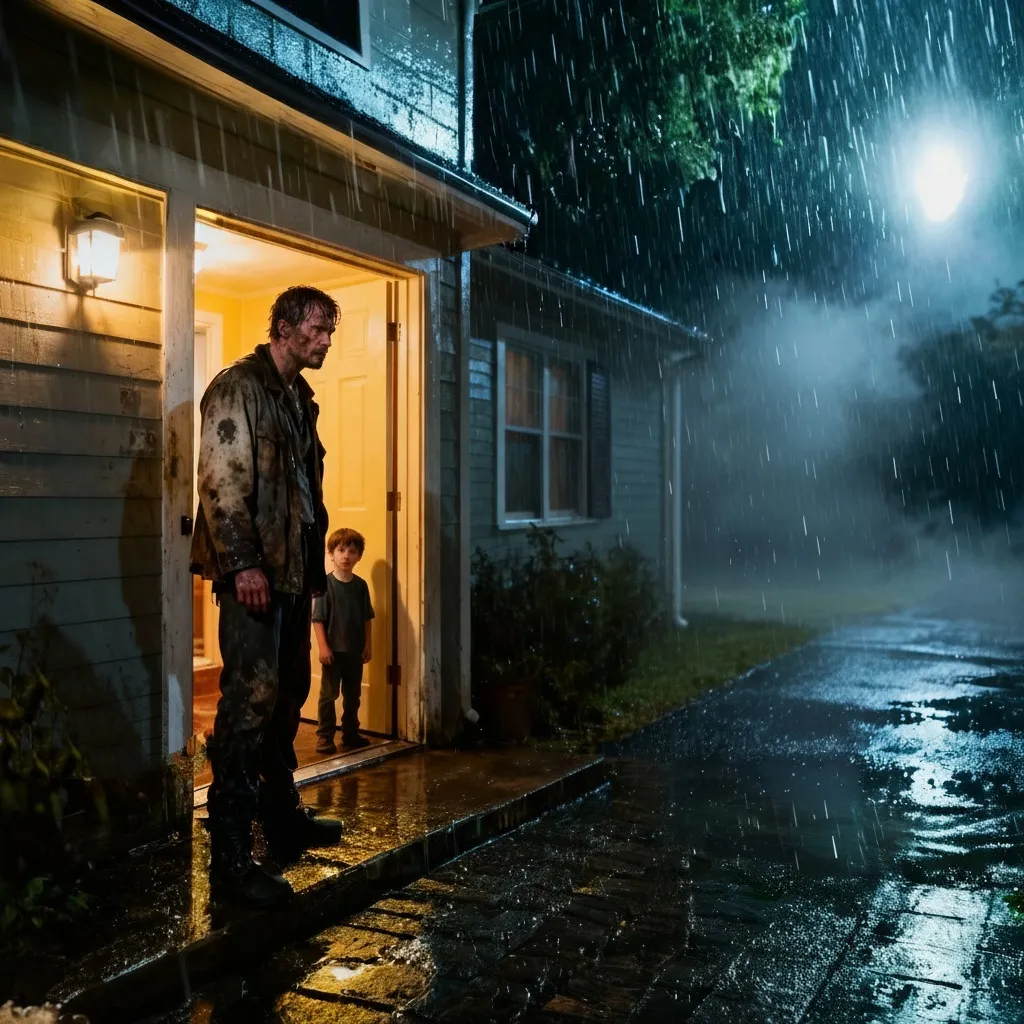

Taylor had mastered the art of invisible living, washing in gas station bathrooms, collecting recyclables for pennies, sleeping in abandoned buildings and under bridges. But winter was coming, and tonight, standing on that overpass, Taylor had reached a breaking point. A truck horn blared from the highway below.
Taylor flinched, stepping back from the railing. The sound had broken her dangerous reverie. She looked at Iris, the only thing tethering her to this world, and something hardened in her eyes.
Not today, she whispered to herself. Taylor pulled the thin jacket tighter around her shoulders and turned back to the shopping cart. The rain had finally stopped, leaving behind a bone-deep chill that promised frost by morning.
Carefully, she adjusted the plastic tarp covering her sleeping daughter. Nine-year-old Iris hardly stirred, exhaustion having claimed her hours ago. Time to move, sweetheart, Taylor said.
Iris blinked awake, her large brown eyes foggy with sleep. A real place? She asked. Sort of, Taylor answered, forcing brightness into her voice.
Remember that old factory I showed you last week? The abandoned Brennan textile mill stood like a forgotten monument on the city’s east side, which had been shuttered since 1987, its windows broken, its chain-link fence festooned with no trespassing signs. But Taylor had spent weeks scouting it, circling it like a cautious animal, marking a spot where the fence had been cut and inexpertly mended with twisted wire. It took them 40 minutes to push the cart across town, avoiding the well-lit areas where police might question them, sticking to shadows and service alleys.
Iris walked alongside, one hand on the cart, the other clutching her rabbit. Almost there, Taylor promised, as the hulking silhouette of the mill came into view. At the fence, Taylor untwisted the wire she’d marked weeks before, creating an opening just wide enough to slip through.
She helped Iris across first, then began transferring their meager possessions, a backpack containing clothes, a small bag of toiletries, three precious books, and a plastic bin with their kitchen supplies, a camping stove she’d found in a dumpster, mismatched utensils, and water bottles. What about the cart? Iris asked. We have to leave it, Taylor said, but we’ll find another when we need one.
Inside, the mill was cavernous, broken windows filtering moonlight onto rusted machinery that stood like mechanical skeletons. Iris pressed closer to her mother. It’s spooky, she whispered.
It’s just a building, Taylor reassured her. The sense of lives and livelihoods long vanished, and it’s dry. Come on, this way.
She led Iris toward the back of the mill, where she had discovered a former supervisor’s office during previous reconnaissance. Unlike the main floor, the office still had an intact door, a dusty desk, and a single dirty window. Most importantly, the roof above it hadn’t leaked, leaving the floor relatively dry.
Home sweet home, Taylor announced. Iris stood in the doorway. For how long? I don’t know, baby.
As long as we can. That night, they cleared decades of dust from one corner of the office, spreading their blankets on the floor. They ate a dinner of peanut butter on stale bread, washed down with water.
Morning brought gray light through the dirty window and new determination. After a breakfast of the last granola bar shared between them, Taylor began transforming their corner of the abandoned mill into something resembling a home. School first, she told Iris firmly.
Then, we clean. For three hours, Taylor homeschooled her daughter as best she could, reading simple math problems worked out with a pencil stub on the margins of an old newspaper. After lessons came the transformation of their space.
Taylor had salvaged rags from a dumpster behind a cleaning service, using rainwater collected in an old bucket. They scrubbed the floor until the original concrete emerged from layers of grime. Look, Mama, Iris exclaimed, pointing to a cleaner patch.
It’s actually kind of pretty, Taylor smiled. It is, isn’t it? They hung tarps salvaged from a construction site to divide the space into rooms, a sleeping area, a kitchen around the camp stove, and what Iris dubbed their living room, which consisted of two milk crates serving as chairs and a wooden spool as a table. On this makeshift table, Iris carefully arranged their few treasured possessions, the three books, her stuffed rabbit, and a framed photograph of Taylor in her orderly uniform, smiling confidently at the camera.
By evening, exhausted but satisfied, they sat on their milk crates, eating beans warmed on the camp stove. Outside, the mill’s broken windows framed a sky turning orange and pink with sunset. It’s not so bad here, Iris offered.
No, it’s not so bad. Mama, when do we get to go home? Like, a real home? Taylor pulled her daughter close. Baby, home isn’t a place.
It’s us. As long as we’re together, we’re home. Over the next three months, they established a routine.
Mornings were for lessons, using books borrowed from the library. Afternoons, Taylor would leave Iris, old enough now to stay alone for short periods, while she hustled for money. She collected cans for recycling, did odd jobs paid in cash, cleaning gutters for an elderly man, helping a small restaurant prep vegetables in the back alley, holding signs on street corners for going out of business sales.
Each day blended into the next. They became experts at invisibility. Part of the city’s backdrop, Taylor learned which dumpsters yielded edible discards, which cops looked the other way, which church served meals on Wednesdays.
She memorized the schedules of public bathrooms, the locations of outdoor spigots where water bottles could be refilled, the places where free Wi-Fi signals reached outside library walls so Iris could occasionally watch educational videos on Taylor’s ancient smartphone. Winter deepened around them. They plugged drafts in the mill office with newspaper and rags.
Taylor borrowed wooden pallets from behind businesses to keep their bedding off the cold floor. On the coldest nights, they burned candle stubs in a metal can for the illusion of warmth, if nothing else. Through it all, Taylor saved.
Pennies became dollars, hidden in an aspirin bottle tucked into her bra. By February, she had accumulated $87. It was on a particularly bitter Tuesday that Taylor encountered Old Luther, a fellow street resident who collected copper wire from abandoned buildings.
They crossed paths behind the Salvation Army, both hoping to be first in line when donations were sorted. Mourning Viv, Luther nodded, his gray beard stiff with ice crystals. Got your girl with you? At the mill, Taylor replied.
Any copper today? Nah, picked clean. But I heard something might interest you. They’re auctioning storage units over at Riverside this afternoon.
People don’t pay their rent, they lose their stuff. Sometimes good pickings, if you’ve got a few bucks. Taylor considered this.
She’d seen such auctions on TV, back when she had a TV. People bidding on abandoned units, sometimes finding treasures worth thousands. What time? She asked, her hand instinctively touching the aspirin bottle through her layers of clothing.
You can go there by noon, Luther told her, adding. Might be worth a look. Better than freezing out here all day.
At noon, Taylor collected Iris from the mill. We’re going on an adventure, she announced. What kind of adventure? Iris asked skeptically.
One that might help us, Taylor said. There’s an auction. Sometimes people find valuable things.
Like treasure? Real treasure? Maybe not pirate gold, but something we could sell. Something to help us get through winter. They caught a city bus using two of their precious dollars, riding to the edge of town where Riverside’s self-storage occupied a sprawling lot.
A small crowd had gathered, perhaps 20 people, mostly men with pickup trucks and vans, clearly professionals who did this regularly. Taylor and Iris stood apart. A bored-looking auctioneer worked his way methodically down a row of units.
The bidding was fast, competitive. Units went for hundreds of dollars, far beyond Taylor’s means. She began to think they’d wasted bus fare….