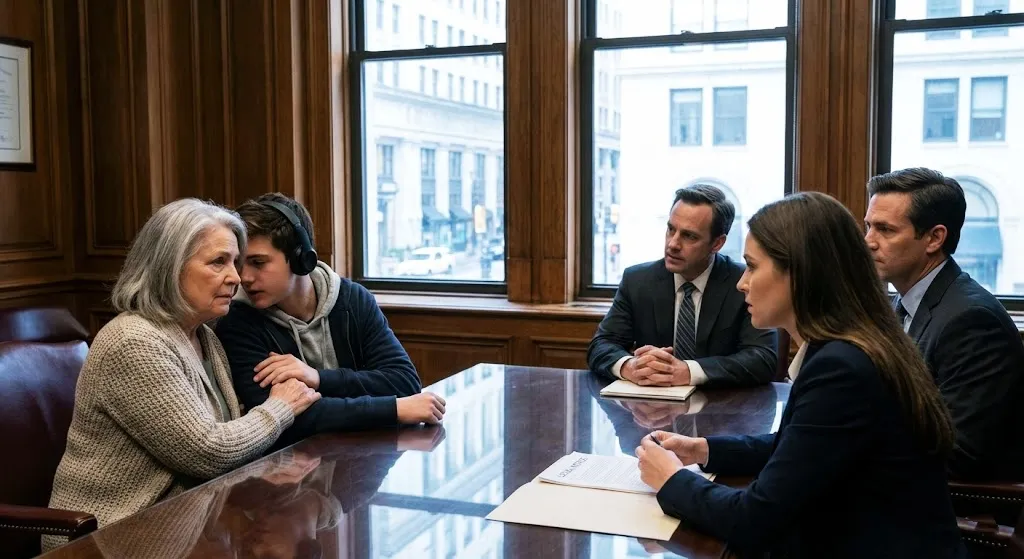

Evelyn was seventy-two years old when her world shrank down to the singular, hollow sound of a door clicking shut. Her own son, Jason, had kicked her out, and the justification for this cruelty was as simple as it was devastating: she had lost her job. There was no screaming, no dramatic shattering of glass, and no flood of tears. It was just that quiet, final click. The door didn’t need to slam to hurt; sometimes, silence breaks a heart far more effectively than any shout ever could.
She stepped out onto the porch, clutching the handle of a worn-out suitcase with a grip so white-knuckled you would think she was holding her entire existence inside it. In a way, she was. Jason stood in the doorway, his arms crossed defensively over his chest, steadfastly avoiding her gaze. Behind him, leaning against the doorframe, stood his wife, Melissa. She wore that specific, half-concealed smile people wear when they have finally maneuvered the world into giving them exactly what they want.
“You can’t stay here anymore, Mom,” Jason said, his voice flattened of all emotion. “We have the kids’ bills to worry about. We just can’t carry the weight of you too. I’m sorry.” No one stepped forward to hug her. No one asked if she had a place to go or if she would be okay. This was the same woman who had once skipped her own meals to afford Jason’s first college textbook, yet now, she was viewed simply as a liability—a burden with no paycheck attached.
So, Evelyn walked. She took it one agonizing step at a time, dragging the suitcase behind her. The wheels scraped against the sidewalk with a rhythmic, gritty sound, as if whispering, you’re on your own now. But what Jason didn’t know—what absolutely nobody knew—was that inside her scuffed leather purse sat a debit card linked to a hidden bank account containing exactly 1.4 million dollars. Evelyn didn’t cry.
She didn’t shed a tear when she stepped off the porch, nor when her legs began to throb with a dull ache halfway down Maple Street. She remained dry-eyed even when she finally collapsed onto the cold wooden bench at the bus stop, just three blocks away from the home that used to be hers. She simply sat there, her back hunched and her hands folded tightly over her purse, watching the world rush by as if it had already erased her from its memory.
What Jason had failed to understand was that Evelyn hadn’t been fired at all. She had resigned. Her back had finally given out, and her doctor had issued a stern warning: continue lifting heavy boxes, and you risk permanent spinal damage. After years of dedicated service at the church thrift store, she had quietly stepped away. The pastor had begged her to stay, but she had smiled gently, telling him she needed rest. And she did.
She needed to rest from a lifetime of pure survival mode. She had raised Jason entirely on her own after his father died in a construction accident. She had cleaned motel rooms, scrubbed hospital floors on her hands and knees, and refused new shoes for herself so her son could have what he needed for school. She had done it all with pride and an abundance of love. But she realized now that the hardest part of motherhood wasn’t the sacrifice itself. It was the deafening silence that followed, when the very people you gave everything to stopped seeing you as a person.
Evelyn had known hunger intimately. She had known bone-deep loneliness. She knew exactly what it meant to count copper coins on a kitchen table in the dark, pretending that the flickering light bulb overhead was a choice rather than a necessity. But she had never known this. She had never known rejection from her own flesh and blood.
Yet, sitting on that bench, she found she couldn’t hate him. She simply couldn’t. Instead, she reached into her purse and pulled out a folded, creased piece of paper. It was an old deed, yellowed with age and officially stamped. Thirty-four years ago, after her husband passed, the insurance company had sent a modest payout. But tucked into the back of that envelope was something everyone else had overlooked.
It was a land deed for forty acres in a remote, forgotten corner of the state, left by an uncle they barely remembered. Back then, everyone told her it was worthless. There was no water access, no roads, and no power lines. “Sell it for a couple of thousand and be done with it,” they had advised. But Evelyn hadn’t listened. Every year, she scraped together just enough to pay the property taxes. Even when she had nothing else, she held on to that land.
“Just in case,” she would whisper to herself. Then, last fall, a man in a sharp suit had appeared at the church. He represented a major development company that was building a massive solar energy facility, and they needed that specific stretch of land to complete their grid. He made an offer. Evelyn didn’t blink. She asked only one question: “Can this remain private?”
Three weeks later, the money—$1.4 million—was quietly transferred into a trust managed by a non-profit established in her late husband’s name. To the outside world, she remained just Miss Evelyn with her sensible shoes, her secondhand coat, and the little apron she wore while serving coffee at Sunday brunch. But now, she had options.
That night, Evelyn didn’t check into a luxury hotel. Instead, she made her way to a women’s shelter. It wasn’t out of necessity, but out of a desire to be among people who wouldn’t judge her or ask what she possessed. She wanted to sit beside those who had once been invisible, just as she was. She shared the meager food she had packed in her bag. She listened to their stories, laughing softly when someone cracked a joke to break the tension.
She held the hand of a weeping woman who was heartbroken over a daughter who wouldn’t return her calls. For the first time in a very long time, Evelyn felt truly seen. The next morning, she visited a run-down cottage on the edge of town. It was in a sorry state, with cracked windows, peeling paint, and wild weeds choking the porch railings. She paid for it in cash.
Three weeks later, operating under the business name Grace Holdings LLC, the property was transformed. It boasted fresh paint, a completely repaired roof, solar panels, and a vibrant new garden. But no one knew it belonged to her. That was exactly how she wanted it. She didn’t want revenge, and she didn’t want the neighbors gossiping.
Most importantly, she didn’t want Jason or Melissa coming back to her simply because they smelled money. What Evelyn wanted was to build something that would never discard a human being. So, she got to work. She began volunteering at food pantries, shelters, and youth centers. She would quietly ask the administrators what they needed, and then secretly fund the repairs or donate supplies under names that couldn’t be traced back to her.
When the time was right, she bought a building. It was an old community hall that had been boarded up and abandoned for years. She christened it “Evelyn’s Table.” It wasn’t fancy, but it radiated warmth—real, tangible warmth. There was always hot soup, clean cots, and soft music playing in the background.
It became a sanctuary for people who had nowhere else to turn. People like her. People who had been forgotten not because they were unworthy, but because they had run out of things to offer the world. Evelyn offered them a place anyway. She did it because she remembered what it felt like to be discarded. And perhaps, somewhere deep down, she still hoped her son would remember who he was, too.
Two years passed. The seasons turned quietly, and the world moved on. Evelyn didn’t just survive; she bloomed in the silence she had created. Evelyn’s Table had become more than just a building; it was a rhythm, a heartbeat for the neighborhood. Soup simmered on the stove every single morning. Children played in the back garden under sunflowers that grew taller than their heads.
Every Friday night, golden light glowed through the windows as people gathered for community dinners. No questions were asked, and no paperwork was needed. But elsewhere, life had not been nearly so kind. Jason had lost the house. At first, it was small things—missed payments, rising utility bills. Then came the notices. Then, the locks were changed.
Melissa didn’t stick around for the struggle. She left and took the kids, telling Jason she needed stability. Jason tried to stay afloat; he took side gigs, worked grueling warehouse shifts, and even sold his cherished old guitar. But nothing stuck. Eventually, he ended up sleeping on a cot in a friend’s basement, sharing instant ramen with the roaches and wondering where everything had gone so terribly wrong.
One rainy afternoon, he wandered into the public library just to stay dry. While shaking off the rain, he noticed a flyer near the front desk. It was printed on thick, cream-colored paper with elegant script and a small wooden logo that looked oddly familiar. It read: Evelyn’s Table. Meals. Shelter. Support. No one left behind.
He froze. His fingers trembled as he read the name again. Evelyn. It couldn’t be. But the sudden ache in his chest suggested otherwise. He stared at the address printed at the bottom. He knew that street. He had walked past it a hundred times without ever paying attention. The next morning, something pulled him there. Call it guilt, call it hope, or call it the last fragile thread he had left.
He walked across town in his worn-out shoes and found it: a small building, freshly painted and framed by wildflowers. He could hear children laughing inside. Steam curled invitingly from a kitchen vent. Above the front door, carved deeply into the wood, were the words: Evelyn’s Table. Everyone has a place. He stepped inside.
Warmth met him instantly—not just the heat of the room, but a sense of presence. The air smelled of fresh bread. There was the soft clatter of dishes and volunteers moving gently, as if they truly belonged there. And then, behind the reception desk, wearing a beige cardigan with her silver hair tucked neatly behind her ears, sat a woman he hadn’t really looked at in years. His mother.
She looked up. Her eyes widened slightly, but she didn’t flinch. Jason froze in the doorway. His throat burned, and words caught like gravel in his mouth. “I… I didn’t know where else to go,” he whispered, his voice barely audible. Evelyn stood slowly. She walked around the desk and stopped just in front of him.
Jason couldn’t meet her eyes. He was shaking uncontrollably. “I lost the house. Melissa’s gone. I… I have nothing.” Silence hung in the air for a heartbeat. Then Evelyn spoke, her voice soft and steady. “Come inside. You look cold.” She led him to a small table and set a mug of warm tea in front of him.
He looked around, still dazed by the reality of it. “This place… it’s yours?” he asked. She nodded. “I thought you had nothing,” he said, confusion clouding his face. “I had peace,” she replied simply. “And enough.” His voice cracked as the realization hit him. “Why didn’t you tell me that you had money? That you were okay?”
She looked at him gently, her expression devoid of malice. “Would it have changed anything?” He didn’t answer; he couldn’t. “I needed to know,” she continued, “who would stand by me when I had nothing to give. That’s how I knew who to build this for.” Jason hung his head. “I was awful to you,” he choked out. “You trusted me, and I threw you out.”
Evelyn reached across the table and took his rough hand in hers. “You forgot yourself,” she said. “That doesn’t mean you can’t find your way back.” And in that moment, Jason cried. Not loudly, not theatrically, but with a quiet, steady stream of tears that spoke of shame, gratitude, and the kind of forgiveness that feels like being born again.
Spring came slowly that year, bringing soft rain and new leaves. Along with the season, something like healing began to bloom in small, quiet ways. Jason started volunteering at Evelyn’s Table. He fixed broken chairs, sorted canned goods, and helped patch leaks in the roof. He didn’t ask to be paid. He just showed up, every single day, as if he were making up for all the days he had missed.
Evelyn didn’t say much about it. She didn’t have to. Every Friday evening, they sat together on the porch, watching the children play in the garden. There was no guilt, no punishment. Just presence. And peace.
One of those evenings, Evelyn handed him a sealed envelope. Jason looked at her, puzzled. He opened it to find the original deed to the house—the one she had once given him—framed together with the voided check from the land she had sold. He looked up, speechless. “You don’t owe me anything,” Evelyn said softly. “But now you know what happens when love comes before pride.”
Jason couldn’t answer. He didn’t need to. He finally saw her—not just as “Mom,” not as the person who stayed up when he was sick, but as a whole person. Someone who had been broken and still chose kindness.
Evelyn passed away peacefully in her sleep that fall. There were no headlines and no long speeches. Just a small, wooden service attended by more than a hundred people. They came from shelters, schools, and churches—people who knew exactly who she was. Jason stood at the front, holding her favorite apron.
He took a breath and spoke softly to the room. “My mother left a house once with nothing but a suitcase and a quiet heart. But in that silence, she built something bigger than any of us ever knew.” He turned toward the doorway. Above it, carved into the wooden arch, were the words Evelyn had written herself the day the shelter opened: The doors that close behind you can never match the ones you open for others.
And Jason—once angry, once lost—had become the man his mother always believed he could be. Not because she had money, but because she had chosen love over revenge, and forgiveness over pride.