“Medically speaking, this man is deceased,” he said quietly to the room. “There’s no pulse, no respiration, no pupillary response. All signs point to death.” But even as he said the words, the doctor sounded unsure. Something about the scene troubled him. He carefully tried to lift Andrew’s arm to check the degree of rigor mortis, but he stopped. The arm wasn’t as stiff as it should have been after so many hours. The muscles felt… relaxed. Almost alive. This contradicted everything he knew. “Strange,” he muttered to himself. “Very strange.” He checked the body’s temperature again, placing a hand on the deceased’s forehead. The skin was cool, but not the icy cold it should have been. The doctor frowned and pulled a thermometer from his bag for an accurate reading.
Meanwhile, Sophie’s mother, Sarah, sat in the corner, fighting a war of emotions. She was exhausted, not just from grief, but from a profound anxiety for her daughter. She wanted to snatch Sophie out of that casket, hold her, and run home, far away from this nightmare. But every time she tried to approach, something stopped her. Maybe it was an intuitive understanding of the moment’s importance, or maybe it was just fear of the unknown. The girl looked so peaceful in her father’s arms that disturbing it felt like a sacrilege. Her brother-in-law, Ryan, tried to gently lift Sophie, but for the first time all night, she showed a sign of resistance. Without opening her eyes or saying a word, she clung to her father more tightly and gave a slight shake of her head. The movement was tiny, but everyone saw it.
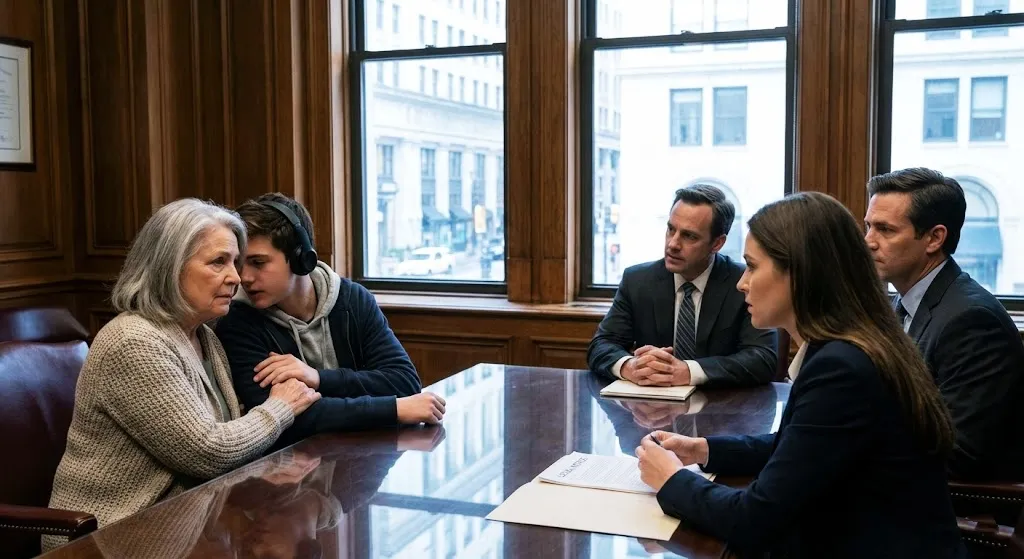
At that moment, Grandma Helen, who had been quiet for so long, decided to reveal what she had hidden for years. She walked over to the doctor and led him aside, away from prying ears. Her voice trembled. “Doctor, there’s something you need to know about my son,” she began softly. “Andrew has had a… condition, since he was young. We’ve hidden it from everyone. When he was about twenty, something very strange happened.” She paused, collecting herself. “We found him unconscious on his bedroom floor. He wasn’t breathing, he had no pulse, no response at all. We were sure he was gone. I was already preparing for the funeral when, six hours later, he opened his eyes and asked why we were all crying.”
The doctor listened intently, his medical mind racing. “We took him to the best specialists in the city,” the grandmother continued. “After batteries of tests, they gave us a diagnosis: catalepsy. They explained it’s an extremely rare condition where all vital functions slow down so much that the person appears to be dead.” “Catalepsy,” the doctor repeated thoughtfully. “Yes, I’ve read about it in medical journals, but I’ve never seen a case. It’s true, it can mimic death so precisely that even experienced physicians can be fooled.”
Grandma Helen nodded. “The doctors said it could happen again, triggered by extreme stress or trauma. Andrew never told anyone, not even Sarah. He was afraid people would treat him like he was sick. When we heard about the accident,” she confessed, “this was the first thing I thought of. But I was afraid to say anything. I was afraid you’d all think I was just a crazy old woman who couldn’t accept her son’s death.”
After hearing the story, the doctor returned to the casket, but now with a completely different perspective. He began a much more thorough examination, using all his knowledge. In a cataleptic state, the signs of life could be so faint they’d be missed by a routine check. He took a small mirror from his bag and held it to Andrew’s lips, checking for any sign of breath. At first, there was nothing. But after several moments, the faintest wisp of fog appeared on the glass. The doctor’s heart began to pound.
The tension in the room ratcheted up when a young neighbor, Alyssa, a college student, stepped forward with her smartphone. “I… I recorded the moment his hand moved,” she said. Until now, no one had paid her much attention. But now, all eyes turned to her, wide with curiosity. “I was filming for my vlog,” she admitted, blushing slightly. “I wanted to show… you know, how our town honors people. But when I watched the video back, I saw it.” She played the video, and everyone crowded around. The footage clearly showed Sophie carefully climbing into the casket. And in the exact instant she settled down, her father’s hand slowly, unmistakably, lifted and came to rest on her back. The movement was fluid and natural, not at all like an accidental shift. “Oh my God,” someone whispered in the back. “It’s true.” The video vaporized any remaining doubts. The proof was undeniable. The hand had moved on its own…