Dr. Matthews decided not to rush things. He asked everyone to step back and give him space for a detailed assessment. “If this is really catalepsy,” he explained, “we have to be extremely careful. Any sudden shock could be harmful.” He made no attempt to move Sophie. He understood that the little girl might be sensing her father’s state better than any medical instrument. Instead, he began checking for vitals using modern methods designed to catch the faintest signs of life. Using a portable pulse oximeter, he tried to get a reading on Andrew’s blood oxygen. For several minutes, the device showed nothing, but then it began to register very weak, irregular signals. It was something, like the heartbeat of a person in a deep coma. “I’ve got something,” the doctor reported quietly. “It’s very weak, but it’s there.” He then took out a newer, more sensitive stethoscope. Pressing it to different points on the man’s chest, he finally heard it: barely audible sounds, like very, very slow, deep breaths.
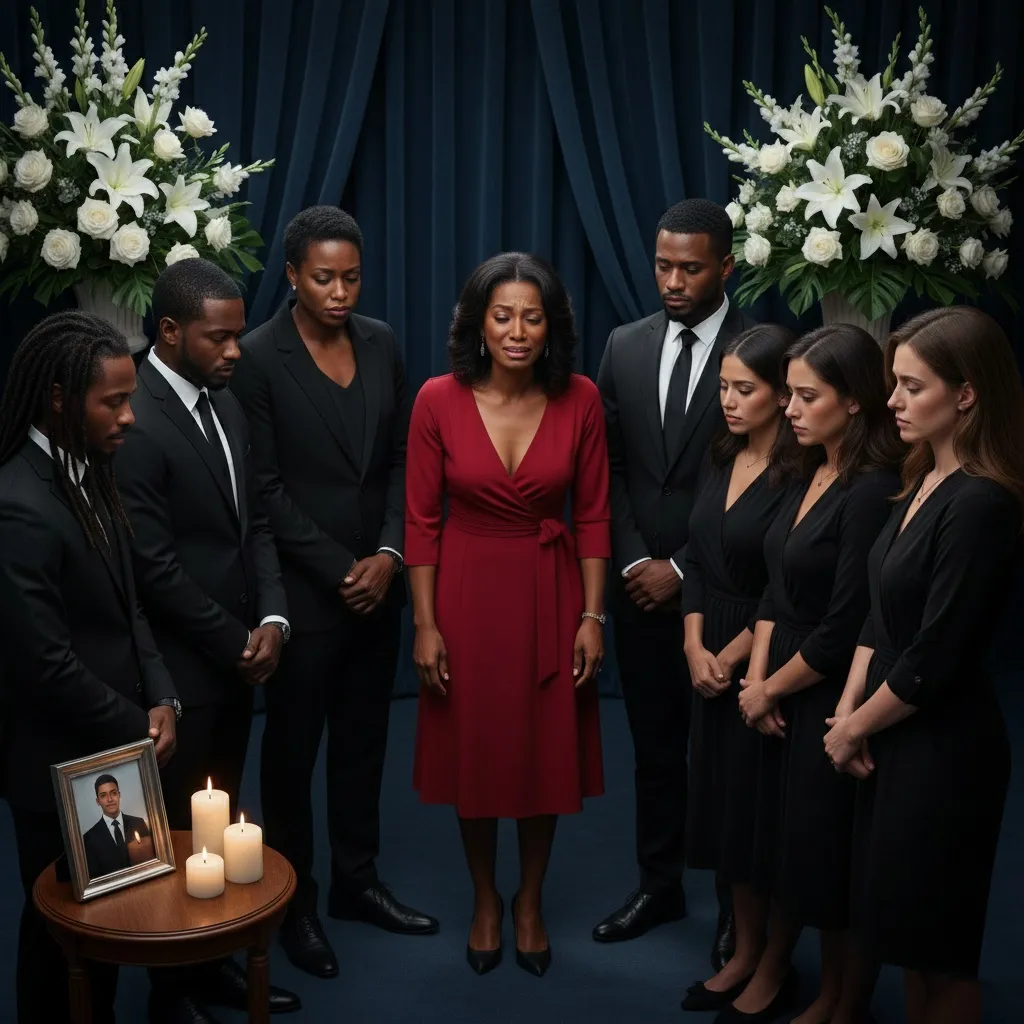
The doctor gave firm instructions not to close the casket or prepare for the funeral. “I need time to observe,” he explained. “If this is a cataleptic episode, his condition could change in the coming hours.” He set up his portable medical equipment next to the casket to track the slightest changes. The room fell into a tense silence again, but this time it was the silence of anticipation, not of grief. Sophie continued to lie in her father’s arms, and her very presence seemed to be stabilizing his condition. The doctor noticed that when someone got too close or spoke too loudly, the readings on his monitors would falter. But when everyone remained calm and quiet, the signals grew a tiny bit stronger and steadier. This observation made him wonder about the connection between this father and daughter, a connection that was perhaps beyond his scientific understanding. He was a man of science, but what he was seeing tonight was forcing him to reconsider his beliefs about life and death.
The night stretched on. None of the close family dared to leave. They dozed in chairs, brought each other coffee, and spoke in low whispers in the kitchen. The doctor never left his post, recording every tiny change. Around four in the morning, the first significant movement occurred. One of the monitors registered a more regular rhythm, something that looked like a slow but stable heartbeat. The doctor immediately double-checked with his stethoscope and confirmed it. “Something’s happening,” he said quietly to Grandma Helen. “The signals are stabilizing.” Helen just nodded, as if she had known it all along. Her mother’s heart had told her her son was still with them.
Sarah, who had been oscillating between hope and despair all night, now sat next to the casket, holding her mother-in-law’s hand. She no longer tried to get Sophie. She intuitively understood that her daughter’s presence was, in some unexplainable way, helping Andrew fight his way back.
At dawn, just as the first gray rays of sunlight pierced the windows, the event everyone had been waiting for—and dreading—happened. It started with a sound so quiet it was almost missed, a soft sigh that sounded as loud as a thunderclap in the silent room. Dr. Matthews was instantly alert, checking his readings. All the monitors registered a sudden improvement in vital signs. The heartbeat was more regular, the breathing deeper. Even his skin temperature was slowly beginning to rise. “He’s coming back,” the doctor whispered, unable to believe it himself. “He’s coming back.” Everyone in the room moved closer, holding their breath…