“They’re watching both of us.”
He studied it, then looked up. “So we give them something to watch.”
Two days later, Anna sat alone in a quiet room on the 29th floor. Her phone buzzed softly. A message from Marcia: Found something. Meet me in the east stairwell. Urgent.
Marcia was waiting, holding a manila folder. “I shouldn’t even have this,” she said.
Anna flipped it open. Inside were maintenance schedules, digital lock override logs, and private communications between Martin Caldwell and someone identified only as “D.W.”
Marcia leaned in. “D.W. is Douglas Whitley. He’s not just a board member. He owns 18% of the company.”
And then Anna saw it. A time-stamped message that read: The girl is a problem. Eliminate her access quietly.
Anna closed the folder. “Can you send this to Yukimura’s private line?”
“I already did.”
Anna headed straight to the executive elevator. Yukimura was standing at the window. “Whitley wants me discredited within the week. He’s scheduled an emergency board vote claiming I’ve breached fiduciary duty.”
Anna stepped closer. “We have proof he’s conspiring with Caldwell.”
“No,” Yukimura said. “Not for the board. These men don’t play by truth. They play by appearances.”
“Then we give them a different kind of truth,” Anna said steadily. “One they can’t spin.”
That night, Yukimura arranged a private meeting with Mr. Hashimoto. Anna presented the folder, translating the content with precise, clear language. When she reached the email where her name was mentioned, her voice didn’t waver.
Hashimoto read in silence. “In our culture,” he said softly, “honor is not negotiable. You must bring this to the full Investors’ Council.” He turned to Yukimura. “If Whitley is trying to fracture your empire, you must show them what loyalty looks like.”
Yukimura bowed. “Then I will ask Anna to present it.”
The following morning, Anna stood before the International Investors’ Council. The room was quiet as she began. She walked them through the breach, the evidence, the attempted cover-up. And then, she read aloud the email.
“The girl is a problem. Eliminate her access quietly.”
A hush swept over the room. Anna turned off the projector and walked to the center of the floor.
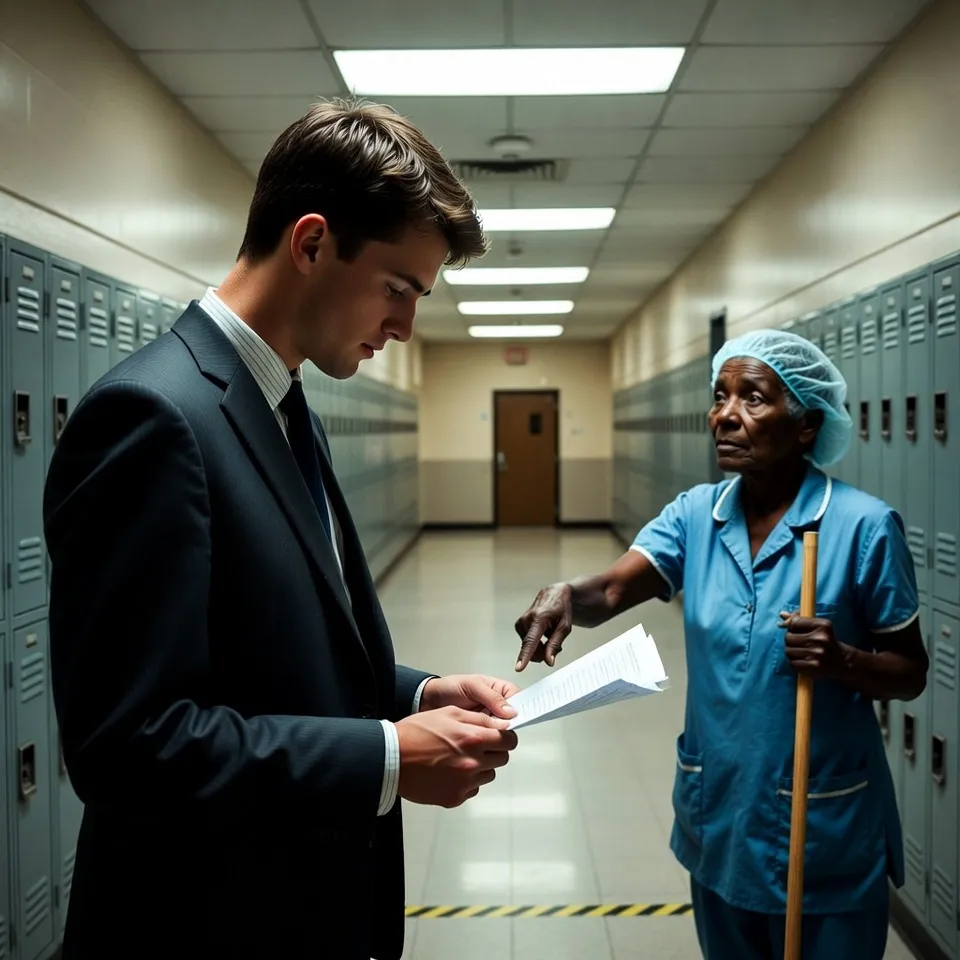
“I was that girl. I cleaned the hallways where these men once walked past me like I was invisible. I wiped their prints from their glasses. I changed their linens. And still, I listened. I learned. I never asked to be here. But now that I am, I will not let this company fall into the hands of men who think betrayal is a strategy.”
Hashimoto stood slowly. “Yukimura,” he said in Japanese. “Do you trust this woman?”
Yukimura answered in the same language. “With my life.”
One by one, the council members nodded. An emergency vote was held. Douglas Whitley was suspended indefinitely. Martin Caldwell resigned within twenty-four hours.
Later that day, Yukimura found Anna in the garden courtyard. He extended a small box to her. Inside was a new employee badge. Her title? Chief of Strategic Integrity.
Anna smiled—not because she had won, but because for the first time, no one could take her voice away.
The silence after the storm should have been comforting, but it wasn’t. Downstairs in the private lounge, Yukimura was meeting with Mr. Gerard Abrams, a high-ranking federal commerce advisor. Anna had been invited to attend.
“You’re the girl who turned this company inside out,” Abrams said, extending a hand.
“I’m the woman who put it back together,” Anna replied.
Yukimura spoke up. “Anna uncovered evidence suggesting the breach wasn’t just internal. There’s a link to a competitor—Riveron Technologies.”
Abrams’ face darkened. “That would explain the noise we’ve been hearing in D.C.”
Anna laid out the transaction trails. “It’s corporate espionage,” she said bluntly. “And it nearly destroyed Yukimura Global from the inside.”
“We either bury it, or go public,” Abrams said, pacing. “Going public will shake markets. But if we don’t, this will happen again. Are you ready for the attention this will bring you?”
“I already am,” she said.
That night, Anna sat at the hotel rooftop terrace. Her phone buzzed. A private message: Walk away. Final warning. She deleted it.
Moments later, Yukimura joined her, carrying a file. “I had this delivered to my suite anonymously. You should see it.”
Inside were surveillance photos—not of her, but of her younger brother, Marcus. Walking out of his high school. Riding the subway.
“They’re trying to rattle you,” Yukimura said.
“No,” she whispered. “It’s a threat.” She stood up. “They made a mistake. They think fear will shut me down. But I didn’t come this far for myself. I came this far so the next girl who mops your floor doesn’t have to bleed to be seen.”
The next day, a press conference was scheduled at the company headquarters in Chicago. The boardroom was transformed into a media center. When Anna arrived, she was dressed not in a suit, but in a modest blouse and slacks—the uniform of someone who worked her way up.
She approached the podium. “When I first came to this company, I wasn’t given a badge. I was given a mop. And every day, I walked past closed doors. But I listened. Last week, our company uncovered a betrayal not just of a CEO, but of trust. So today, we choose to go broke before we sell our integrity.”
The applause was quiet at first. Then it grew.
That evening, Anna walked out of the building. A woman in her fifties stepped forward and took Anna’s hand. “My granddaughter watches you on the news. She thinks you’re magic.”
Anna smiled. “No,” she said gently. “I’m just finally visible.”
The wind picked up the next morning outside the federal courthouse. The Justice Department had officially filed criminal charges against Raymond Whitley and Riveron Technologies. Anna’s phone vibrated. A text from Marcus: Watching you on the live stream. Grandma says you’re like Harriet Tubman in heels.
She smiled, blinking back emotion.
Inside the courtroom, Anna took the witness stand. She spoke clearly, steadily. She laid out the paper trail, the secret accounts, the corporate sabotage.
“My name is Anna Foster,” she said, glancing at the jury. “I started as a maid. I cleaned the marble floors of boardrooms where men like Mr. Whitley made decisions that affected thousands of lives. I was never meant to speak in those rooms. But I listened. And I remembered.”
By the time the judge called recess, the courtroom no longer buzzed. It vibrated.
That evening, Yukimura invited Anna for a private dinner. He handed her a sealed envelope. “An offer,” he said. “To join the global board. As a leader.”
Anna opened the envelope. Senior Executive Director of Integrity and Cultural Intelligence.
“Thank you,” she said finally. “But I’ll only accept if you also fund an independent foundation to train and empower voices like mine. People from the kitchens, the mailrooms, the janitor closets.”
He leaned back and smiled. “Already in motion. We’ve named it the Foster Initiative.”
The following month, the courtroom verdict was read aloud: Guilty on all counts. Whitley was stripped of power. Riveron Technologies plummeted in value. And on the steps outside, dozens of former employees held a banner that read: Truth Has No Rank.
Anna didn’t attend the celebration. Instead, she stood in the parking lot of her old high school, speaking to a group of graduating seniors.
“You won’t always be invited into the rooms where decisions are made,” she began. “But that doesn’t mean you don’t belong. Never forget this: Silence is not weakness. It is space. And in that space, you get to choose whether to fill it with fear or with truth.”
The students stood in applause. Outside, under the old oak tree, Lucille—her childhood housekeeper—stood waiting with a smile. “You did it, baby,” she said. “You showed them all.”
Anna leaned into the hug. “I didn’t show them,” she whispered. “I reminded them.”
The story reminds us that true power doesn’t come from titles or wealth. It comes from courage, integrity, and the refusal to stay silent in the face of injustice. Anna’s journey shows that even the most unheard voices can bring down empires when they speak with truth. It is a tribute to those who rise from the margins, not for revenge, but to restore dignity and reshape the future.