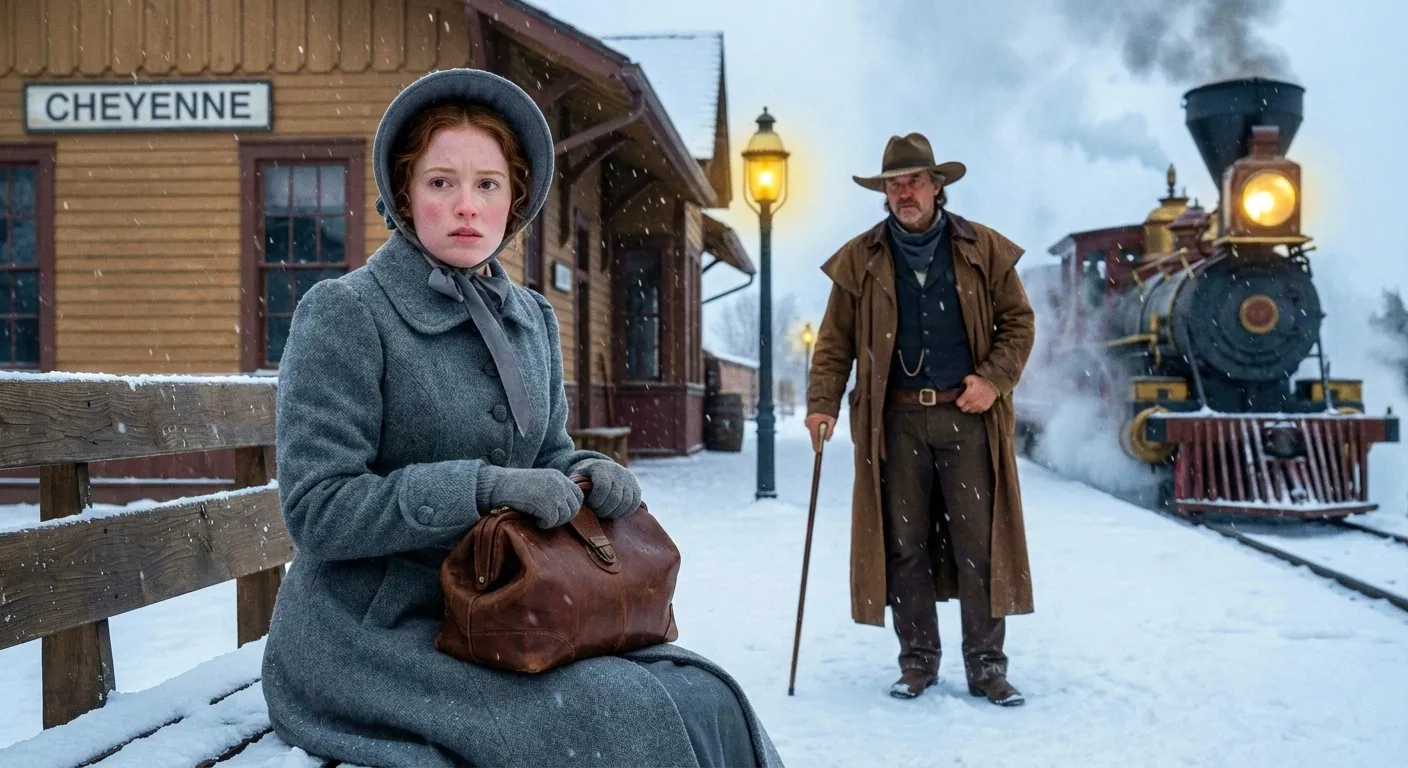
The factory town was a far cry from the elegant, tree-lined streets of Sarah’s childhood. The air here was thick with industrial smoke, the streets lined with soot-covered buildings, the people weary from long hours of hard labor. But here, they were just another couple struggling to get by. No one looked twice at a white woman standing beside a man. It wasn’t acceptance, exactly. It was indifference. And indifference was enough.
They found a place to stay in a cramped boarding house where the walls were thin and privacy was non-existent. Their room was barely big enough for the narrow bed they shared, but it was theirs. Oliver took a job at the local steel mill, working twelve-hour shifts in unbearable heat. Sarah found work as a seamstress, her fingers quickly becoming blistered from long hours of stitching. It was hard, grueling work, and nothing like the life she had known. But she never complained, because for the first time, she had chosen this life.
The marriage took place in a tiny church on the outskirts of town. There were no guests, no flowers, no music, just the two of them and a preacher who barely looked at them as he muttered the vows. There was no ring, no celebration, just a quiet exchange of promises, spoken not for the world, but for each other. When the ceremony ended, Sarah stood outside the church, staring up at the gray sky, feeling the weight of the moment settle in her chest. She was no longer Sarah Whitmore, daughter of privilege. She was Sarah Bryant, wife of a man in a world that would never fully accept them.
And yet, she felt lighter than she ever had before. The first year of marriage was a test of endurance. The factory town was safer than the South, but that did not mean it was kind. Oliver’s co-workers kept their distance, uncertain what to make of the man who had arrived with a white wife. The women in the town looked at Sarah with wary eyes, unsure if she was lost, confused, or simply foolish. They were tolerated, but never welcomed.
Money was always tight. Some nights they went to bed hungry, the ache in their stomachs a familiar companion. Sarah learned how to mend clothes until they were more stitch than fabric. Oliver learned how to stretch every dollar, bargaining for scraps at the market, working overtime until his body screamed in pain. But they endured, because love had carried them this far. And yet, love did not erase fear.
Sarah’s father had not forgotten her. Letters arrived at the boarding house, each one colder and more terrifying than the last. The first was a command: “Come home. Now.” The second was a warning: “You don’t understand what you’ve done.” The third was a direct threat: “You will regret this.”
Sarah burned them all in the stove, watching the paper turn to ash, but the fear lingered. Her father was not a man who accepted defeat. One day he would find her, and she did not know what he would do when he did. That fear crept into her dreams. It whispered in the back of her mind when she walked through the market, when she saw men in suits glancing at her too long, when she heard footsteps behind her at night.
And so, without telling Oliver, she began to save money. At first, it was just a few coins tucked beneath the mattress, then a few bills hidden in the hem of her dress. She told herself it was nothing, just a precaution, a habit born from fear, not from doubt. But deep down she knew the truth. She had chosen Oliver, but part of her still feared that one day she would have to leave him behind to survive.
The years passed, and life in the factory town settled into a pattern. It was never easy, never truly comfortable, but it was theirs. Oliver worked himself to the bone, coming home each night with aching muscles and soot-stained hands. Sarah stitched clothes until her fingers bled, her once delicate hands now rough with calluses. They built a life together, piece by fragile piece.
And then the first child came. Sarah had never been more terrified. She had expected joy, had imagined the moment she would place her newborn in Oliver’s arms and feel the warmth of their family growing. But when she saw the tiny boy wrapped in blankets, she felt something else entirely. Guilt. Because as she looked at her son, she couldn’t stop thinking about the child she had abandoned.
She had been seventeen, a different girl in a different life. Her family had kept the pregnancy a secret, hiding her behind closed doors, telling friends and relatives that she had taken ill, that she needed rest. She had never been given a choice. When the baby was born—a boy just like this one—she had barely been allowed to hold him before he was taken away. Her father had arranged for everything. A quiet adoption, a discreet payment to ensure there would be no records, no connection to the Whitmore name.
Sarah had cried for weeks, but in time she had learned to silence the ache. She had told herself that it was for the best, that the child would have a better life without her, without the burden of scandal. And then she had met Oliver, and she had buried that past beneath a new life, a new love. But now, holding her newborn son in her arms, the past clawed its way back.
She had another child out there, a son who had been lost before he even had a chance to know her. She never told Oliver. She couldn’t. The weight of that secret settled into her bones, a quiet, gnawing guilt that never fully left her. Their son, Isaac, grew fast, his skin a rich blend of his parents’ colors, his eyes sharp like his father’s, his smile soft like his mother’s.
He was the first thing they had ever truly built together, a living testament to their love. And yet, Sarah couldn’t shake the feeling that something was missing. She dreamed of the child she had given away. She wondered if he looked like Isaac, if he had her nose, if he had Oliver’s steady gaze. She wondered if he ever thought of the mother he had never known. She never spoke of it. Instead, she buried it deeper, and she devoted herself to Isaac, to Oliver, to their life.
But the past had a way of creeping back, even when you tried to outrun it. Years passed, and another child came, Margaret. She was wild from the start, loud and unafraid, her laughter filling the tiny rooms of their boarding house. She had none of her mother’s softness, none of her father’s quiet reserve. She was a force unto herself, a storm in a little girl’s body…