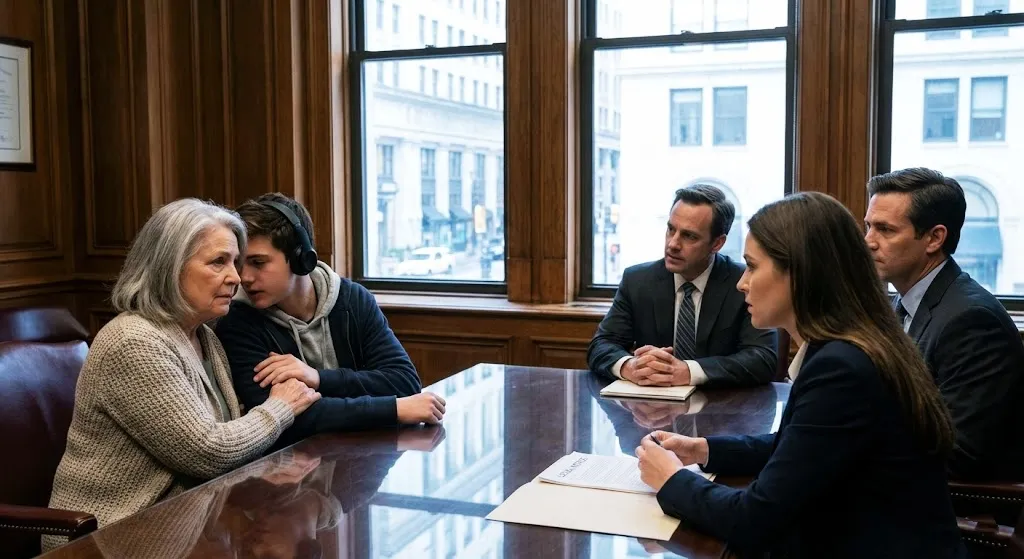
When I arrived home, I found an older woman sitting on the steps of my front porch. “Mrs. Richter?” she asked as I approached. “I’m Eleanor Brooks. I live next door. We’ve been neighbors for years, but our paths never seem to cross. I… I heard some raised voices here yesterday, and I just wanted to make sure everything was alright.”
Her sincere concern touched a place in my heart that had been numb for a long time. Here was a virtual stranger showing more genuine care for my well-being than my own son. “Come in, Eleanor,” I said. “I’ll make a pot of coffee, and I’ll tell you a story you might find hard to believe.”
As we sat in my kitchen, I told her everything. The three years of financial support, the secret wedding, the “special people” comment, the visit with the lawyer, my decision to cut them off. Eleanor listened without interrupting, her kind eyes never leaving my face. When I finished, her eyes were glistening with tears.
“Mrs. Richter,” she said, reaching across the table to pat my hand, “you did the right thing. I went through something very similar with my own daughter about five years ago. I, too, thought it was my duty to finance her life as an adult. I, too, believed she wouldn’t love me if I didn’t give her money.”
“What happened?” I asked, hungry for her experience.
“I cut off the money when I realized the only time she called was when she needed something,” she said. “It was terrible at first. There were threats, emotional blackmail, attempts to make me feel like the worst mother in the world. But after about six months, she called me with a genuine apology. Now, we have a real relationship. It’s based on love, not on money.”
Her story gave me a fragile, precious thread of hope. “Do you think… do you think Max and Lena will ever understand?”
“Maybe,” she said with honest compassion. “And maybe not. But that is no longer your responsibility, my dear. Your responsibility now is to live your own life.”
That night, for the first time in three years, I went to bed without a single worry about whether Max and Lena had enough money for rent or food. I went to bed thinking about my own plans, my own future, and I slept a deep, untroubled sleep.
The next morning, at eight sharp, Ethan and Mr. Sommer arrived to change my locks and install the security system. As they worked, my phone buzzed repeatedly from various unknown numbers. Lena was still trying to reach me, but I was developing a new, vital skill: the art of completely ignoring what did not serve me.
“Mrs. Richter,” Ethan said as he mounted a camera near the front door, “this system will give you complete peace of mind. You can see who’s at your door from your smartphone, even when you’re not home. And if anyone tries to enter without permission, it sends an automatic alert directly to the police.”
The irony was not lost on me. I was installing a security system to protect myself from my own son. But the pain of that thought was now secondary to the practical need for safety and peace.
While they worked, I decided to call my sister, Diana, in Chicago. We had drifted apart because every conversation had become a report on how much money I was spending on Max and Lena, as if their financial success was my greatest achievement.
“Renate!” Diana answered, her voice filled with surprise. “It’s been months! How are you?”
“I’m good, Diana. Better than good, actually,” I said. “I’m calling to tell you that I’ve finally come to my senses.”
I told her the whole story, from the wedding announcement to the lawyer’s visit to my decision to cut them off. Diana listened in silence, and when I was finished, her response stunned me.
“Renate, sister,” she said with a heavy sigh, “it was about time. Do you have any idea how it broke my heart to listen to you talk about all the money you gave them? It was as if you were trying to measure your love in dollars. I wanted to say something for years, but I never knew how.”
“What did you want to tell me?” I asked, my heart aching.
“That Max never spoke about you with love,” she said gently. “At family gatherings, it was always, ‘My mom helped me with this,’ or ‘My mom bought me that.’ It was never, ‘I miss my mom,’ or ‘I love talking to my mom.’ It was as if you were a service he subscribed to, not a person he loved.”
Her words were painful, but it was the good kind of pain, the kind that cleanses an infected wound. “And there’s something else,” she continued. “Lena always talked about you in the future tense. ‘When Renate is no longer here, we can remodel her house,’ or ‘When we get the inheritance, we’ll invest in a business.’ It was as if they were just waiting for you to die so they could really start living.”
This revelation felt like a bucket of ice water dumped over my head. They didn’t just see me as a bank; they saw me as a temporary obstacle standing between them and their windfall. While I was killing myself to make them happy in the present, they were patiently planning for a future that didn’t include me.
After the call with Diana, I sat at my kitchen table, processing this new, devastating information. My entire identity as a mother had been built on a lie. The doorbell rang, and I checked the new camera monitor. It was Eleanor, holding two steaming mugs. I opened the door.
“I thought you might appreciate some company after everything you shared yesterday,” she said with a warm smile. “And I brought coffee.”
We sat in my living room, and Eleanor shared more of her own story. “My daughter used the exact same lines on me that Lena uses on you. ‘You’re like a second mom to me.’ ‘We’re special to you.’ ‘It’s all going to be ours one day anyway.’ They’re rehearsed phrases, my dear. It’s like they all read from the same handbook on emotional manipulation.”
“Do you think such a handbook actually exists?” I asked, only half-joking.
“Not officially,” she chuckled. “But it might as well. Chapter One: Make Her Feel Indispensable. Chapter Two: Create Constant Financial Emergencies. Chapter Three: When She Resists, Question Her Mental Health.”
We shared a bitter laugh. It was both tragic and liberating to see our experiences as part of a predictable, ugly pattern. “Did you ever feel guilty,” I asked her, “for cutting off the money?”
“Every single day for the first three months,” she admitted honestly. “But then I started to see the results. My daughter had to get a second job. Her husband had to stop his lazy habits and find extra work. They learned to live within their means. And, more importantly, they learned that I was a person, not a resource.”…