
My daughter abandoned her five-year-old autistic son at my front door and never looked back. That was eleven years ago, in the autumn of 2010. I raised Ethan on my own, navigating a world that wasn’t built for him. People—neighbors, former colleagues, even family members—whispered that he would never succeed. They called his silence a deficit; they called his rigid need for order a disability. They were wrong. By the time he turned sixteen, he had architected a piece of software valued at 3.2 million dollars.
Two weeks after the local news broke the story of his success, my doorbell rang.
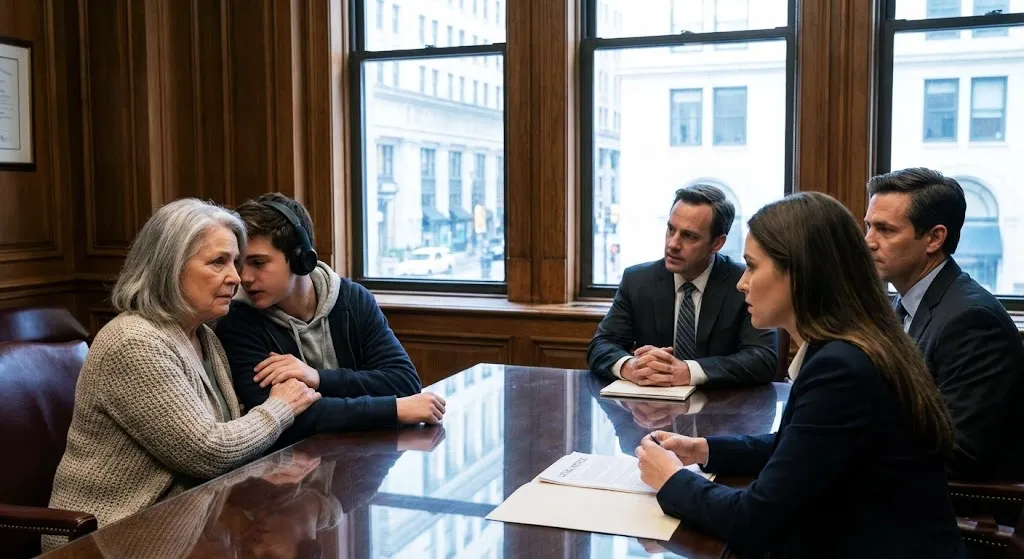
It was Rachel. She stood on the porch, flanked by a sharp-suited man with a leather briefcase and holding a thick, pristine folder of documents. She looked me in the eye and claimed she had been co-parenting from the shadows the entire time. She had custody papers, financial ledgers, and visitation logs. They were all lies—every single page. But they looked terrifyingly official. Our lawyer, a cautious man named James Nakamura, reviewed them and gave us the news that nearly stopped my heart: without concrete forensic proof that these papers were forged, the court would likely default to the biological mother.
My chest tightened with a panic so visceral I almost collapsed. I looked at Ethan, expecting him to retreat, to cover his ears and hum to block out the threat. Instead, he leaned over and whispered three words that changed everything: “Let her talk.”
I stared at him. We were facing the loss of his autonomy, his fortune, and our life together, and he wanted to let her spin more lies? But he sat there with a stillness I hadn’t seen before. He was watching her, his eyes tracking her movements. I didn’t realize then that he wasn’t just listening; he was gathering data.
My name is Vivian. I am 68 years old, and this is the story of how we fought back.
The Arrival: November 2010
It began on a grey Friday in November 2010. The wind was stripping the last of the oak leaves from the trees when Rachel’s car pulled into my driveway. She didn’t turn off the engine. She walked Ethan to the door, carrying a single, deflated backpack that looked like it contained nothing more than a change of clothes.
“Just for the weekend, Mom,” she said, shifting her weight from foot to foot, her eyes darting toward the street. “I need a break. Please. Just two days.”
Ethan stood beside her, a small five-year-old figure in a jacket that was slightly too thin for the weather. His gaze was locked on the wood grain of the porch floor. He rocked rhythmically, heel to toe, heel to toe, his hands pressed tight against his ears to block out the ambient noise of the wind and the idling car.
“Rachel, wait. You look… are you okay? I need to know…”
“I’ll call you Sunday,” she cut me off, already turning away. She walked fast toward her car, her shoulders hunched. She didn’t hug him. She didn’t kneel down to say goodbye. She just got in, slammed the door, and drove away.
I had been a teacher for thirty-five years. I had managed classrooms of thirty children; I thought I understood the resilience and fragility of youth. But standing there with my grandson as the taillights faded, I realized I was a stranger to his world.
“Hey Ethan,” I said softly, crouching down to his level. “It’s getting cold. Want to come in?”
He didn’t react. He didn’t blink. He just kept rocking. I reached out to touch his shoulder, and he flinched so violently he nearly lost his balance. I pulled my hand back, stinging with rejection. I picked up his backpack—it was heartbreakingly light—and opened the door. After a long, agonizing minute, he walked past me into the house, finding the farthest corner of the living room where he crouched down, making himself as small as possible.
The Adjustment: 2011–2013
The first night was a lesson in helplessness. I made chicken nuggets, the universal food of children; he wouldn’t touch them. I tried pasta with butter; he pushed the bowl away without looking at it.
“What do you want to eat?” I asked, desperation creeping into my voice as the clock ticked past 8:00 PM.
He hummed, a low vibration in his throat, staring at the beige wall. Finally, purely by chance, I offered him plain saltine crackers. He ate exactly three. Not two, not four. Three.
Bedtime was worse. When I tried to help him brush his teeth, he screamed—a sound of pure, unadulterated terror, as if the bristles were sandpaper flaying his skin. I backed off immediately, my heart hammering against my ribs. He didn’t sleep that night. Through the thin wall of the guest room, I heard him humming until dawn, a self-soothing mantra against a terrifying new reality.
The “weekend” passed. Then a week. Then two. I called Rachel’s phone until it went to voicemail, then until the mailbox was full, and finally, until the number was disconnected.
I took Ethan to a specialist in the city. The waiting room was filled with noisy toys, and Ethan spent the entire hour with his hands over his ears, eyes shut tight.
“He is on the spectrum, Mrs. Cooper,” the doctor said gently, reviewing the observation notes. “Severe sensory processing disorder. He needs structure, not just supervision. His brain doesn’t filter information like ours does; it absorbs everything, all at once. It’s overwhelming.”
“His mother…” I started, then stopped. There was no point in explaining. “I’m handling it. Tell me what to do.”
I learned to live by his rules, because his rules were the only things that made him feel safe.
I learned that breakfast had to be scrambled eggs and toast cut diagonally, served on a blue plate. If the plate was white, he wouldn’t eat. If the toast was cut vertically, the day was ruined before it began.
I learned that the route to his speech therapy sessions could not vary, not even by one street. One day, road construction forced a detour, and Ethan screamed until he threw up in the back seat.
I learned that silence was his language. I stopped trying to force hugs or “I love yous.” Instead, I sat near him while he read, letting him know I was there without invading his space.
I lost friends during those first few years. They would invite me to coffee, to book clubs, to lunches. I always said no. I couldn’t leave him, and I couldn’t bring him. Slowly, the invitations stopped coming. My world shrank until it was just the size of our house, but within those walls, we were building something durable.
The Architect: 2014–2017
In the early mornings, I would find him lining up his toy cars in the hallway. He didn’t play with them in the traditional sense; he organized them. He created gradients of color so subtle I had to squint to see the difference—red fading into red-orange, orange into yellow, yellow into lime green. It was beautiful, precise, and entirely his own.
School was a battlefield. At parent-teacher conferences, I heard the same refrain: “He’s brilliant, Mrs. Cooper, but he’s unteachable. He won’t participate. He corrects the teachers.”
“He’s not trying to be rude,” I would explain, clutching my purse. “He’s trying to be accurate.”
By age ten, he was pointing out inefficiencies in the grocery store checkout lines. “If they moved the card reader six inches to the left, the transaction time would decrease by four seconds,” he told me once. We watched, and he was right.
Then came the summer of 2017. Ethan was twelve. It was a rainy June, and he was restless. I dug my old laptop out of the closet—a heavy, clunky machine—hoping it would distract him.
I walked into the kitchen an hour later to find him transfixed. The screen was black, filled with lines of neon text that looked like gibberish to me.
“What is this?” I asked.
“Python,” he said without looking up. His voice was calm, focused. “It makes sense, Vivian.”
He had started calling me Vivian that year. He said ‘Grandma’ was a title, but ‘Vivian’ was my identifier. I didn’t mind.
“Why does it make sense?”
“People say one thing and mean another,” he said, typing a string of commands. “They use sarcasm. They lie. Code is binary. It is either true, or it is false. It only does what you tell it to do. It never lies.”
He spent that entire summer learning languages: C++, Java, Python. He devoured textbooks I checked out from the library. In September, I made a decision. I took the money I had been saving for a new roof and bought him a powerful workstation with dual monitors. The clerk at the electronics store tried to talk down to him, suggesting a gaming PC. Ethan just recited the specifications of the processor he wanted until the man fell silent and rang us up.
The Archive: 2018–2019
In 2019, when Ethan was fourteen, he started a project he called “The Archive.”
I came home one day to find the living room filled with boxes I had stored in the garage. Old receipts, bank statements, school notices, legal documents regarding his guardianship.
“I want to digitize everything,” he told me.
“That’s thousands of papers, Ethan. Why?”
“I need to index them. I need to establish the timeline.”
“Timeline of what?”
“Of existence,” he said simply. “Memory is faulty. RAM is volatile. Hard storage is permanent.”
I didn’t understand the depth of his obsession, but I let him work. He spent months scanning faded grocery receipts from 2011, bank statements from 2013, calendar pages marked with doctor’s appointments. He built a database that cross-referenced dates, GPS data from my old phones, and financial transactions. I thought it was just a coping mechanism, a way to order his chaotic past and understand the mother who left him. I didn’t know he was forging armor.
The Breakthrough: 2020
In the spring of 2020, at age fifteen, he finished his core software. It wasn’t a game or an app; it was an algorithm designed to detect digital forgery in corporate contracts. It analyzed pixel density and metadata to determine if a document had been altered after signing.
He listed it on a niche developer marketplace.
First, he made $20,000. I remember staring at the check, my hands shaking. That was half a year’s pension for me.
“We can fix the roof,” Ethan said.
Then $50,000. Then a contract with a cybersecurity firm. By November 2020, when he turned sixteen, major tech firms were bidding for the exclusive rights. We hired James Nakamura to handle the contracts.
Ethan sold the software rights in March 2021 for $3.2 million.
We were on the local news. They filmed a segment in our living room. Ethan looked uncomfortable, his eyes darting away from the camera, wearing a hoodie I had bought him at Target. The headlines called him a “Prodigy.” For two weeks, life was a strange, celebratory blur.
The Return: April 2021
Then, the doorbell rang.
Rachel sat at my kitchen table, looking polished and expensive. She wore a tailored suit and a scent that smelled like vanilla and money—a sharp contrast to the smell of old coffee and paper that usually permeated our house. She didn’t look like the frazzled woman who ran away; she looked like a victim who had recovered.
“I know I wasn’t perfect,” she said, smoothing her skirt, avoiding Ethan’s gaze. “But I never stopped being his mother, Vivian. I was sick. I needed time. But I sent money orders. I came to visit when you were at work. I have the records.”
Her lawyer, Mr. Walsh, placed the files on the table with a heavy thud. “My client is petitioning for full custody and control of the minor’s estate. Given the biological bond and the proof of ongoing support, the court usually favors the mother.”
“You were never here,” I whispered, shaking with rage. “You never sent a dime.”
Rachel looked at me with a pitying smile, reaching across the table as if to pat my hand. “You’re getting older, Mom. Your memory isn’t what it used to be. It’s okay. The documents speak for themselves.”
I looked at the papers. They were perfect. Dates, signatures, stamps. If I didn’t know the truth in my bones, I would have believed them.
The Trial: May 2021
The court hearing was scheduled for late May. Our lawyer, Linda, was grim during our prep sessions.
“The papers look real, Vivian,” she warned me, rubbing her temples. “Notarized, dated. The judge sees a biological mother who claims she was alienated by a controlling grandmother. Unless we prove fraud—which is incredibly hard with physical documents—we are in trouble.”
Ethan didn’t sleep the night before the trial. I heard the frantic, rhythmic click-clack of his mechanical keyboard until the sun came up. I wanted to tell him to rest, but I knew he was in the zone—that hyper-focused state where he ceased to be a boy and became a processor of pure logic.
In the courtroom, Rachel put on a performance worthy of an Oscar. She cried on the stand, dabbing her eyes with a silk handkerchief, describing her “secret visits” and the pain of being kept from her son by my “gatekeeping.” She sounded reasonable. She sounded loving. It was terrifying.
Then, it was our turn.
“Your Honor, we call Ethan Cooper to the stand.”
The courtroom murmured. Ethan walked to the witness box, clutching his laptop like a shield. He didn’t look at Rachel. He didn’t look at me. He connected his laptop to the court’s HDMI cable.
“Ethan,” Judge Harrison asked gently, “what do you have to show us?”
“The truth,” Ethan said. His voice was mechanical, devoid of emotion, but loud enough to reach the back of the room.
The screen lit up.
“The plaintiff submitted digital copies of visitation logs and receipts dated 2012 through 2019,” Ethan began. “I extracted the metadata from the files her lawyer emailed to us.”
He pressed a key. A wall of code appeared.
“The ‘Date Created’ tags on all fifty files are identical: April 4, 2021. This is three days after the news of my sale aired.”
Rachel’s lawyer stood up, his face flushing. “Objection! File dates change when files are copied or moved. That proves nothing!”
“Correct,” Ethan continued, ignoring the objection. “Metadata can be fragile. But the compression artifacts are immutable.”
He zoomed in on a document dated 2014. It was a receipt for $200.
“I ran an Error Level Analysis on the JPEGs. Look at the signature.”
On the screen, the signature glowed with a different heat map color than the rest of the paper.
“I compared this signature to the document dated 2018. It is a pixel-perfect match. No human signs their name exactly the same way twice. The variance is zero. Down to the micrometer. This is a copy-paste artifact.”
The courtroom went dead silent. Even the stenographer stopped typing.
“Finally,” Ethan said, “The Timeline.”
He pulled up the system he had built from our old boxes—The Archive.
“Rachel Cooper claims she visited on December 14, 2013, at 2:00 PM. She submitted a log of this visit.”
He clicked a slide.
“Here is my grandmother’s physical calendar from that day. The entry reads: ‘Ethan – Flu.’ Here is the pharmacy receipt for Tamiflu, timestamped 2:15 PM. Here is the GPS data extracted from my grandmother’s old iPhone 4. We were at the urgent care clinic, five miles away from the house.”
He clicked to the next slide, relentless.
“She claims she sent a $500 money order in April 2015. Here are our bank records for that month. No deposit. Here is the grocery list for that week. We bought generic oatmeal and canned beans because we couldn’t afford milk or fresh meat. If we had received $500, we would have bought milk.”
It was a dissection. He didn’t just prove she was lying; he proved she wasn’t there. He overlaid her fabricated narrative with the hard, undeniable data of our struggle. Every timestamp was a bullet; every receipt was a shield.
“I have documented every variable of my life,” Ethan said, finally looking directly at Rachel. “Because the world is chaotic, and I need to know what is real. This woman is not part of the data set.”
Rachel was pale, gripping the table so hard her knuckles were white. She whispered something to Mr. Walsh, but he physically recoiled from her, closing his briefcase.
Judge Harrison looked at the screen, then at Rachel. Her expression hardened into stone.
“Mrs. Cooper,” the judge said, her voice dropping to a dangerous register. “This court takes perjury very seriously. I am dismissing your petition with prejudice. And I am forwarding these ‘documents’ and this transcript to the District Attorney’s office immediately.”
The gavel banged. It sounded like a gunshot.
The Constant: Present Day
Six months later, Rachel was serving two years of probation for fraud and forgery. She never contacted us again.
Ethan moved out a few months later, not far, just to a luxury apartment downtown. He started a new company called “Clear Logic,” hiring neurodivergent testers to find bugs that neurotypical developers missed.
“I’m hiring people like me,” he told me. “People who see the patterns others ignore.”
His first hires were Stephen and Marcus, two of my former students who had struggled to find employment. Now, they were his top engineers.
On a Tuesday evening, I went to his apartment for dinner. It was quiet, organized, and peaceful. The walls were bare, just how he liked them. We ate Thai food in comfortable silence.
As I gathered the plates to wash them, Ethan spoke.
“Vivian.”
I turned. “Yes?”
“I ran the calculations.”
“What calculations?”
“On the investment. You spent your savings on my therapy. You didn’t retire when you wanted to. You stayed home when your friends went out. You spent 4,015 days acting as my primary caregiver.”
“Ethan, you’re my grandson. It wasn’t an investment. It was my life.”
“It was an allocation of resources,” he corrected me, his face serious. “And the return on investment was successful.”
He stood up and walked to the cupboard. He pulled out the old yellow plastic cup—scratched, faded, the rim slightly chewed, but still intact. He filled it with cold water and placed it on the table in front of me.
“You were the constant,” he said. “In the code, you are the variable that defines the function. Without you, the system fails.”
I reached out and took his hand. For the first time in eleven years, he squeezed back.
“I’m proud of you, Ethan.”
I drove home that night, the city lights blurring in my vision as tears finally fell—not from sadness, but from relief. I stopped at a red light, and my phone buzzed in the cup holder.
It was a text from him. Just two words.
Thank you.
And that was enough.







Unreal