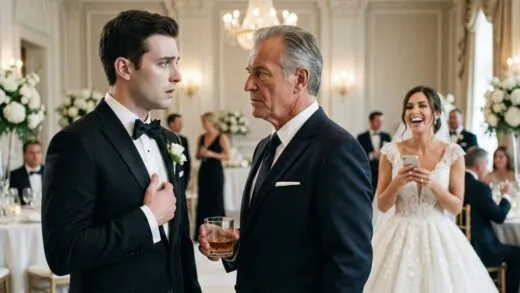
What followed was both predictable and painful. First, denial. Then, accusations of a conspiracy against her. She attempted to win allies through familiar manipulation tactics, appealing to Grandma Martha’s sense of propriety and Uncle Paul’s loyalty.
When those failed, the rage came—cold and cutting, then hot and uncontrolled. And finally, when cornered by irrefutable evidence, came the tears and claims of misunderstanding. Of only wanting “what was best” for the family.
“I will not be treated this way!” she declared when everyone remained unmoved by her performance. “After everything I’ve done for this family! For Rebecca’s wedding!”
“About the wedding,” Rebecca interrupted, standing to face our mother directly. “Lisa will be my maid of honor. As I always wanted. If you can’t accept that and behave respectfully toward her, then you will have a severely limited role in both the wedding and our lives going forward.”
Mom’s face contorted with shock. “You would choose her over your own mother?”
“I’m choosing truth over manipulation,” Rebecca replied steadily. “I’m choosing health over toxicity.”
“Your father will never allow this!” Mom snapped, looking at Dad for support.
Mom turned to Dad, expectation clear in her expression. For perhaps the first time in their marriage, Dad didn’t yield to keep the peace.
“Deborah, enough,” he said, his voice surprisingly firm. “Look at what you’ve done. Look at the evidence. This stops now.”
The intervention didn’t end with a neat resolution wrapped in a bow. Mom left in a fury, promising consequences for our “betrayal.” But something fundamental had shifted in the room that night. The pattern of manipulation had been exposed, named, and rejected by those it was designed to control.
As for Megan, Rebecca handled that situation swiftly the next morning. She met Megan for coffee and, with a calmness that belied her anger, relieved her of her Maid of Honor duties.
“I know you were just trying to get close to the family,” Rebecca told her, “but you did it by helping Mom hurt Lisa. I can’t have someone like that standing next to me.”
Megan was uninvited from the bridal party entirely, though allowed to attend as a guest—an offer she eventually declined out of embarrassment.
The week before Rebecca’s wedding arrived with a tentative new normal establishing itself within our fractured family. After the intervention, Mom had cycled through various tactics: icy silence, tearful pleas for understanding, rage-filled accusations, and finally, a grudging outward acceptance of the new boundaries we’d established.
Dad had surprised us all by standing firm in his support of Rebecca’s decision to reinstate me as maid of honor. After decades of choosing peace over confrontation, he seemed to have found a reserve of strength none of us knew he possessed.
“I should have protected you both long ago,” he told me during a private conversation on my apartment balcony one evening. The city lights twinkled below us, indifferent to our family drama. “I convinced myself that saying nothing was the same as keeping the peace. I was wrong.”
“Why now, Dad?” I asked gently. “What changed?”
He stared into his coffee cup for a long moment. “Seeing it all laid out like that… the deliberate nature of it… I couldn’t hide from it anymore. And honestly, Lisa? I’m tired. Tired of walking on eggshells. Tired of pretending everything is fine when it isn’t.”
His vulnerability was both shocking and healing. This new version of my father—willing to acknowledge hard truths, willing to apologize—gave me hope that genuine transformation might be possible.
Rebecca and I had been rebuilding our relationship day by day. Our bond was bruised, certainly, but not broken. We spent long hours talking through the manipulations that had driven us apart, grieving the months of sisterhood we’d lost.
“I keep thinking about what would have happened if James hadn’t discovered those fake texts,” she said during one of our reconciliation brunches.
“Let’s not think about that,” I suggested, squeezing her hand across the table. “We’re here now.”
As for Mom, the family had presented her with clear, non-negotiable conditions. She could participate in the wedding, but her role would be significantly restricted. No more unilateral decisions. No private conversations with vendors. No attempts to isolate or manipulate any family members.
“And if I refuse these conditions?” she had asked, the words dripping with disdain.
“Then you’ll attend as a guest only, with no input on any elements of the ceremony or reception,” Rebecca had stated, her voice trembling but firm.
To everyone’s surprise, Mom had eventually agreed. Though her compliance seemed more strategic than genuine—flashes of resentment in her eyes were quickly masked by artificial pleasantness—it was enough to move forward.
My own journey through this ordeal had been transformative in unexpected ways. The initial devastation had given way to clarity about family dynamics I’d normalized for too long. Working with Dr. Marshall, a therapist specializing in family trauma, I began to recognize patterns of enabling and people-pleasing in my own behavior that had made me vulnerable to manipulation.
“Your worth isn’t measured by what you provide to others,” Dr. Marshall reminded me during a particularly difficult session. “Not financially. Not emotionally. Not practically.”
These words became a mantra as wedding preparations entered their final, frantic phase. I reinstated my role as maid of honor with a newfound sense of boundaries. Yes, I would help coordinate the bridesmaids and assist Rebecca with last-minute details. No, I would not deplete my savings or sacrifice my mental well-being to manage everyone else’s emotions.
I also rebooked a modified version of the honeymoon package for Rebecca and James. I used the refunded money to book a beautiful trip, though I let James handle the logistics this time to ensure no interference could occur.
“This is a gift freely given, with no strings attached,” I told them when presenting the revised itinerary. “Not a payment for inclusion or affection.”
The wedding day itself arrived sunny and clear, a beautiful contrast to the emotional storms of previous months. The ceremony was scheduled for 4:00 PM at the Clayton Hotel, leaving the morning and early afternoon for preparations.
Mom maintained her promised behavior, though the effort visibly strained her. Her interactions with me were minimal but outwardly polite. Her attention focused on playing the role of “Mother of the Bride” perfectly for the gathering guests.
As I helped Rebecca into her wedding dress—the one I hadn’t been present to see her choose—I felt a momentary pang of loss for the uncomplicated joy this day should have held.
Rebecca caught my expression in the mirror. “I wish we could erase the last few months,” she said softly.
“I don’t,” I surprised myself by responding. “As painful as it was, it brought truth into the open. We can build something healthier now.”
She turned to face me, radiant in ivory lace. “When did my big sister get so wise?”
“Probably around the time my little sister got so brave,” I replied, carefully adjusting her veil.
The ceremony proceeded beautifully. I stood proudly beside Rebecca, holding her bouquet as she and James exchanged vows full of authentic emotion. Mom sat in the front row beside Dad, her composure perfect, her eyes occasionally meeting mine with unreadable emotion.
It was during the reception that the most unexpected moment of healing occurred. As guests mingled during the cocktail hour, I found myself momentarily alone near the gift table, adjusting some displaced place cards.
“The calligraphy is beautiful.”
Mom’s voice came from behind me. I stiffened, bracing for a criticism disguised as a compliment.